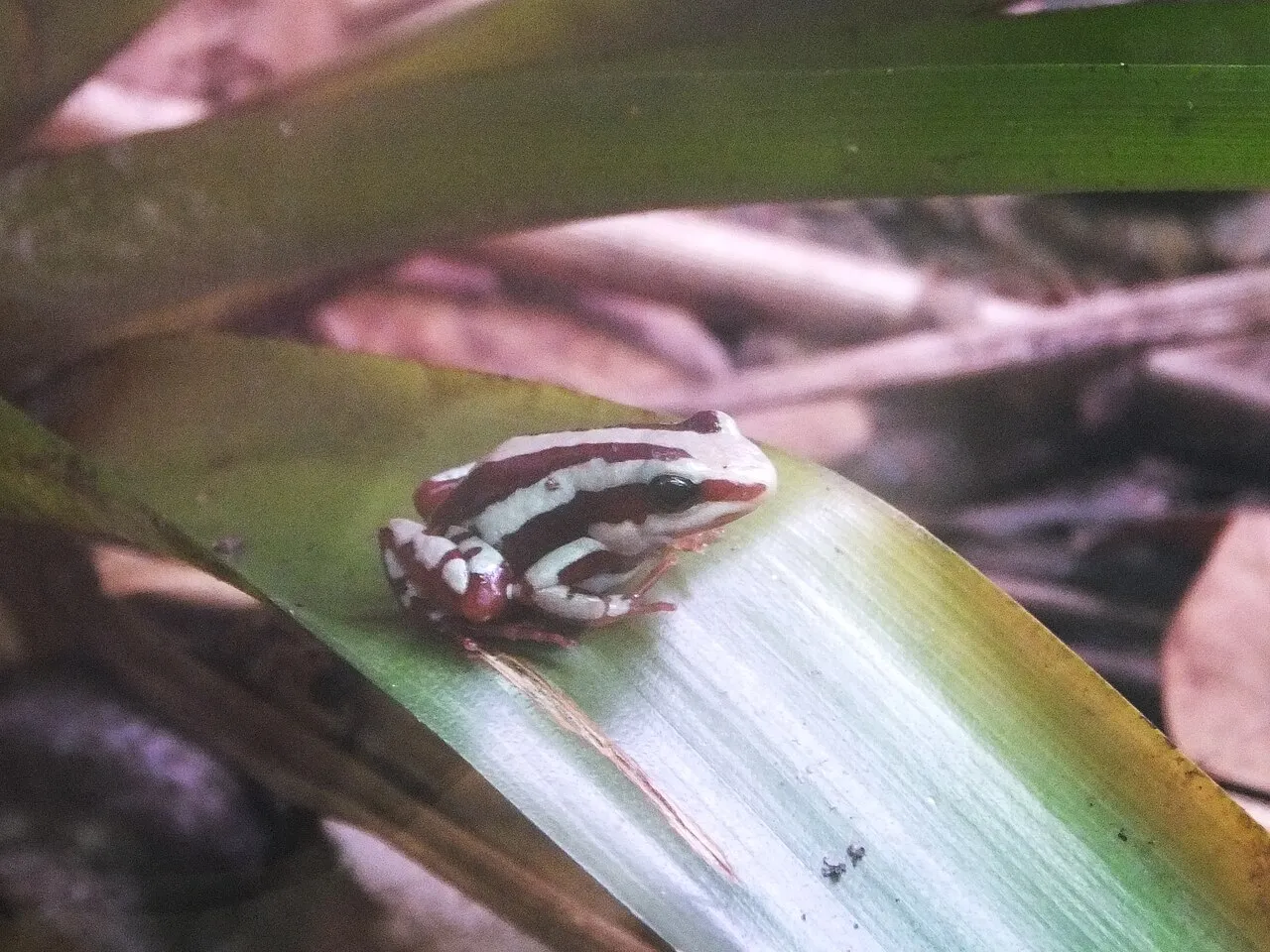
Epipedobates tricolor, the phantasmal poison frog, is a small, brightly marked member of the family Dendrobatidae, endemic to Ecuador, found on the Andean slopes of central Ecuador in Bolívar Province, in a limited area estimated at less than 5,000 km². That narrow range, combined with the potent toxin in its skin, has made it one of the better-known poison frogs to researchers even though few people outside herpetology circles have heard its name. It was first described by the herpetologist George Albert Boulenger in 1899, and has since been shuffled between several genera as its taxonomy was revised, appearing in the literature under names including Prostherapis tricolor and Dendrobates tricolor before settling in Epipedobates.
Identification
Adults are compact, reaching only about 22.6 mm in snout-vent length, a small species among the poison frogs. The body is dark brown to dark red or black, crossed by two or three bright orange, bright yellow or even light green longitudinal stripes that can run straight or in a flame-like shape, with blotches or spots on the limbs that match the stripe colour and distinct red or orange markings toward the hind end. The head is wide with a truncated snout and smooth skin, and the fingers are partially webbed, with the first finger longer than the second. Like its dendrobatid relatives, this bright pattern is aposematic, advertising a genuinely toxic skin to would-be predators; its skin produces epibatidine, an alkaloid toxin that has drawn sustained interest from medicinal researchers studying pain relief, a fact tied directly to the conservation pressure described below. The species is also known by the common name “phantasmal poison-arrow frog”.
Habitat and range
The species lives in Chocoan tropical and subtropical rainforest at elevations between 319 and 1,769 m, mainly in leaf litter near streams and in inland wetlands. It is not confined strictly to undisturbed forest: it has also been recorded in banana and cacao plantations and in pastures near streams, suggesting some tolerance of agricultural land at the margins of its range, provided streamside leaf litter and moisture remain available. That tolerance matters for a species with such a small total range: a strip of plantation between two patches of forest can still function as usable habitat rather than a hard barrier, so long as the ground stays damp and litter-covered.
Behaviour and breeding
The phantasmal poison frog is diurnal, active during the day, feeding on ants, termites and beetles found in its Andean habitat. Males are the vocal sex, calling mainly in the mornings but also at night from elevated perches, and defending territories first with calls and then by chasing or fighting off intruders; females are not territorial. A female lays a clutch of around 10 eggs in the leaf litter, after which a male guards the eggs and later carries the hatched tadpoles on his back to a nearby body of water to complete their development.
Its defining biological trait, though, is chemical rather than behavioural: its skin secretes epibatidine, an alkaloid defence described as over two hundred times as powerful as morphine as a painkiller, which has made wild-collected individuals a target for researchers studying the compound as an opioid blocker rather than reproducing it from captive stock.
Conservation
The facts box above carries the species’ current IUCN Red List category, Vulnerable. The listing reflects both its limited range and an apparent decline in numbers, with habitat destruction in the few locations where the species is known to survive cited as a driver alongside the added pressure of over-harvesting for medicinal research into its epibatidine toxin, a second threat distinct from habitat loss and one shared by few other dendrobatids. The two pressures compound each other: a frog confined to one small Andean province has little room to retreat from either bulldozers or collectors, which is why conservation accounts for this species tend to treat habitat protection and regulation of collecting as a single problem rather than two separate ones.
Similar species
The closest look-alike is Epipedobates anthonyi, Anthony’s poison arrow frog, which shares similar colouring and calls and was only formally distinguished from E. tricolor in 2004; the two were historically confused with each other. Its very small size among poison frogs and its restriction to Bolívar Province’s limited Andean slope habitat are the more reliable clues to identity than colour pattern alone, since dendrobatid markings vary widely even within a single species. A field observer without a known locality in hand should treat colour alone as a starting point rather than a confirmation, and rely on range and size together to tell the two frogs apart.