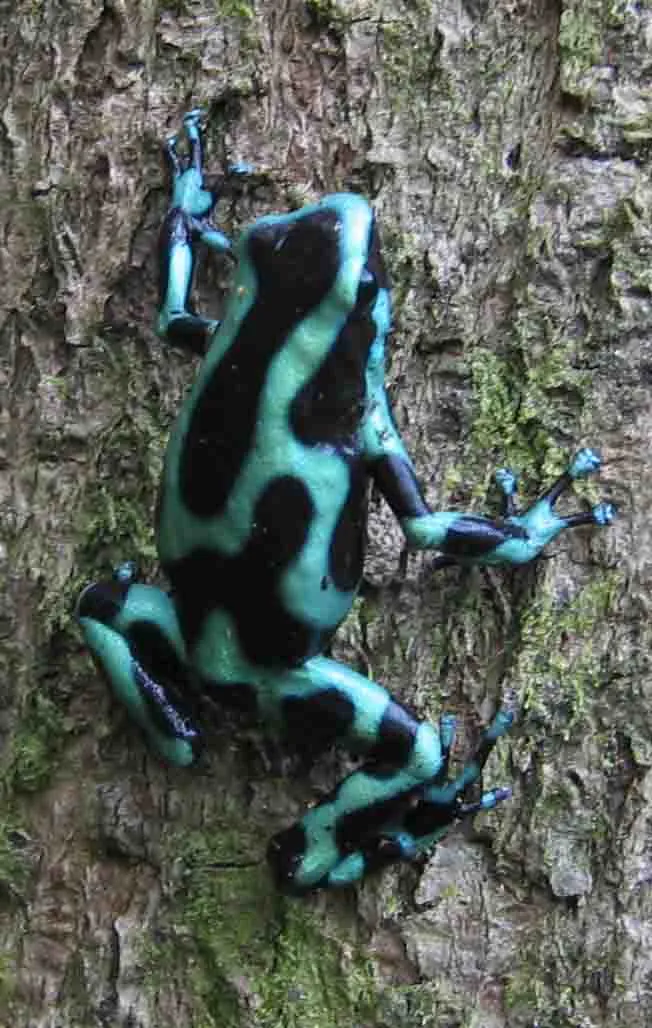
Dendrobates auratus, the green and black poison dart frog, is a small, boldly patterned frog of the family Dendrobatidae, native to southeastern Nicaragua, eastern and southwestern Costa Rica, Panama, and far northwestern Colombia’s Chocó Department. It has also been introduced to Oahu, Hawaii, where it has established breeding populations far outside its native range. Like other dendrobatids, its vivid colouring advertises a genuinely toxic skin, a warning most predators learn to heed.
Identification
Males average about 19 mm in snout-vent length, with females somewhat larger at roughly 25 mm or more; Animal Diversity Web gives an average adult length nearer 40 mm, reflecting how much the species varies across its range. The common name undersells its variety: populations show a highly variable spotted or banded pattern that is most often vivid mint-green, but can run to darker green, forest-green, lime, emerald, turquoise, blue, whitish or pale yellow, set against black; a few populations are almost entirely black, with only a few small green spots or streaks. The introduced Hawaii population tends toward metallic green or brownish-black individuals.
Habitat and range
The species lives in humid lowland and submontane forest from sea level to about 1,000 m, across its native band from Nicaragua through Panama into Colombia’s Chocó region. It is semi-arboreal, often staying near small streams or pools and using the water-holding leaves of bromeliads, where its tadpoles complete their development. Away from the forest floor, adults climb into the canopy to reach those bromeliad pools. On Oahu, where it was introduced, it has proven adaptable enough to establish self-sustaining populations well outside its natural range.
Behaviour and breeding
Adults hunt visually, using sticky, retractable tongues and sharp eyesight to catch small invertebrates, with ants and mites carrying alkaloids making up a large share of the diet. The frog does not make its own poison: it sequesters alkaloids from that arthropod diet and stores them in its skin, which is why captive frogs raised on crickets and fruit flies lose their toxicity over time. Wild skin secretions contain hundreds of distinct alkaloids that disrupt nerve and muscle signalling, and can cause numbness, loss of motor control or, in extreme cases, cardiac arrest in a predator that ignores the warning colours.
Breeding follows a pattern shared across the genus: males establish territories and call while females move between them to choose a mate, and a female lays up to six eggs in a small pool of water, which hatch after about 14 days. Parental care then falls to an adult, usually the male, which carries the tadpoles on its back up into the canopy and deposits them in a bromeliad’s water-filled leaves, where they feed on algae and small invertebrates through a further roughly six weeks of development before metamorphosing into froglets.
Conservation
The facts box above carries the species’ current IUCN Red List category, Least Concern. It is also listed on CITES Appendix II, which regulates rather than bans international trade in the species. Where populations are under pressure, the main driver is loss of the tropical rainforest habitat the species depends on, rather than direct collection; the frog’s own toxicity fades quickly in captivity on a diet without alkaloid-rich prey, which has reduced demand for wild-caught animals over time.
Similar species
Within its native Central American range, Dendrobates auratus overlaps with other brightly coloured, toxic frogs, including species of Oophaga and Phyllobates, and confusion is possible at a glance given how much its own colouring already varies from population to population. Its combination of a black body patterned in green, blue or near-black tones, a habit of carrying tadpoles up into bromeliads rather than leaving them in leaf litter, and a range confined to Nicaragua, Costa Rica, Panama and northwestern Colombia — plus the introduced Oahu population found nowhere else in this genus — are the more reliable clues to identity than pattern or colour alone.