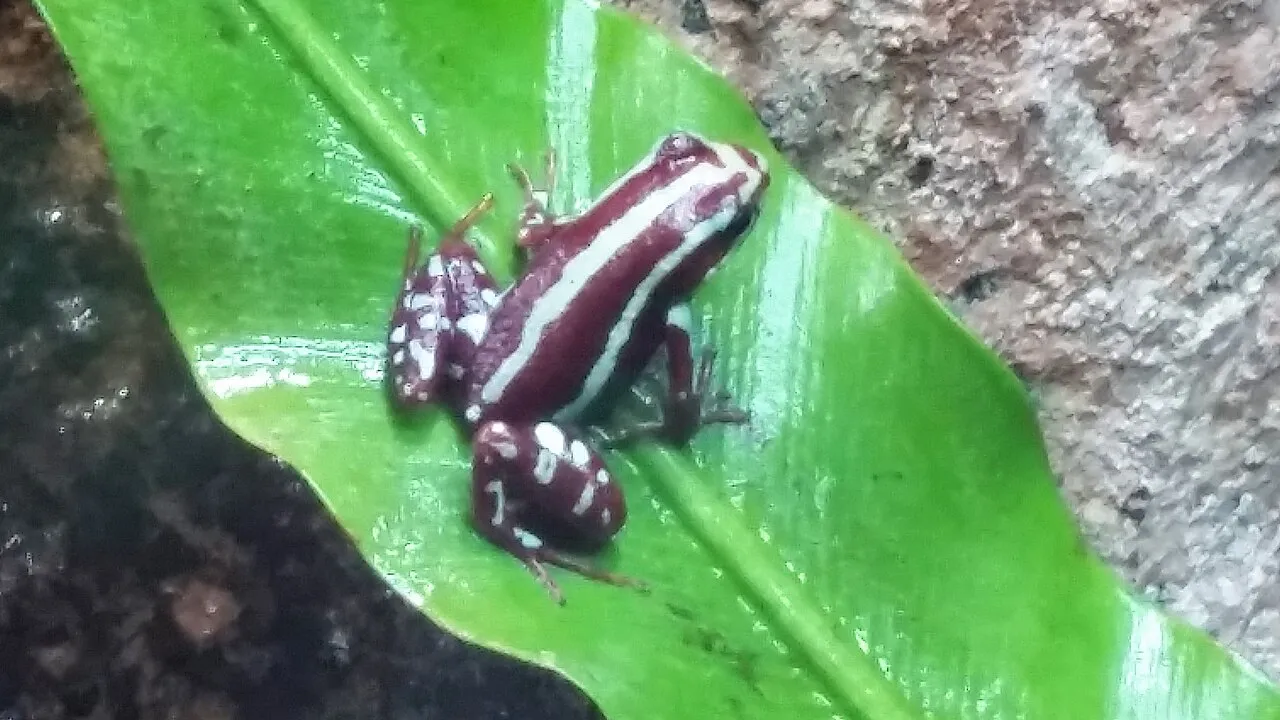
Epipedobates anthonyi, Anthony’s poison-arrow frog, is a small dendrobatid endemic to southwestern Ecuador and northwestern Peru, found at elevations between about 153 and 1,769 m. It was formally described in 1921 by the herpetologist Gladwyn Kingsley Noble, who placed it first in the genus Phyllobates and named it for the American Museum of Natural History mammalogist Harold Elmer Anthony; later taxonomic revisions moved the species into Epipedobates, and it has carried several scientific synonyms along the way. It shares its closest kinship with the Andean Epipedobates tricolor, a species it was only formally distinguished from in 2004, having been historically confused with it.
Identification
Adults reach only about 19-26 mm in snout-vent length, with newly metamorphosed froglets around 11 mm, making this one of the smaller dendrobatids. The hind legs are short and robust rather than built for long leaps. The dorsal surface is dark red or brown, marked with yellowish-white oblique stripes and a central longitudinal stripe running down the back, a pattern that gives the species its common warning coloration. As in other dendrobatids, the bright markings are aposematic, signalling the toxin in the skin described below.
Habitat and range
The species occupies leaf litter on the floor of tropical dry forests, especially near streams, across a range the IUCN estimates at less than 20,000 km² spanning coastal Ecuador and Peru. That combination of a wide elevation band, from near sea level up to nearly 1,800 m, and a comparatively narrow geographic footprint is typical of dendrobatids with specific moisture requirements. It tolerates some degree of disturbance, also turning up in agricultural land such as banana and cacao plantations and along roadsides, provided damp leaf litter remains available near running water.
Behaviour and breeding
Anthony’s poison-arrow frog is diurnal and terrestrial, with territorial males. A female lays a clutch of 15 to 40 eggs directly on the leaf litter, and the male then guards the clutch for around two weeks until the eggs hatch. He carries the tadpoles on his back to a nearby body of water, where metamorphosis takes roughly sixty days to complete.
This species is the namesake source of its most notable trait: epibatidine, an extremely toxic nicotine-like alkaloid, was first derived from and named for Epipedobates anthonyi. Researchers have found that frogs collected from different habitats carried different levels of the toxin, while frogs raised in captivity had none at all, evidence that the alkaloid is acquired through diet rather than synthesised by the frog itself, likely from a specific, as yet incompletely identified, prey item in the wild.
Conservation
The facts box above carries the species’ current global IUCN Red List category, Near Threatened, a status also applied in Peru, while Ecuador separately lists the species as Least Concern. The overall population trend seems stable, but pressures remain, chiefly habitat degradation from agrochemical pollution on nearby farmland and collection for medicinal use. There is also some collection for the international pet trade, though scientists do not yet know whether this poses a real threat to the species’ survival.
Similar species
Epipedobates tricolor, the phantasmal poison frog, is the closest look-alike, sharing similar colouring and calls and only formally distinguished from E. anthonyi in 2004. E. tricolor is restricted to a much smaller Andean range in Bolívar Province, Ecuador, whereas E. anthonyi occupies the wider coastal lowlands of southwestern Ecuador and northwestern Peru described above; the dorsal striping on E. anthonyi’s back is a more reliable clue than overall colour, which varies within both species.