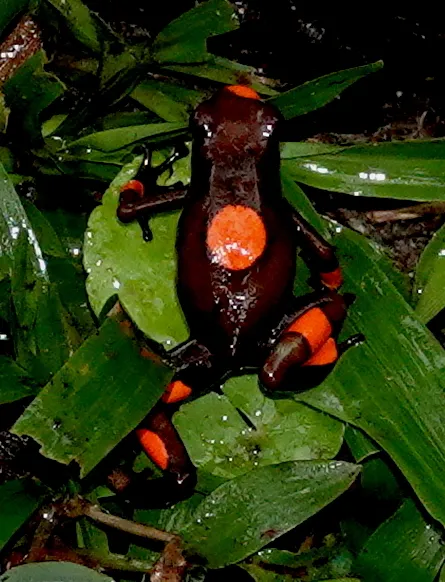
Oophaga histrionica, the harlequin poison frog, is a small, boldly coloured dendrobatid endemic to the Chocó region of western Colombia, where it lives in tropical rainforest at elevations between about 300 and 700 m. The facts box above gives its conservation status: a range this narrow leaves the species exposed to any pressure that reaches it.
Identification
Adults reach an average snout-vent length of about 32.9 mm. The background colour varies from light to dark brown, usually set off by a vivid spot on the back, a pattern that gives the species its common name and lets it vary widely between populations. Its skin carries cardiotoxic alkaloids called histrionicotoxins, which act as potent blockers of nicotinic acetylcholine receptors and, more weakly, of sodium and potassium channels — a chemical defence absent from its close relative Oophaga lehmanni, which produces pumiliotoxins and other alkaloids instead.
Habitat and range
The species is confined to the Chocó region of western Colombia, in tropical rainforest between roughly 300 and 700 m elevation, including the unprotected slopes around Parque Nacional Tatamá. It is terrestrial, living on the forest floor among fallen branches and leaf litter. Adults forage for ants and mites on the ground after sunrise and before 16:00, and males call from a low perch to advertise their presence.
Behaviour and breeding
Parents of this species practise the egg-feeding care typical of Oophaga: after the eggs hatch, the parents carry the tadpoles to a tiny water reservoir, often the leaf axil of a bromeliad. There, the mother returns periodically to deposit unfertilised eggs as food, since the tadpoles are obligate egg-feeders that cannot complete development on any other diet.
Conservation
The IUCN category is shown in the facts box above. The frog is threatened chiefly by habitat loss from mining-related deforestation and by collection for the international pet trade, and its population is thought to be declining. Much of its range, including the slopes around Parque Nacional Tatamá, falls outside any protected area.
Similar species
Oophaga lehmanni, Lehmann’s poison frog, is very similar in appearance, and the two can hybridise, including successfully in captivity. The clearest distinction is chemical: O. lehmanni’s skin lacks the histrionicotoxins that give this species its cardiotoxic defence, producing pumiliotoxins and other alkaloids instead. Three further species, Oophaga anchicayensis, Oophaga andresi and Oophaga solanensis, were split from what was once classified as Oophaga histrionica in a 2018 taxonomic revision, so historical records under this name may refer to any of the group.