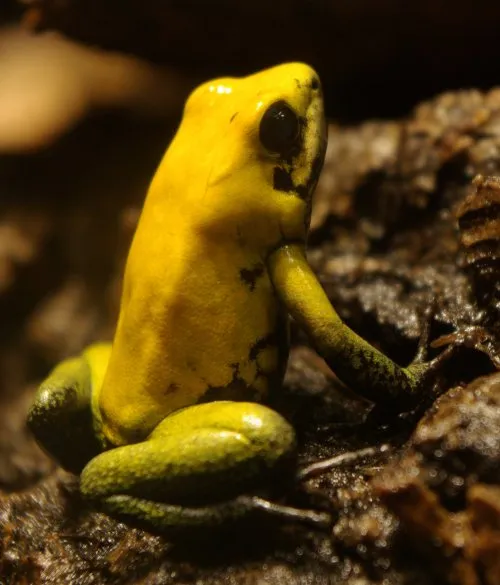
Phyllobates bicolor, the black-legged dart frog, is a mid-sized, brightly coloured amphibian of the family Dendrobatidae, found only in the humid lowland rainforest of Colombia’s Chocó region. Like its larger relative Phyllobates terribilis, it carries a potent toxin in its skin, a defence that lets it move about in daylight with little fear of predators, trusting its colouring and toxicity rather than camouflage or flight to deter anything that might try to eat it.
Identification
Adults show sexual size dimorphism: males reach about 45-50 mm snout-to-vent length, while females grow slightly larger, to about 50-55 mm, placing the species roughly in the middle of the dart frog size range: smaller than the golden poison frog but not among the tiny species in the family. The body is yellow or orange with black or dark blue forelimbs and hindlimbs, the limb colouring that gives the species its common name and makes it easy to tell apart from dendrobatids with a single, uniform body colour. Juveniles look very different from adults, starting out brown or black and becoming more vividly coloured as they mature; a young, dark-coloured individual found in the Chocó can therefore be easy to overlook next to the striking two-tone pattern of a grown frog.
Habitat and range
The species is found only in tropical rainforest of the Chocó region of Colombia, west of the Western Andes. Its populations are geographically isolated from each other by the Andes and by the San Juan river basin, which limits gene flow between them, so frogs from one valley may differ subtly from those in the next, and a local population lost to habitat clearance is not easily replaced by frogs from elsewhere in the range. Within that range it lives on the rainforest floor near streams and puddles, favouring damp, humid ground with leaf litter, moss, rocks and fallen branches that provide daytime shelter; that clutter of ground cover gives an otherwise conspicuously coloured frog places to retreat to when it is not out foraging.
Behaviour and breeding
The black-legged dart frog is diurnal, moving in quick, rapid hops across the forest floor while foraging for ants, beetles, termites and other small invertebrates. Individuals are sometimes solitary and sometimes found in pairs or small groups, a looser social pattern than the strictly spaced-out habits of some related species, and one that suits a frog with little need to avoid being noticed.
Breeding takes place in the wet season, from around September to October, when rainfall fills the puddles and stream edges the species depends on for its tadpoles. Males call with high-pitched notes to attract females, then guard the eggs and carry the hatched tadpoles on their backs to suitable water, a form of parental care shared with many other dendrobatids and one that gives the slow-developing tadpoles a far better chance of reaching water than if they were simply abandoned on the forest floor.
Like other members of its genus, Phyllobates bicolor secretes the toxin batrachotoxin in its skin; an estimated 2-200 micrograms can be lethal to a human, a wide range reflecting how much the toxin load can vary between individual frogs. That makes the species one more reason the Chocó’s dart frogs are best admired from a distance rather than handled.
Conservation
The IUCN category is shown in the facts box above. The species’ restricted, fragmented range in the Chocó makes it vulnerable to any further loss of its rainforest habitat.
Similar species
Phyllobates bicolor can be confused with its larger relative Phyllobates terribilis, but the two are told apart by size and colour pattern: the golden poison frog is larger and essentially uniform in colour, while the black-legged dart frog combines a yellow or orange body with contrasting black or dark blue limbs. Its genus name and limb colouring also set it apart from other Chocó dendrobatids, such as the Oophaga species, which tend to show more varied, mottled patterning rather than a simple two-tone body.