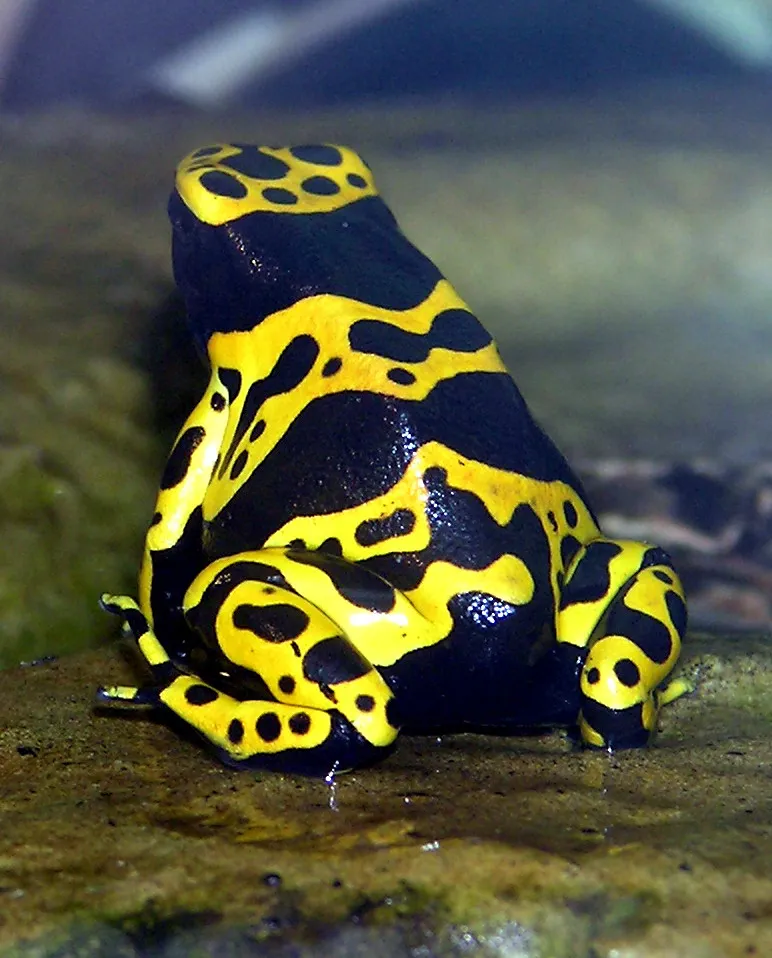
Dendrobates leucomelas, the yellow-banded poison dart frog, is a stocky, brightly patterned frog of the family Dendrobatidae, native to the northern part of South America, most notably Venezuela, with populations also in Guyana, northern Brazil and southeastern Colombia. Its bold black-and-yellow banding is aposematic, warning off predators that learn to associate the colouring with a genuinely toxic skin, and it is one of the larger, hardier members of its genus — hardy enough to be the only poison dart frog known to estivate through the dry season.
Identification
Adults reach a snout-vent length of about 31 to 50 mm, with most individuals under 40 mm and an average weight around 3 grams, making this one of the largest species in its genus. Females tend to be slightly larger and more robust than males, though otherwise the sexes look alike. The body is predominantly bright yellow crossed by black bands or spots, and as frogs age the black bands often break up into spots rather than staying as solid bands; some individuals show orange rather than yellow ground colour. Like other dendrobatids it has glandular, adhesive pads on its toes and fingertips that let it climb plant surfaces, and a short, sticky, protrusible tongue for catching prey.
Habitat and range
The species lives in humid tropical rainforest near freshwater, from sea level up to about 800 m elevation, using flat rocks, wet tree trunks and roots, bromeliads and leaf litter on the forest floor; tadpoles develop in water pooled in epiphytic plants such as bromeliads, while adults shelter under rocks and fallen logs during dry periods. Typical lowland temperatures run 26 to 30°C or higher. Although it prefers high humidity, the species tolerates lower humidity better than other frogs in its genus, which helps explain why it is, unusually for a poison dart frog, the only species in the genus known to estivate during dry spells, sheltering under rocks and logs until conditions improve.
Behaviour and breeding
Yellow-banded poison dart frogs are diurnal and mainly terrestrial, though they climb into low vegetation, and males are fiercely territorial, living in small groups and defending calling or breeding sites against rivals; territorial disputes involve two males grasping each other belly-to-belly while emitting a sporadic buzzing call. The frogs feed on ants, termites, tiny beetles, crickets and other small insects and spiders, and like other dart frogs they do not make their toxin themselves: captive frogs raised on crickets and fruit flies lose their skin toxins over time, suggesting the toxin is derived from a component of the wild diet, with ants suspected as a likely source.
Breeding runs from February to March, during the rainy season, when males call with pleasant, birdlike trills lasting 10 to 15 seconds to attract females, and females compete for access to calling males. A female lays multiple clutches of 2 to 12 eggs, as many as 1,000 eggs across a breeding season, typically on the undersides of leaves in humid spots, which hatch after 10 to 14 days. Parental care then falls entirely to the male, who climbs high into the forest canopy and deposits the tadpoles one at a time into separate pockets of water in bromeliads and other water-holding plants, spreading them across many plants so a predator cannot find them all at once; a tadpole that finds another already occupying its pool will eat it. Metamorphosis into froglets takes 70 to 90 days, and frogs reach sexual maturity at 12 to 18 months, averaging about two years. Wild frogs typically live 5 to 7 years, against 10 to 15 years in captivity.
Conservation
The facts box above carries the species’ current IUCN Red List category, Least Concern, reflecting its robustness, relatively common numbers in the wild, and widespread natural distribution. It is also listed on CITES Appendix II, regulating rather than banning international trade. The main pressures are some overharvesting for the exotic pet trade, though captive breeding is easy and has driven prices down, and habitat loss from lumber exploitation within its range; neither is considered an especial conservation concern at present.
Similar species
Within Dendrobates, the blue poison dart frog, Dendrobates tinctorius, is the species most often mentioned alongside D. leucomelas for comparison, though the two are not hard to tell apart: D. tinctorius runs larger, with most adults reaching about 50 mm and some forms up to 70 mm, against a rarely-over-40 mm yellow-banded frog, and its patterning runs to black with yellow, white or pale blue markings rather than the bold, near-continuous yellow-and-black bands typical of D. leucomelas. Range is also a clue: D. tinctorius is confined to the eastern Guiana Shield — French Guiana, Guyana, Suriname and adjacent Brazil — while D. leucomelas centres on Venezuela, so the two overlap only at the eastern edge of the yellow-banded frog’s range in Guyana and Brazil.