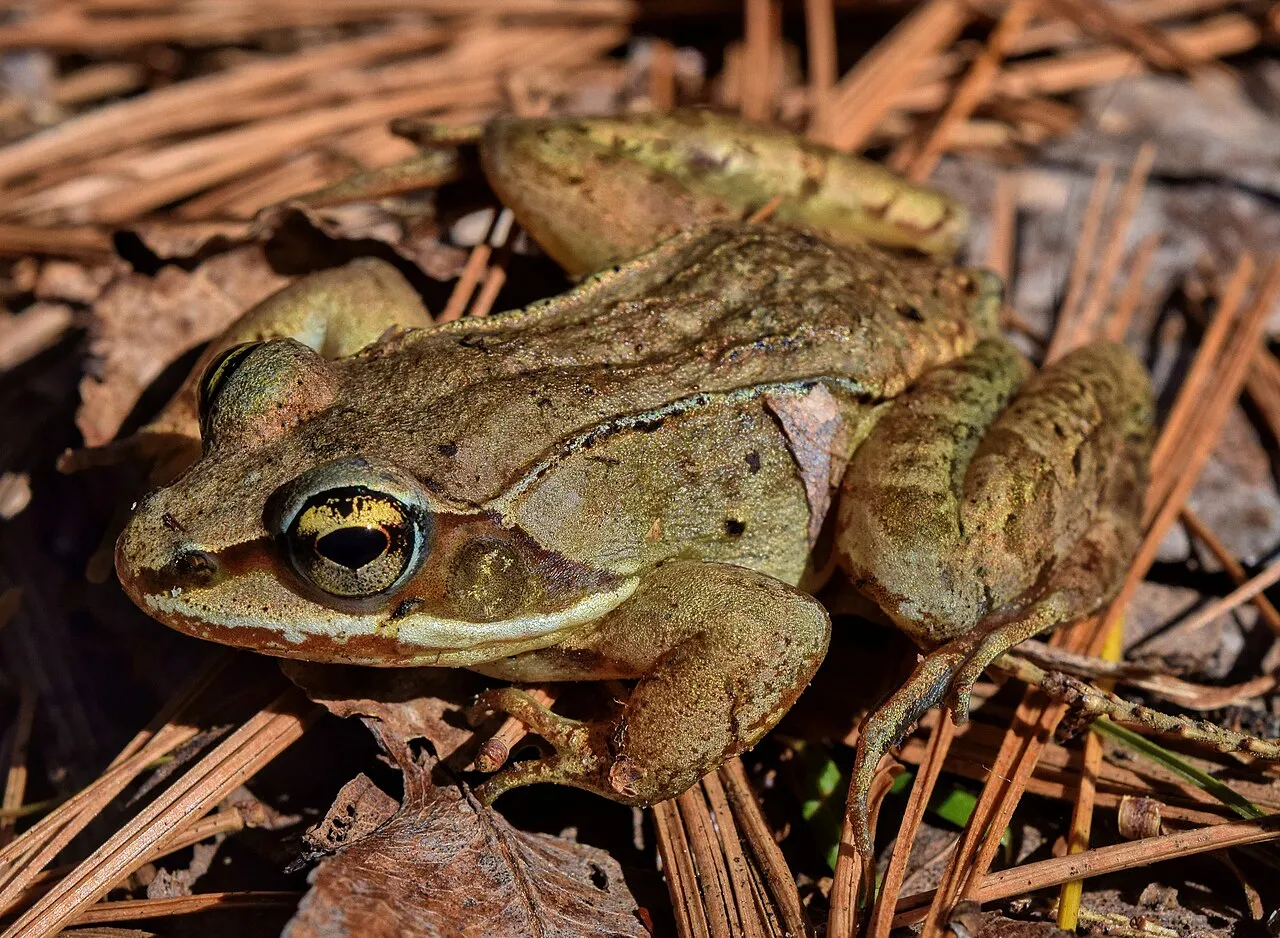
Lithobates sylvaticus, the wood frog, ranges farther north than any other frog on the continent, occurring throughout the boreal forests of Canada and Alaska, west to southern British Columbia, and south through the eastern United States to northern Georgia and the southern Appalachians. It is the only North American frog known to live north of the Arctic Circle, a distribution made possible by a startling trick of physiology: it can survive its own blood freezing solid over winter.
Identification
Adults measure 51 to 70 mm (2.0 to 2.8 in) in length, with females noticeably larger than males. Most individuals are brown, tan or rust-coloured and show a dark mask across the eye, though the exact shade is not fixed: the same frog can shift between lighter and darker brown tones, and exposure to sunlight darkens its skin further. The build is compact and the limbs proportionate for a frog that spends most of its life walking and hopping across the forest floor rather than swimming. Its feeding technique reflects that terrestrial habit: it takes prey by touching it with just the tip of the tongue, much as a toad does, rather than the wider tongue strike typical of more water-bound frogs, and the diet is made up mostly of small forest-floor insects.
Habitat and range
With a strongly terrestrial habit, it spends most of its life camouflaged among leaf litter and breeds primarily in ephemeral, freshwater woodland vernal pools. Those temporary pools, filled by snowmelt and spring rain and free of fish, give eggs and tadpoles a predator-lighter head start before the water dries up later in the season. Its range stretches from the boreal forest in the north to the southern Appalachians, and from northeastern Canada and Alaska west to southern British Columbia. That northern reach is exceptional: it is the most widely distributed frog in Alaska and the only North American frog known to occur north of the Arctic Circle, a foothold no other frog on the continent holds, underwritten by the species’ tolerance for freezing winters that would kill most other amphibians outright.
Behaviour and breeding
The wood frog’s defining trait is freeze tolerance: it can survive the freezing of its blood and other tissues through the winter, which is what lets it live farther north than any other North American frog and be the only one recorded above the Arctic Circle. The tolerance is not marginal: a frozen wood frog can lose 65 to 70 percent of its total body water to ice and, in natural hibernation, has been recorded staying frozen for 193 (plus or minus 11) consecutive days before thawing out largely unharmed. That physiology also shapes its breeding calendar — because the frog itself can shrug off a hard freeze, it is free to become one of the earliest amphibians active each spring, moving to vernal pools to breed as soon as the ice starts to break. Once there, males call with a duck-like quacking sound to attract females, and most populations pack their entire breeding season into about a week, a pace far more explosive and brief than species that use permanent water, since the pools the wood frog depends on will not last the season. Tadpoles hatch into an omnivorous stage, feeding on plant detritus and algae alongside other tadpoles of their own and other species, before completing metamorphosis while the vernal pool still holds water.
Conservation
The species’ facts box carries its current IUCN Red List category, Least Concern. Its wide range across boreal Canada, Alaska and the eastern United States, and its tolerance of a broad range of forest conditions, leave it in a stronger position than many amphibians that depend on a single habitat type. Its reliance on vernal pools for breeding still makes local populations vulnerable wherever those temporary wetlands are drained or built over, even where the species as a whole remains widespread.
Similar species
A brown to rust-coloured frog with a dark mask across the eye, seen anywhere from the boreal forest to the southern Appalachians, is worth checking against the wood frog first. Geography narrows the field further: no other North American frog is known to range north of the Arctic Circle, so a frog encountered that far north, in Alaska especially, is a strong candidate for this species by location alone.