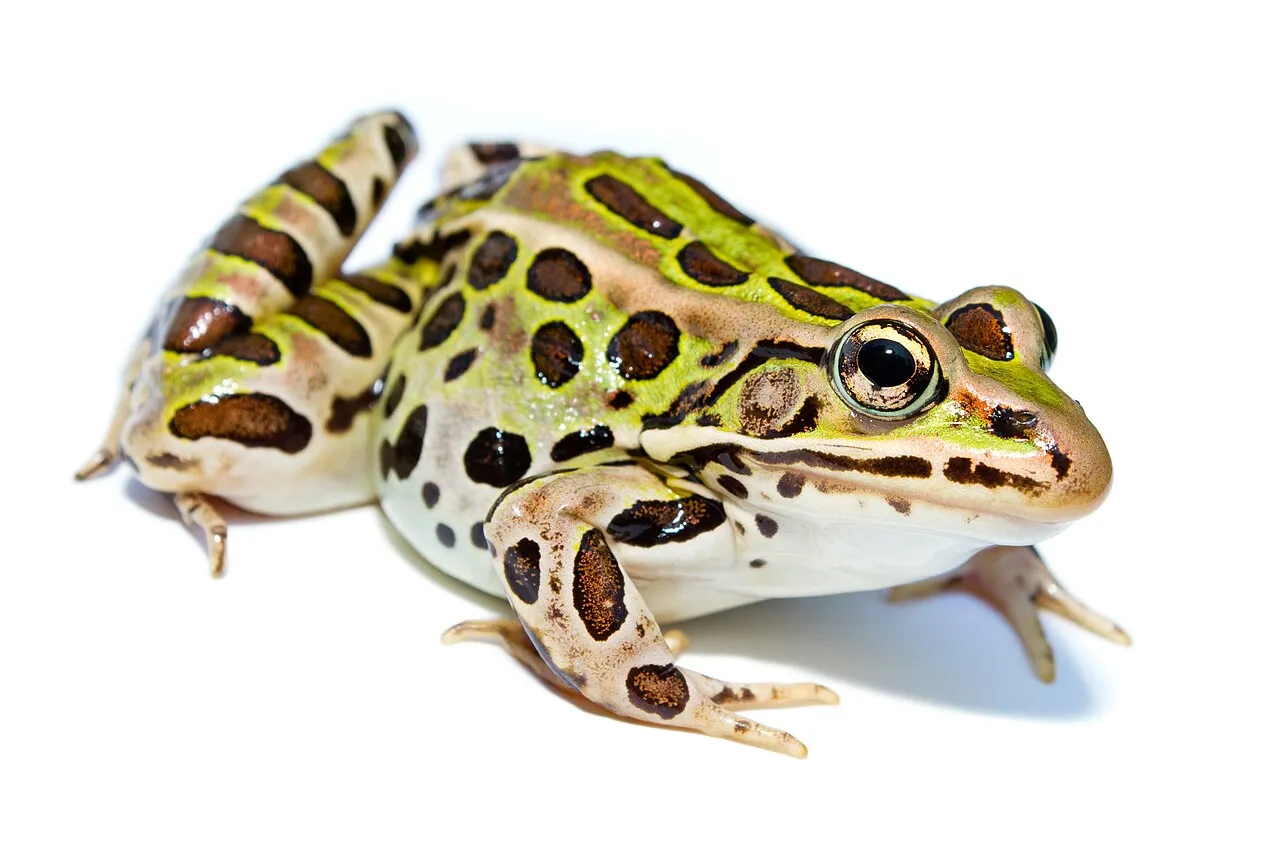
Lithobates pipiens, the northern leopard frog, is a fairly large, boldly spotted frog whose range stretches from Great Slave Lake and Hudson Bay in Canada south to Kentucky and New Mexico in the United States. Its common name comes from the dark, rounded blotches scattered across its back, a pattern that once made it one of the most familiar frogs across the continent and a staple of biology classrooms.
Identification
Adults reach about 11 cm (4.3 in) in snout-to-vent length, making the species one of the larger true frogs in its range. The common name describes the frog well: irregular dark, rounded spots, each usually ringed with a lighter halo, cover the back and legs against a green or brown ground colour, a pattern shared in general form with several related North American frogs but distinctive enough at a glance to have given the species its name.
Habitat and range
The northern leopard frog occurs from Great Slave Lake and Hudson Bay, Canada, south to Kentucky and New Mexico in the United States, one of the broadest ranges of any North American frog. Across that range it inhabits permanent ponds, swamps, marshes and slow-moving streams with abundant aquatic vegetation, turning up in forest, open country and urban areas alike wherever still or slow water and cover are both available. It is also notably cold-tolerant, occurring at elevations above 3,000 m, well into terrain few other frogs reach. The species was once common through parts of western Canada and the United States, but has suffered range-wide declines since the 1970s, driven by habitat loss and fragmentation, environmental contaminants, introduced fish, drought and disease; many of the populations that collapsed then have still not recovered.
Behaviour and breeding
Like other pond-breeding frogs of open, vegetated wetlands, the northern leopard frog depends on the same still and slow-moving waters it favours as an adult for laying eggs, and on nearby wet meadows and fields for summer foraging away from the water’s edge. Its decline since the 1970s has been especially instructive for conservation biology: because several of the pressures behind it, among them environmental contaminants and introduced fish, act at the level of whole watersheds rather than single ponds, the species has become a widely studied example of how a once-common, wide-ranging amphibian can thin out across much of its range even while remaining, overall, a species of low extinction risk.
Conservation
The facts box above carries the species’ current IUCN Red List category, Least Concern, a reflection of its continuing wide distribution across Canada and the United States. That status sits alongside a documented regional decline: the frog has been in retreat since the 1970s across parts of western Canada and the United States from habitat loss and fragmentation, environmental contaminants, introduced fish, drought and disease, and many affected populations have not recovered even where the species persists elsewhere. The gap between a secure global category and a locally depleted range is common among wide-ranging amphibians, and is one reason this species is tracked closely in the parts of its range where it has thinned out most.
Similar species
A large, green-to-brown frog patterned with dark, halo-ringed spots across the back and legs, found in a pond, marsh or slow stream anywhere between Hudson Bay and New Mexico, is a good match for the northern leopard frog. Several related Lithobates species share a broadly similar leopard-spotted look across overlapping range, so location and the immediate wetland habitat, permanent water with abundant aquatic vegetation, are the more reliable first clues alongside the spotting pattern itself.