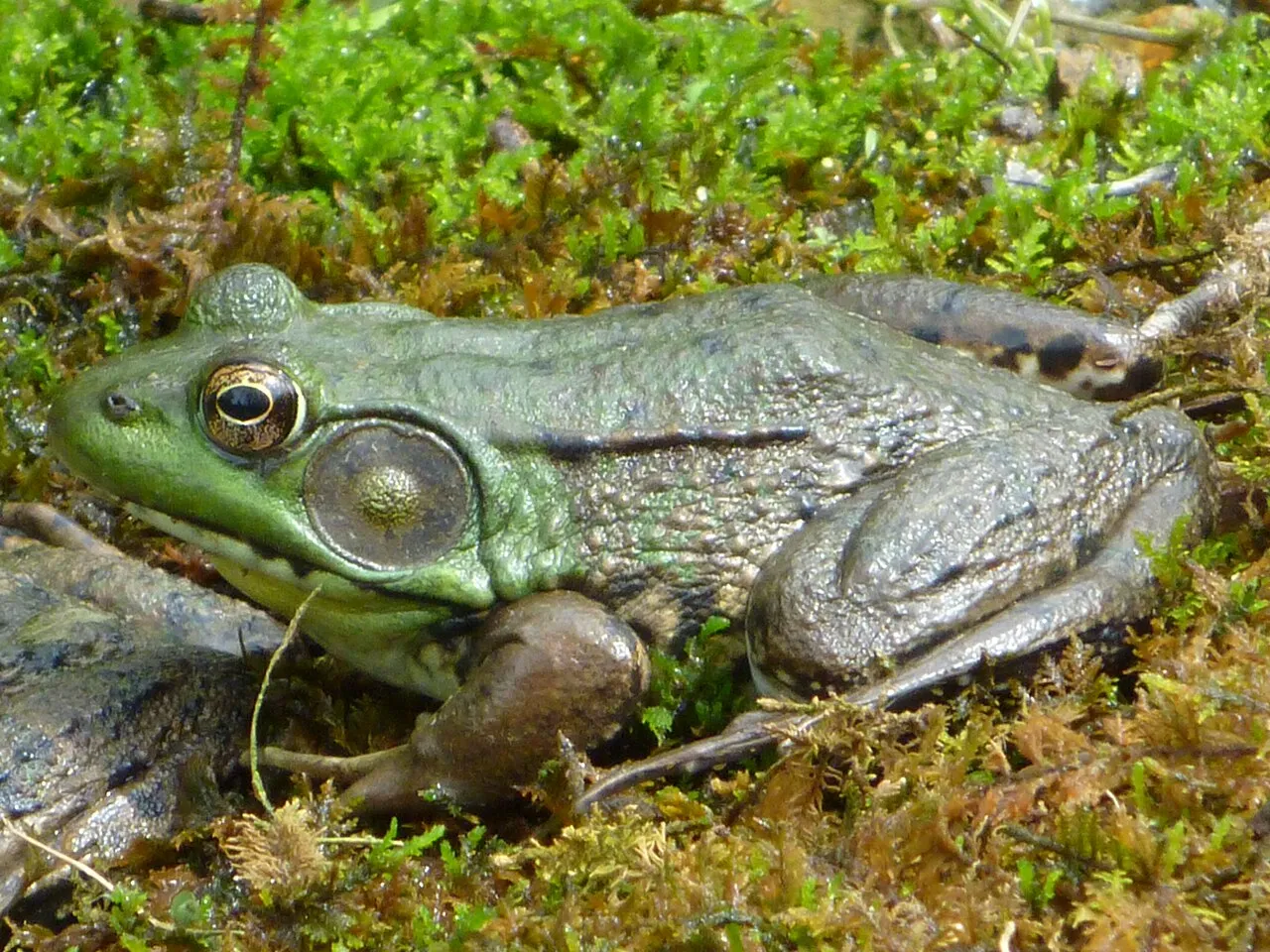
The American green frog, Lithobates clamitans, is a common sight along the still edges of ponds and ditches across eastern North America, where its single-note call — likened to a plucked loose banjo string — carries across the water through spring and summer. It is native to eastern North America, ranging from the St. Lawrence River Valley in southeastern Canada south to northern Florida and west to eastern Texas.
Identification
Adults measure 50–100 mm in snout-to-vent length; the facts box carries the exact range. Green frogs typically show a green head with a body that is brown, gray, or dark green, and a white belly mottled with black; on colder days individuals darken further to absorb heat. The clearest field mark separating this species from the similarly sized bullfrog is a pair of dorsolateral ridges, raised seam-like folds of skin running down each side of the back, which bullfrogs lack. Males and females can be told apart by the ear membrane: a male’s tympanum is roughly twice the diameter of its eye, while a female’s is about the same size as the eye, and a breeding male also develops a yellow throat. A rare genetic condition called axanthism, which blocks yellow pigment production, can produce blue individuals.
Habitat and range
The species keeps to margins of shallow freshwater ponds, road-side ditches, lakes, swamps and streams, holding small home ranges around these water sources and using vernal pools and other temporary waters less often than some other frogs. Within that range it favours areas near water with open surroundings and is reported to spend about a third of its time foraging in dense vegetation and leaf litter near the water’s edge.
Behaviour and breeding
Males reach sexual maturity at one year old, while females mature at two or three years, and breeding runs from spring through summer, with the exact timing shifting with local temperature. Breeding males hold and defend territories for the season, and research on the species describes four main vocalisations: the advertisement call that gives the species its banjo-string reputation, plus calls tied to dominance, to answering a rival’s territorial intrusion, and to the outcome of a wrestling match between males; both sexes also give a release call when clasped by another frog during amplexus. A female approaches a preferred male in a low posture before mating, and a clutch holds 1,000 to 7,000 eggs, laid as a surface film 15–30 cm across and attached to vegetation. Depending on when in the season they hatch, tadpoles either complete metamorphosis within the same breeding season or overwinter and transform the following summer, with a larval stage lasting 70 to 360 days in total. Eggs are taken by turtles, tadpoles by diving beetles, giant water bugs and water scorpions, and adults by ducks, herons and crows; tadpoles sharing a pond with invertebrate predators tend to grow smaller bodies and larger tail muscles that improve their chances of escaping an attack.
Conservation
The species’ facts box carries its current IUCN Red List category, Least Concern, reflecting its broad range across eastern North America. That status is not a guarantee against decline: the wider literature on amphibians puts global population loss at up to 211 times the background extinction rate, and this species’ populations face the same combination of habitat loss from deforestation, road building and agriculture, alongside climate change, disease and chemical contaminants, that pressures amphibians generally.
Similar species
The American bullfrog is the most frequent source of confusion, since both share the same ponds and a similar green-brown wash, but the bullfrog lacks the dorsolateral ridges that run down the green frog’s back and grows noticeably larger. Within its own genus, the American green frog is also easy to separate from the Northern leopard frog, whose body is covered in dark rounded spots rather than a plain or mottled wash, and from the wood frog, which shows a dark eye mask and no dorsolateral ridges at all.