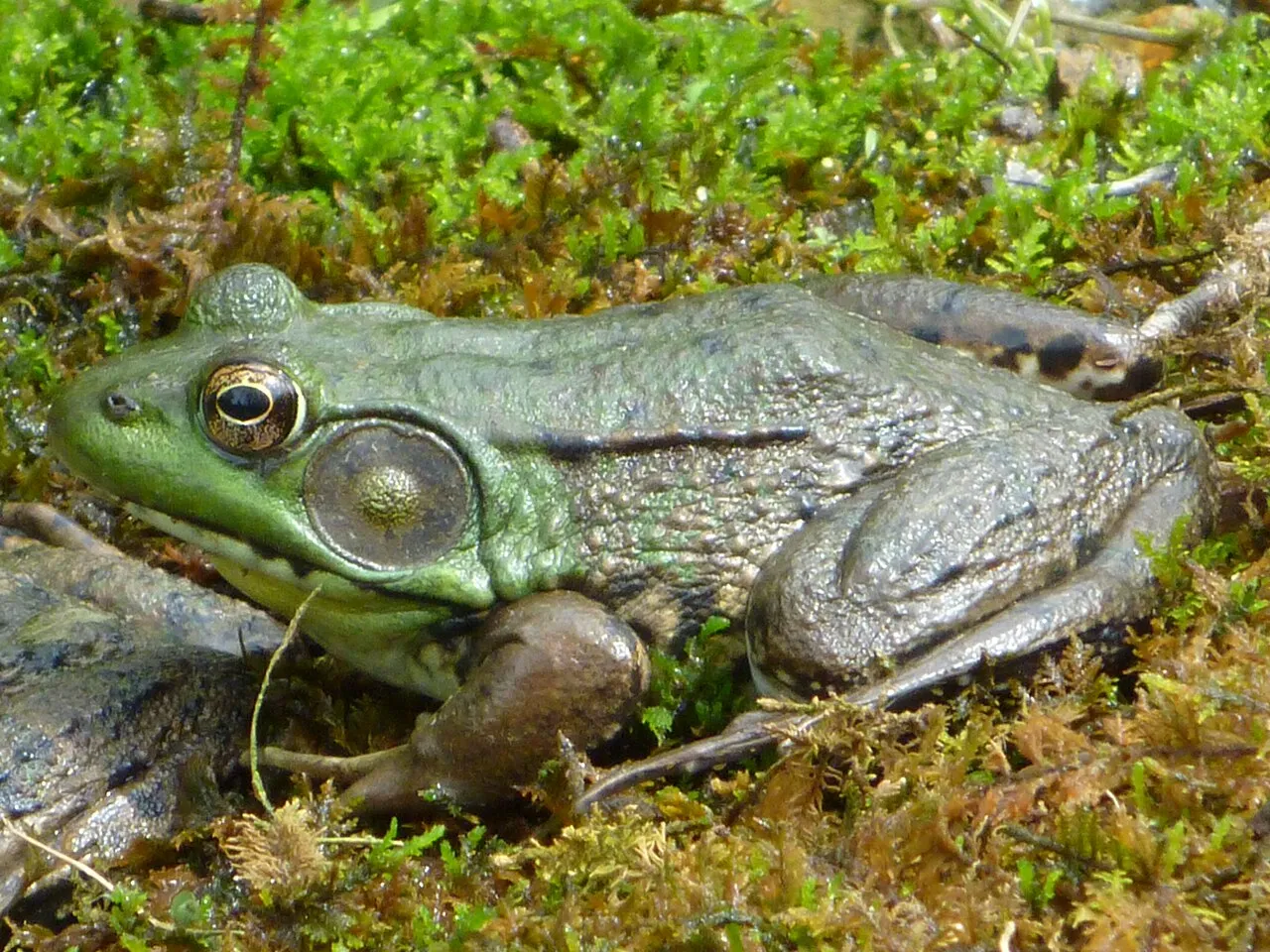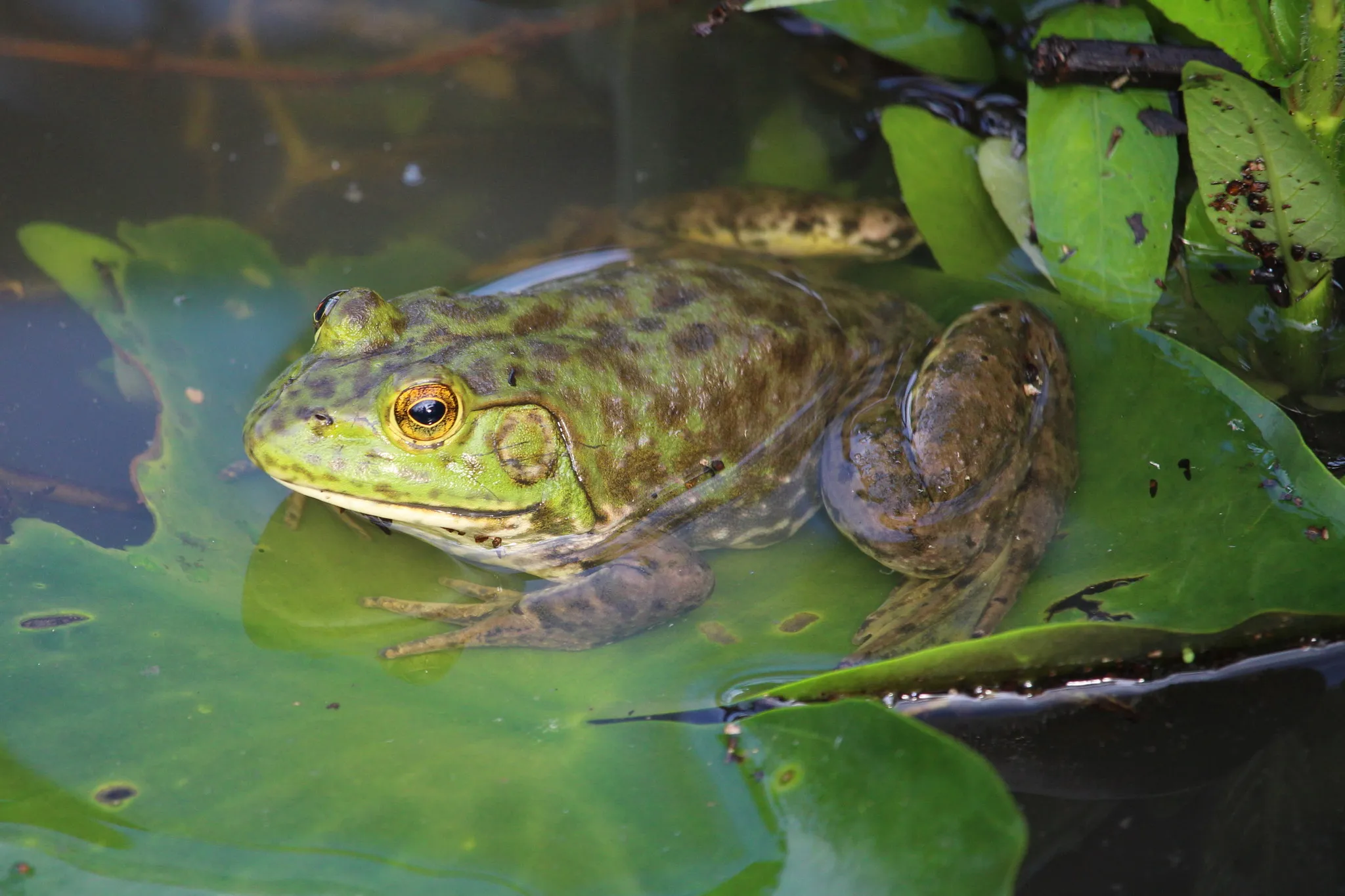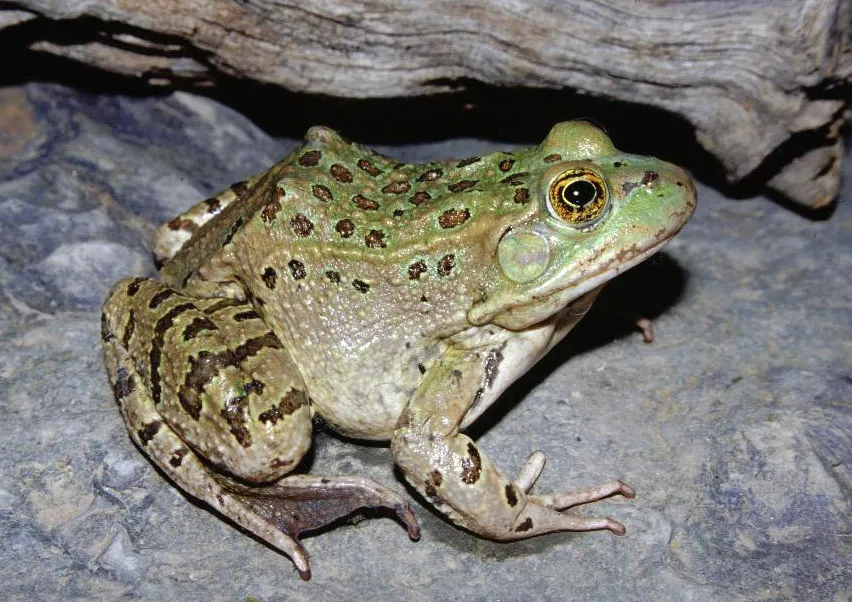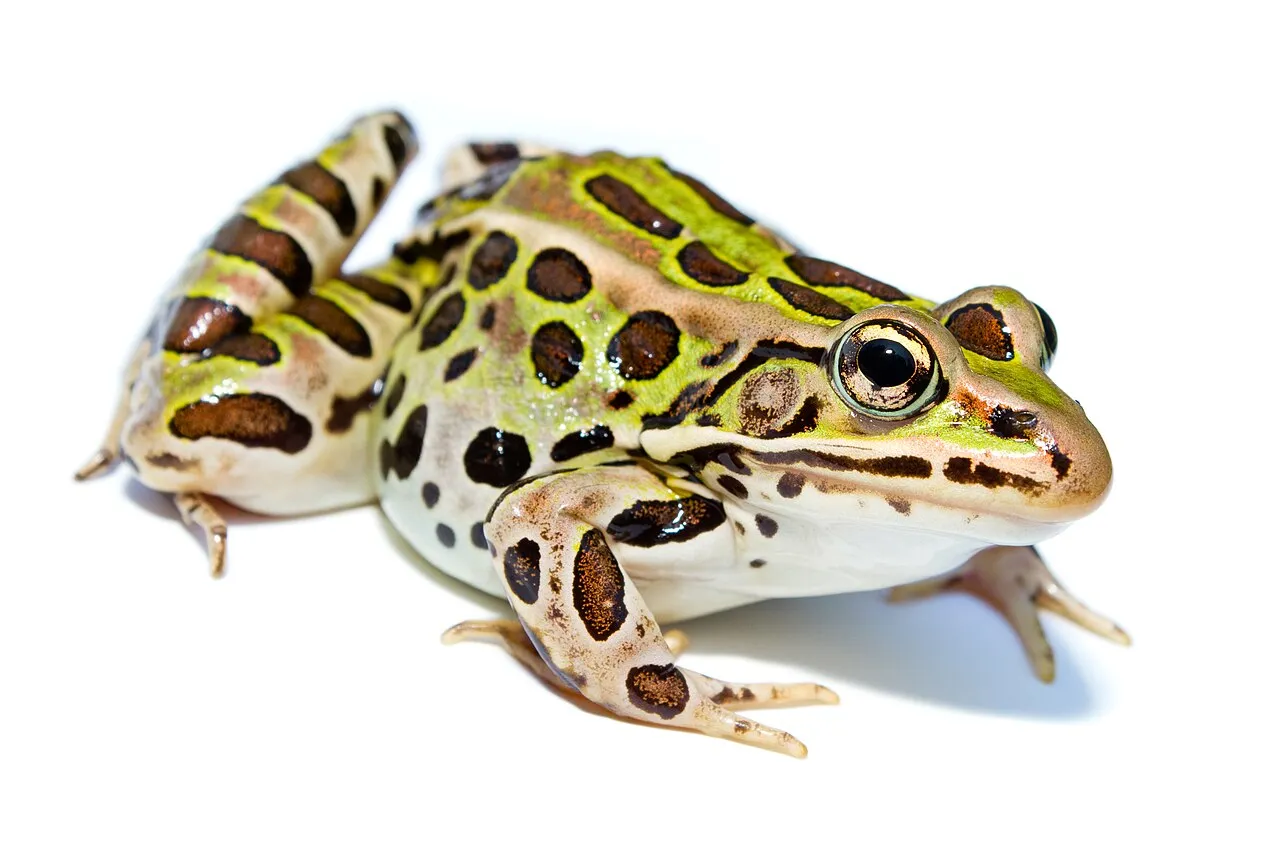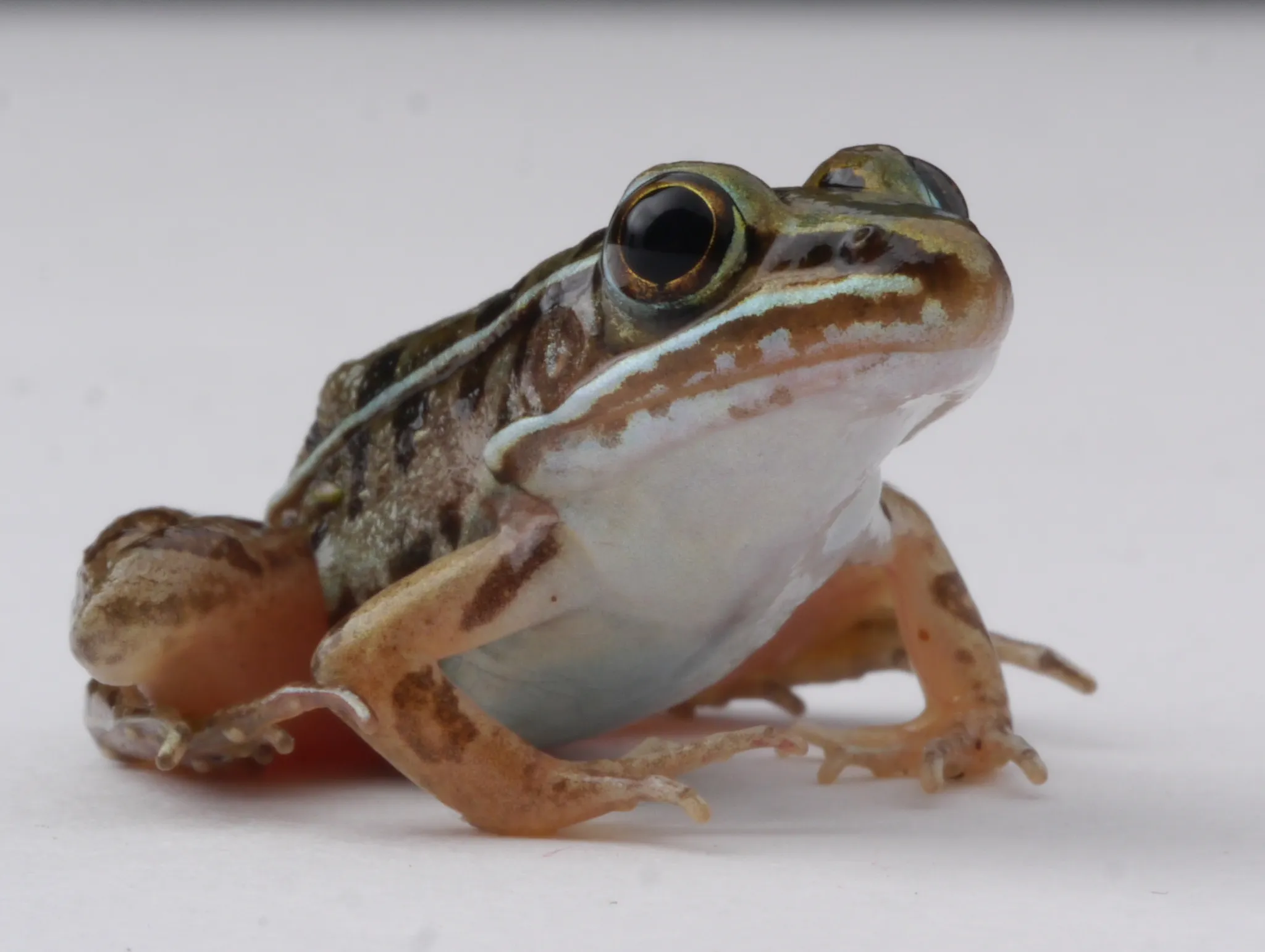
Lithobates sphenocephalus, the southern leopard frog, is a medium-sized frog of the family Ranidae1, the true frogs. It is also known as Rana sphenocephala2. Its range runs from New Jersey south through the Coastal Plain to Florida, and west through Kentucky, southern Indiana, southern Illinois, eastern Iowa, eastern Oklahoma and eastern Texas3.
Identification
Adults measure 5.1–8.9 cm2 by the Savannah River Ecology Laboratory’s account. Males at sexual maturity average 52.9 mm snout–vent length, females 63.8 mm1. Animal Diversity Web gives an average adult length of 80 mm and notes that males tend to be smaller than females3.
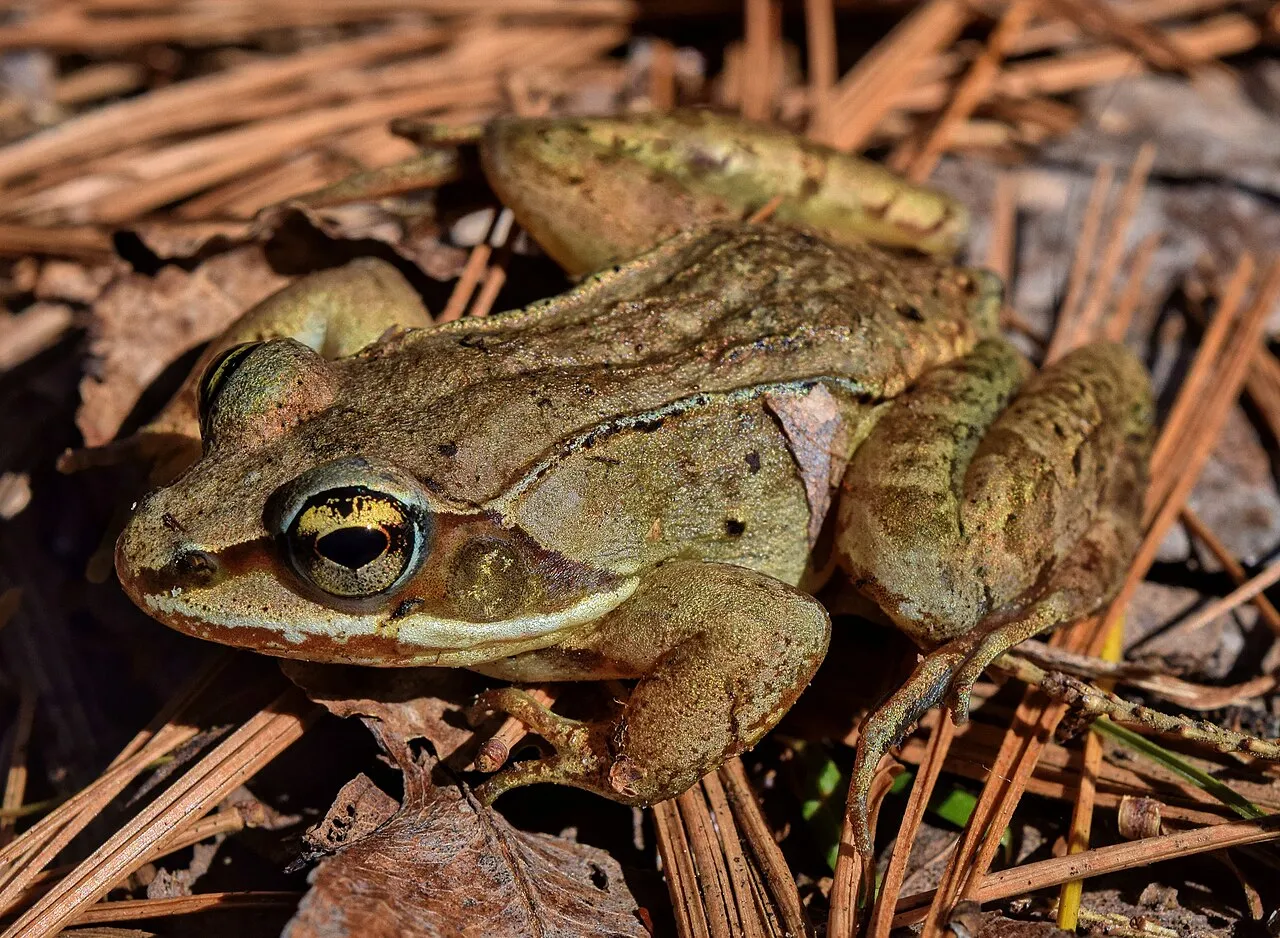
It is a slender frog with long legs and a sharply pointed head, and prominent dorsolateral folds run from behind the eye to the hips. The back and sides are green and brown with distinct round spots. Spots on the sides and legs are typically smaller than those on the back, and a light, sometimes yellowish stripe2 runs along the upper jaw. The tympanum is about the size of the eye and occasionally has a small white dot in the middle. The toes lack digital pads3.
Males have paired vocal sacs and enlarged thumbs and forearms, and the sacs are spherical when inflated. The call is a short, guttural trill at 10 to 12 per second, compared to chicken clucks or fingers rubbed across a balloon3. The Savannah River Ecology Laboratory describes it as a guttural, chuckling croak2, sometimes compared to a low laugh.
Newly hatched tadpoles are 20 to 25 mm long and reach 65 to 70 mm before transformation. The tadpole’s tail bears dark spots when metamorphosis is imminent, and the newly transformed frog is approximately 20 mm long3.
Habitat and range
The frog occupies nearly any shallow freshwater habitat, favouring wetlands without fish, but may also tolerate slightly brackish water. In summer adults disperse from the water and settle in moist vegetation, and can be found 1 to 5 km from their aquatic habitats3. Although strongly tied to water, it is more terrestrial than many ranids2 and may be found far from it. In the northern parts of its range it is dormant during the winter1, staying in well-oxygenated, unfrozen water bodies.
It is an introduced species in the Bahamas, Arizona and two locations in California. Frogs are believed to have reached California’s Prado Flood Control Basin with a shipment to the Chino Gun Club in 1929 or 1930. A second Californian population has been suspected since the March 2016 discovery of two females in the San Joaquin River1, northwest of Fresno.
Behaviour and breeding
Animal Diversity Web describes the species as nocturnal, hiding by day in vegetation at the water’s edge. The Savannah River Ecology Laboratory reports it active both day and night2, often seen in large numbers crossing roads on rainy nights. A threatened frog enters the water and swims away; on land its jumps are high and often in sequences of 3. It is solitary outside the breeding season3, when it gathers in large breeding colonies.
Adults are primarily invertivores, feeding on terrestrial arthropods. Larger individuals occasionally eat small vertebrates, although this is rare. Young tadpoles are herbivorous, feeding on algae, plant tissue and organic debris. The frogs are a staple for great blue herons, river otters, grackles3, several water snakes and water moccasins, and humans eat them too, particularly the legs.
Breeding is typically initiated by rain, and heavy winter rains can trigger explosive breeding. Animal Diversity Web gives a season of November to March in the south and March to June in the north of the range. The Savannah River Ecology Laboratory says it breeds primarily during winter and spring2, though secondary breeding events sometimes occur in fall. Males call during any month except July and August3.
Eggs are laid just below the water’s surface in a firm cluster about 90 mm wide and 40 mm thick, holding several hundred eggs. A single mass can contain up to 1,500 eggs. Once laid, the eggs are left to survive on their own. The frogs typically nest communally in cooler weather, and individually in warmer weather. Eggs hatch in 4 days to nearly two weeks. The tadpoles take 50 to 75 days to develop1 by one account, while Animal Diversity Web puts the whole tadpole stage at usually around 90 days3.
The majority probably do not survive their first year. Adults that hibernate in the north suggest they can live at least 2 to 3 years3.
Geographically separated populations produce distinct numbers and combinations of antimicrobial peptides in response to the chytrid fungus Batrachochytrium dendrobatidis. These peptides mature around 12 weeks post-metamorphosis1.
Conservation
The IUCN lists the southern leopard frog as least concern4, in its 2021 assessment. Animal Diversity Web gives the reasons as its wide distribution and presumed large population. The Savannah River Ecology Laboratory calls it common and widespread throughout the Southeast2 and not protected. Loss of forests is among the leading causes of population decline1. After heavy rains many frogs are killed on busy roads, and the species is captured in large numbers3 for fishing bait, scientific research and classroom teaching.
Similar species
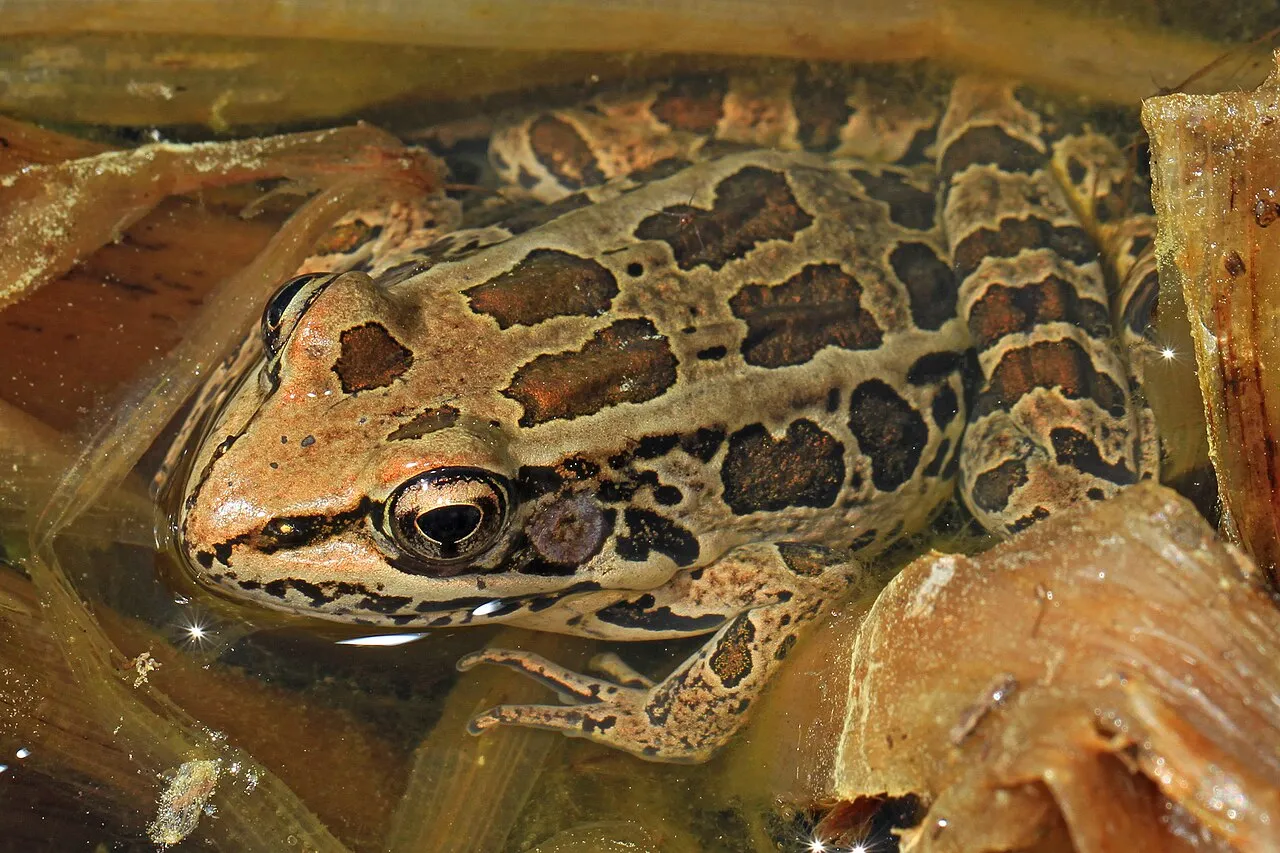
- Pickerel frog, Lithobates palustris: the southern leopard frog has rounded rather than square dorsal spots2 and no bright orange flash colours on the thighs. The pickerel frog’s tympanum spot, if present, is dark green/brown, not stark white1.
- Atlantic Coast leopard frog, Lithobates kauffeldi: where both occur it may be impossible to confidently distinguish the two. The southern leopard frog has a lighter inner thigh, more elongate snout and light tympanum spot1.