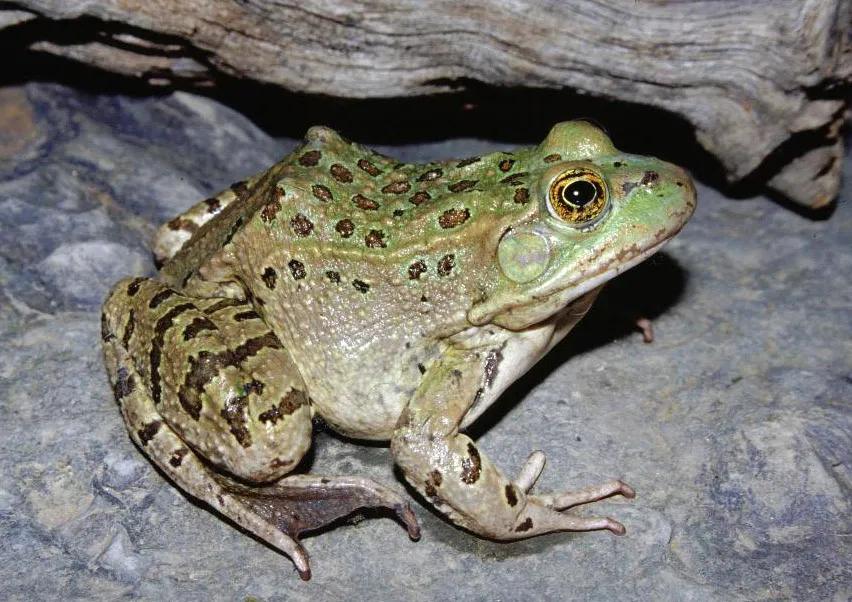
The Chiricahua leopard frog, Lithobates chiricahuensis, is a stocky, spotted frog of the mountain waters of the American Southwest, native to Arizona, New Mexico and Mexico. Two main population groups divide its range: one along the Mogollon Rim from central Arizona into western New Mexico, the other in the mountains of southeastern Arizona and adjacent Sonora, reaching southwestern New Mexico and the Sierra Madre Occidental into Chihuahua and Durango. It is one of several leopard frogs native to the region, but its reliance on permanent mountain water and its sharp decline over the past decades set it apart.
Identification
L. chiricahuensis is olive to dark green above with charcoal spots, giving it a stocky, bullfrog-like build rather than the more slender look of many leopard frogs. A useful field mark is yellowish pigmentation on the groin that can extend onto the abdomen and hind legs, a wash of colour that helps separate it from similar species sharing its range. Adults range from about 50 to 135 mm in body length, with females typically larger than males; the facts box carries the full range.
Habitat and range
The species keeps to permanent, well-oxygenated aquatic habitats with aquatic vegetation, including springs, streams, lakes, ponds and stock tanks, generally at 1,000–2,600 m elevation. That dependence on year-round water at moderate-to-high elevation ties the frog closely to the mountain ranges and riparian corridors scattered through its two population groups, rather than to the arid lowlands between them.
Behaviour and breeding
Breeding timing tracks elevation: the frog breeds June–August at elevations above about 1,800 m, and from spring through late summer below that elevation. Eggs are laid in clumped, spherical masses attached to vegetation or floating at the surface, and tadpoles take 2–9 months to complete metamorphosis, a wide window that reflects how much the cool, high-elevation sites in its range slow development compared with warmer, lower ones. In the wild, the species can live up to 14 years, long for a mid-sized ranid.
Conservation
The species’ facts box carries its current IUCN Red List category, Vulnerable, and the figures behind that listing are stark: the frog has been eliminated from about 80% of its former range by habitat loss and the fungal disease chytridiomycosis. Recovery work is already under way, with captive breeding and reintroduction carried out by the Phoenix Zoo, the Arizona Game and Fish Department and the U.S. Fish and Wildlife Service.
Similar species
The northern leopard frog, Lithobates pipiens, overlaps with the Chiricahua leopard frog at the edges of its range and shares the same general spotted pattern, but lacks the yellowish groin wash and favours lower, flatter wetlands over the mountain springs and streams this species prefers.