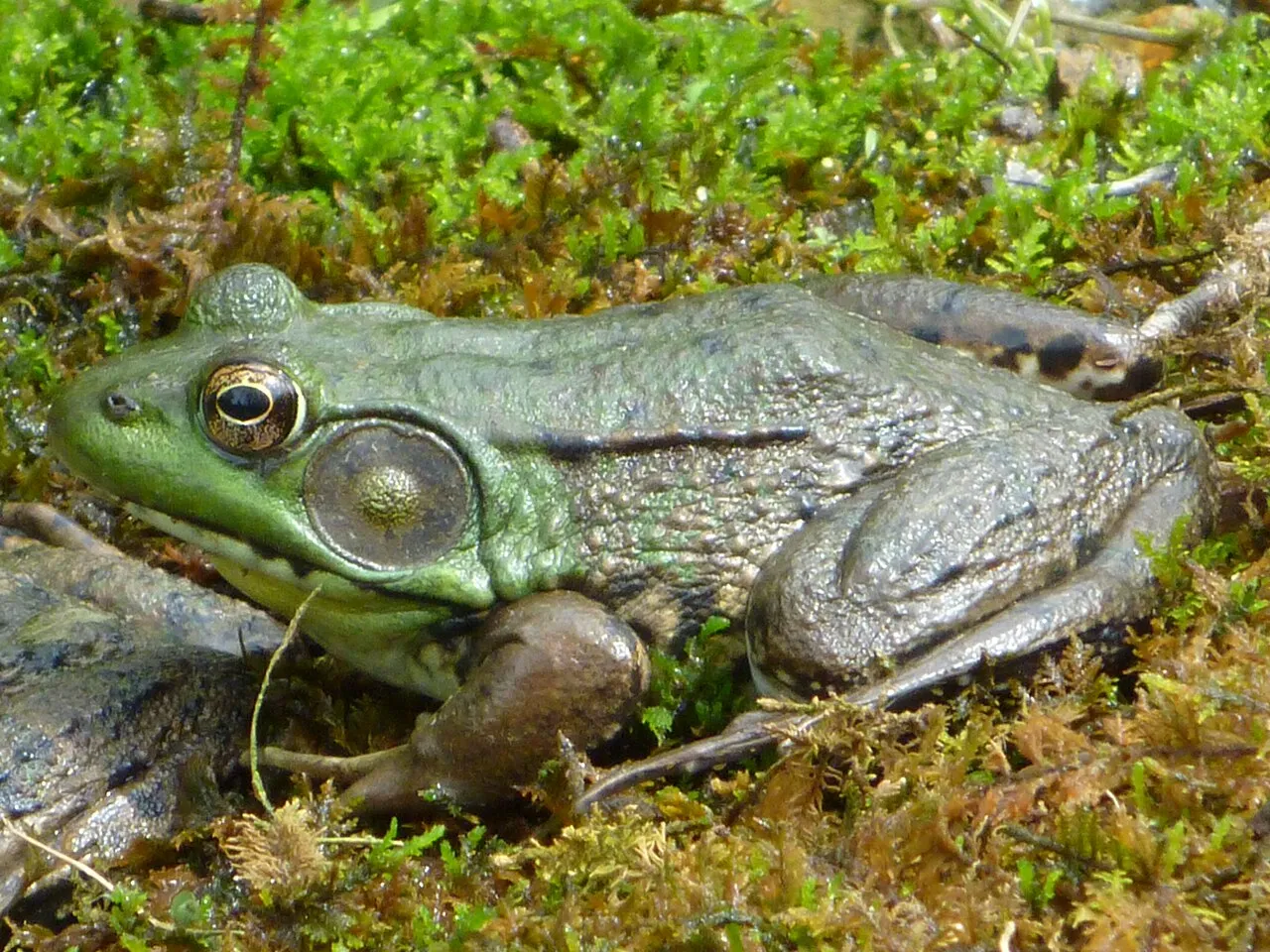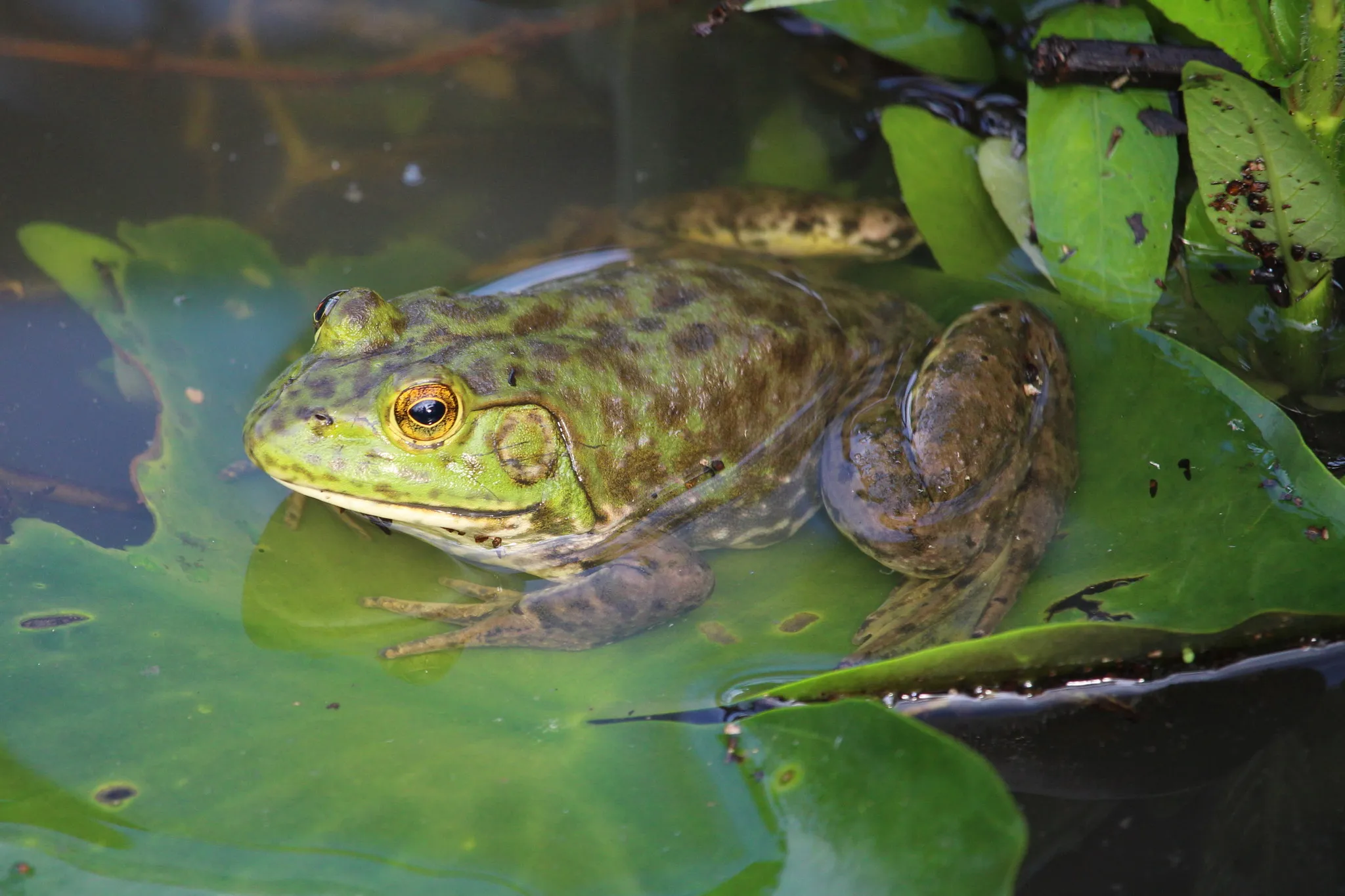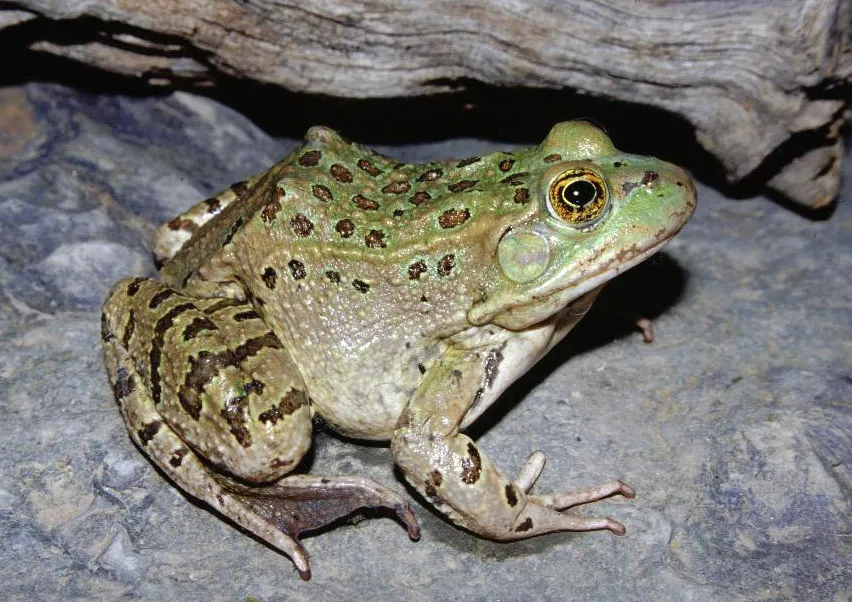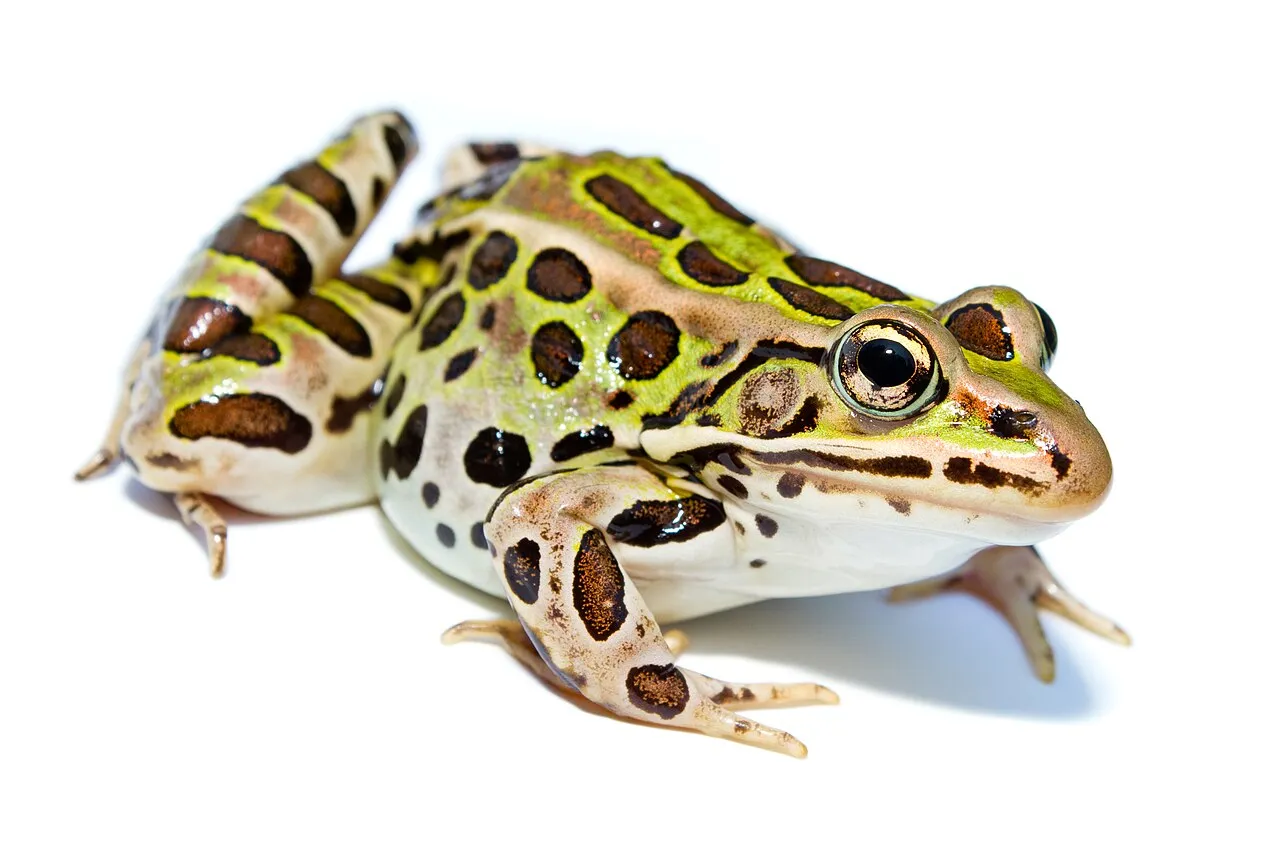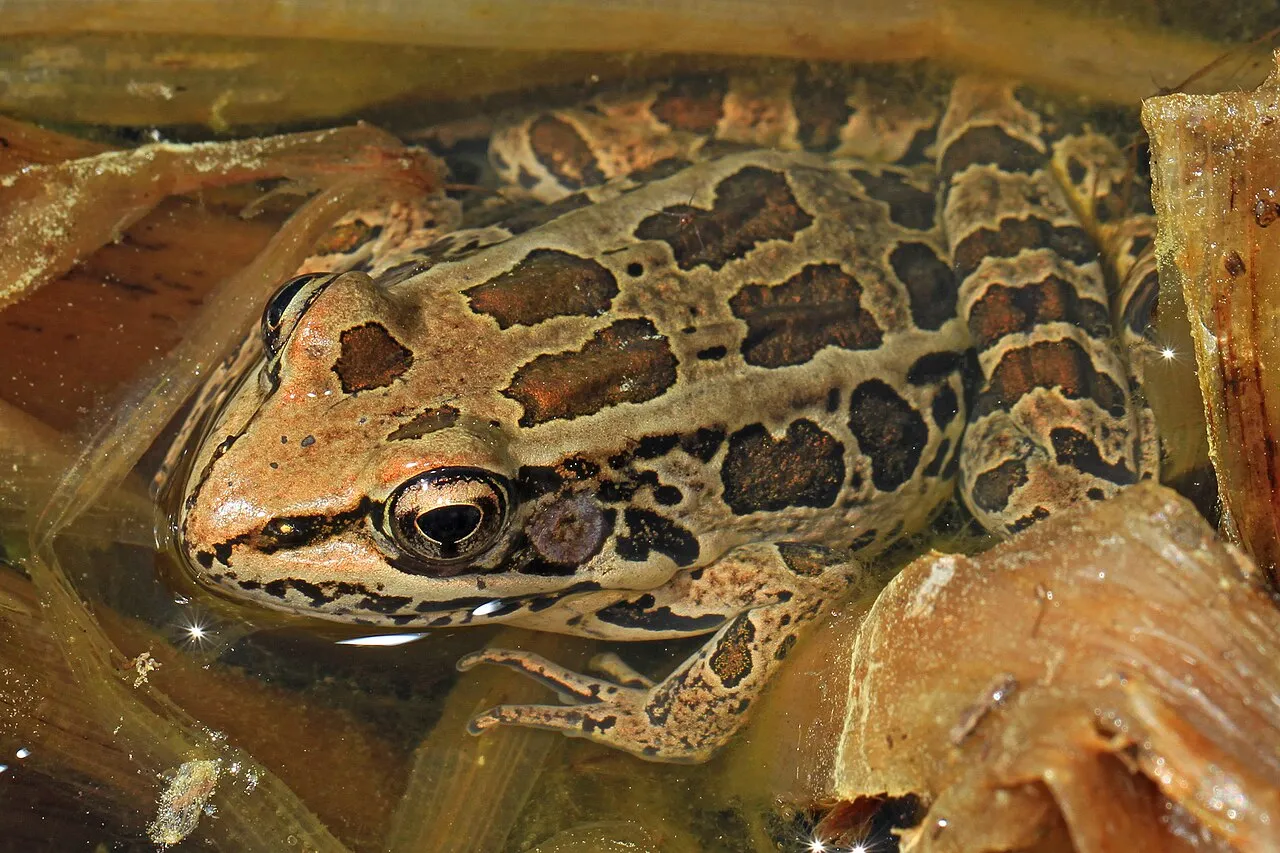
Lithobates palustris, the pickerel frog, is a frog of the family Ranidae found in much of the eastern United States and parts of southeastern Canada1. It was formerly known as Rana palustris2.
Identification
Virginia’s wildlife agency describes it as a medium-sized frog of up to 3.5 inches3. Adults average 44 to 75 mm snout-vent length, with a maximum of 87 mm, and females are generally reported to be larger1 than males.
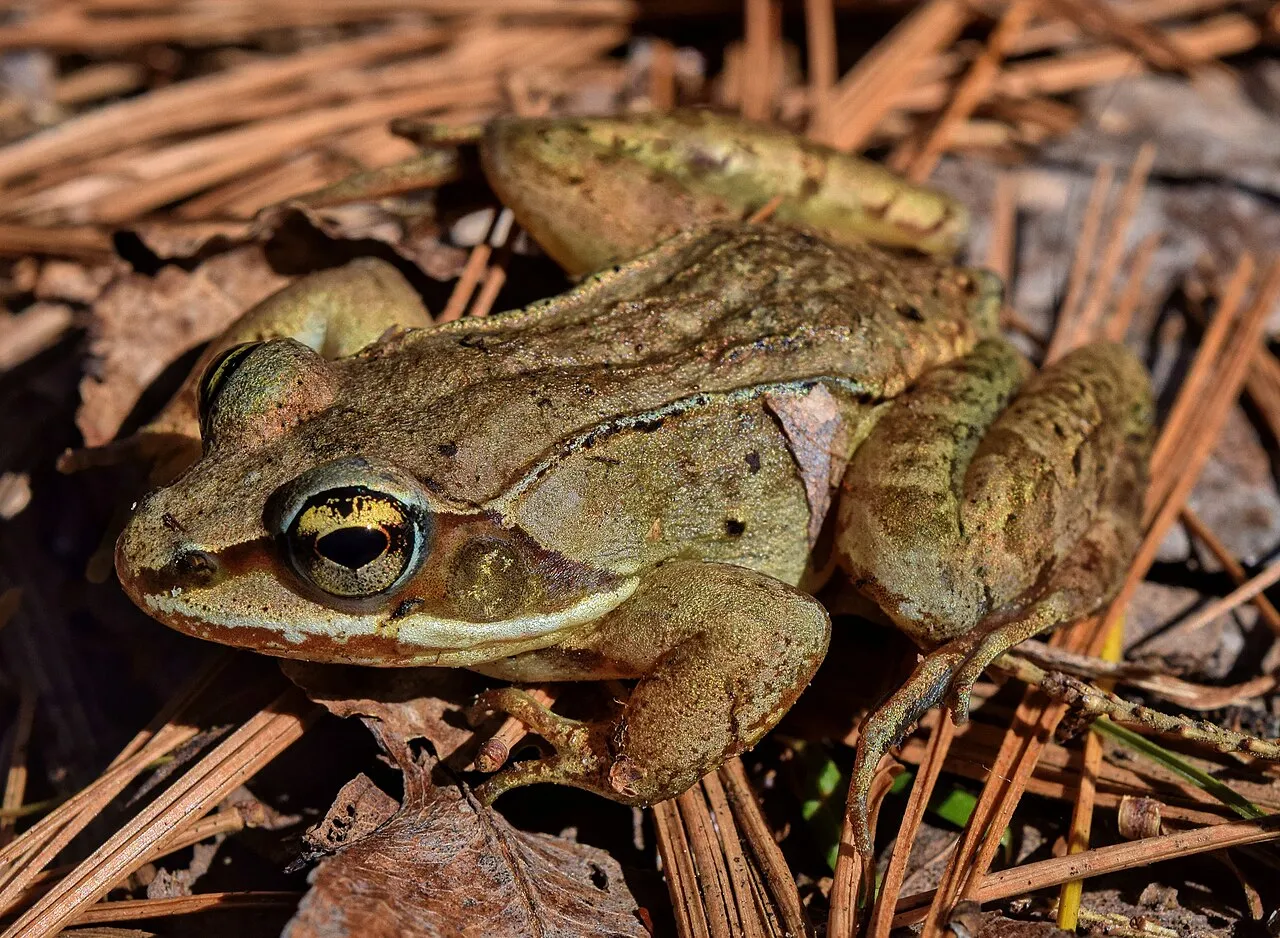
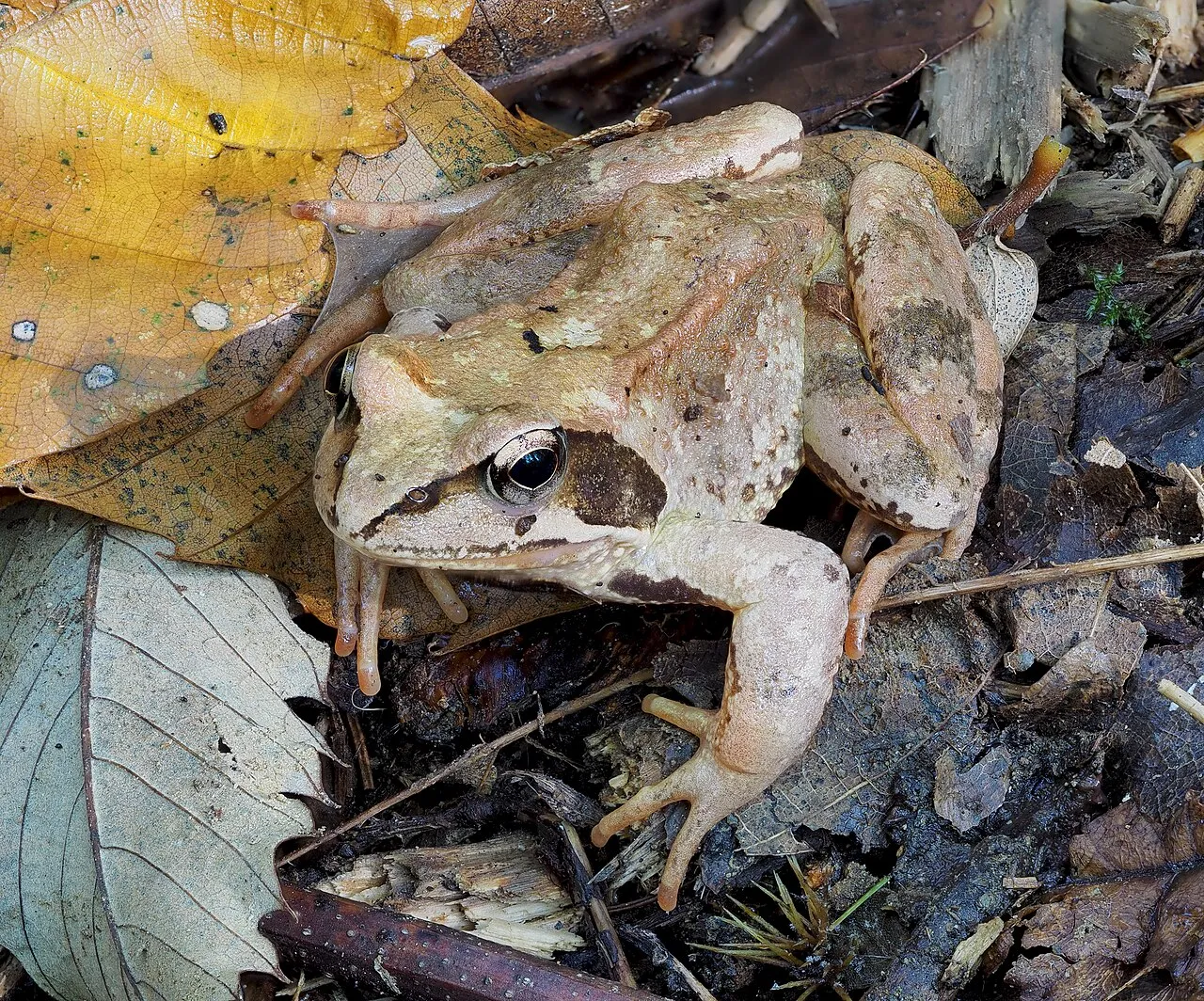
The body is gray or tan, with a double row of dark squarish blotches on the back. Adults generally have seven pairs of black or brown dorsal spots and a spot on the snout, though the number, fusion and pattern of the spots vary across the range. Other marks are a prominent white line on the upper jaw, conspicuous dorsolateral folds running from the eardrum down the body, and a white or yellowish belly. The hind legs are usually banded with black or dark brown stripes, and their concealed surface is yellow or orange3. In the mating season, males have enlarged thumb pads1 that make them easy to identify.
Tadpoles may be green, brown, or gray and measure 5 to 8 cm1.
The skin secretions are irritating to people and toxic to some predators2, and the frog secretes toxins through its skin that can be harmful to humans and pets if ingested1. Because of these noxious skin secretions, few snakes will eat3 pickerel frogs.
Habitat and range
The range reaches north to New Brunswick, Nova Scotia, and the Upper Peninsula of Michigan, south to South Carolina, and west into northern Alabama, Mississippi, and eastern Texas. The frog occurs in northern Georgia but is almost entirely absent from Florida1. In Virginia it is found statewide except for extreme Southeastern Virginia and much of the Eastern Shore3.
In the north it lives in clear, cool waters of lakes, ponds, streams, or pools; in the south, in warmer waters of swamps and rivers. In warmer months it can turn up in fields, grasslands, or wooded areas1, and in Virginia it is often found far from water3 in summer.
In many southern and midwestern states its distribution is almost entirely dependent on limestone cave habitats, where it has been reported to overwinter. In some states it has also been found overwintering in abandoned mines1.
Behaviour and breeding
The pickerel frog hibernates during winter months, usually in the substrate of ponds, and goes into hibernation much later than the visually-similar northern leopard frog. After hibernation it congregates near bodies of water for the mating season; afterwards it may move into fields and woods and lead a mostly solitary lifestyle1.
Animal Diversity Web gives breeding between February and May in pools, ponds, lakes or other standing water; in Virginia the species breeds from April-May and often gathers in large numbers. Virginia breeding sites include sphagnum bogs, slow moving streams, ponds and wet meadows. The advertisement call is a distinctive snore with a duration of 1 to 3 seconds, given from above or below water3. Animal Diversity Web describes it as a short snoring sound, lasting an average two seconds. Males also use two aggressive vocalizations1 toward other males.
Females deposit between 2,000 and 3,000 eggs in a clump on a submerged twig or stem. The eggs hatch in 11 to 21 days, and the frog remains a tadpole for roughly 3 months1 before metamorphosis.
Adults generally rely on terrestrial arthropods, specifically insects and arachnids. Snails, crayfish, isopods and aquatic amphipods only make up roughly 5% of their diet1.
The poisonous secretions cannot stop all creatures2: its usual predators include green frogs, bullfrogs, northern water snakes, eastern ribbon snakes and common garter snakes.
Conservation
The pickerel frog is listed as Least Concern4 in the IUCN Red List version 2022.2. In 2019, Animal Diversity Web considered the population stable, though with localized declines in Iowa, Wisconsin, Minnesota, and Kansas and in Ontario. The same 2019 account described its habitat as subject to clearcutting and urbanization1. In Virginia the species appears to be secure3 (profile updated August 2024).
Similar species
- Northern leopard frog, Lithobates pipiens: the pickerel frog is easily confused with the leopard frogs, which have more rounded blotches3 on the back, against the pickerel frog’s squarish ones.
- Plains leopard frog, Lithobates blairi: it shares the orange or yellow flash on the inner hind legs, but its dorsolateral ridges are interrupted and inset medially2, while the pickerel frog’s are unbroken.
- Green frog, Lithobates clamitans: larger pickerel frog tadpoles are often mistaken as green frogs, but the pickerel frog tadpole has a more pointed nose and eyes closer together2.
- Wood frog, Lithobates sylvaticus: the egg masses superficially resemble those of wood frogs, but pickerel frog egg masses contain more eggs, about 2000–30002.