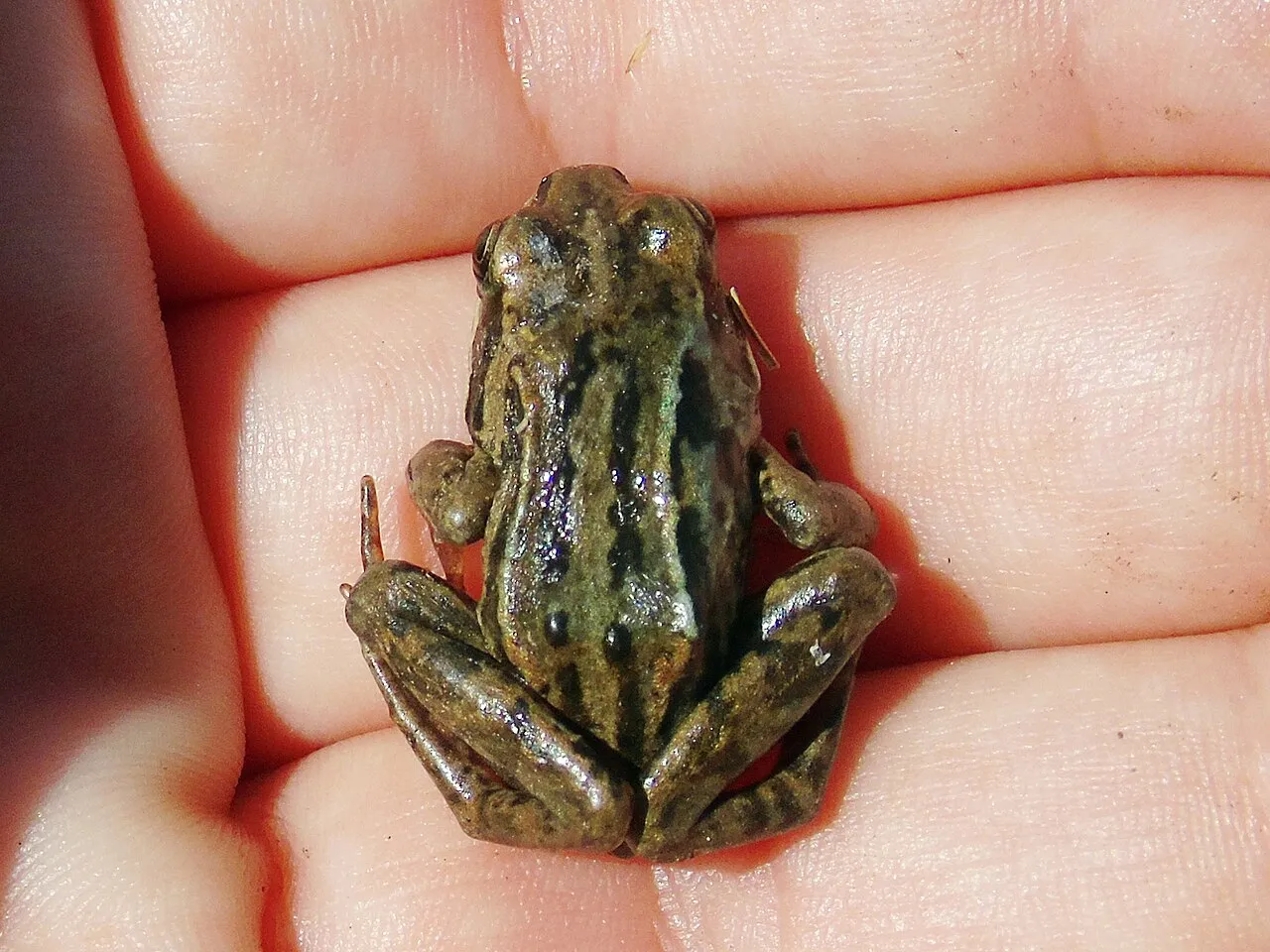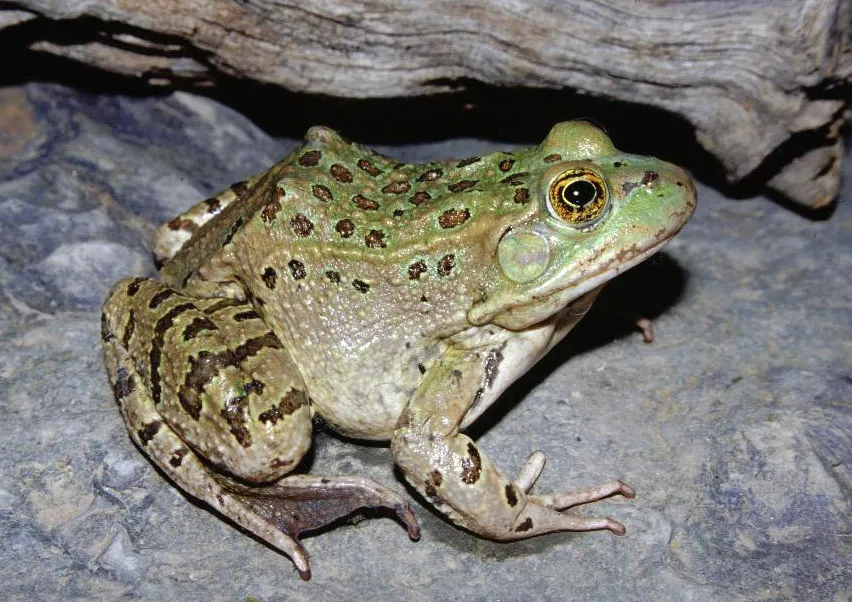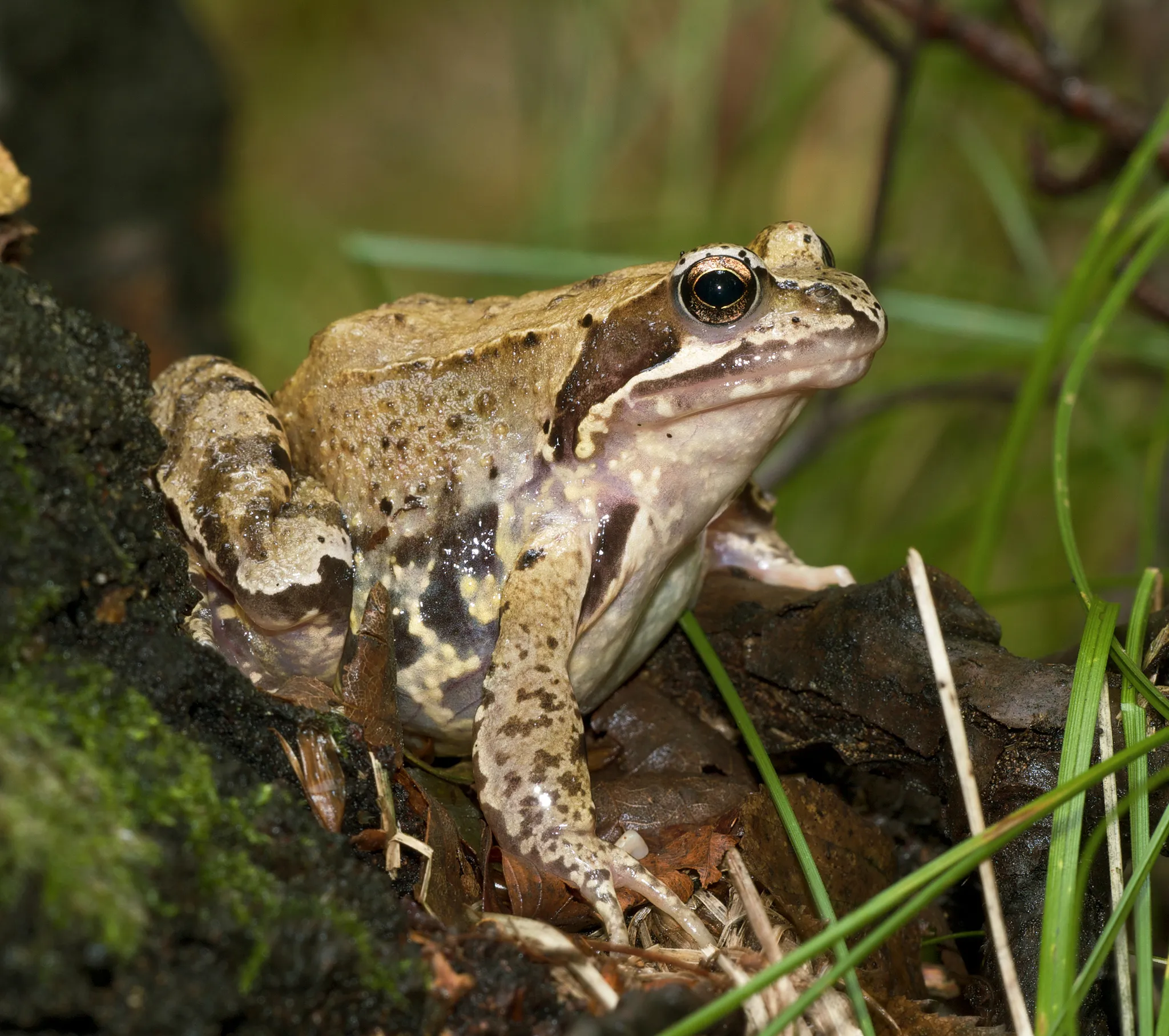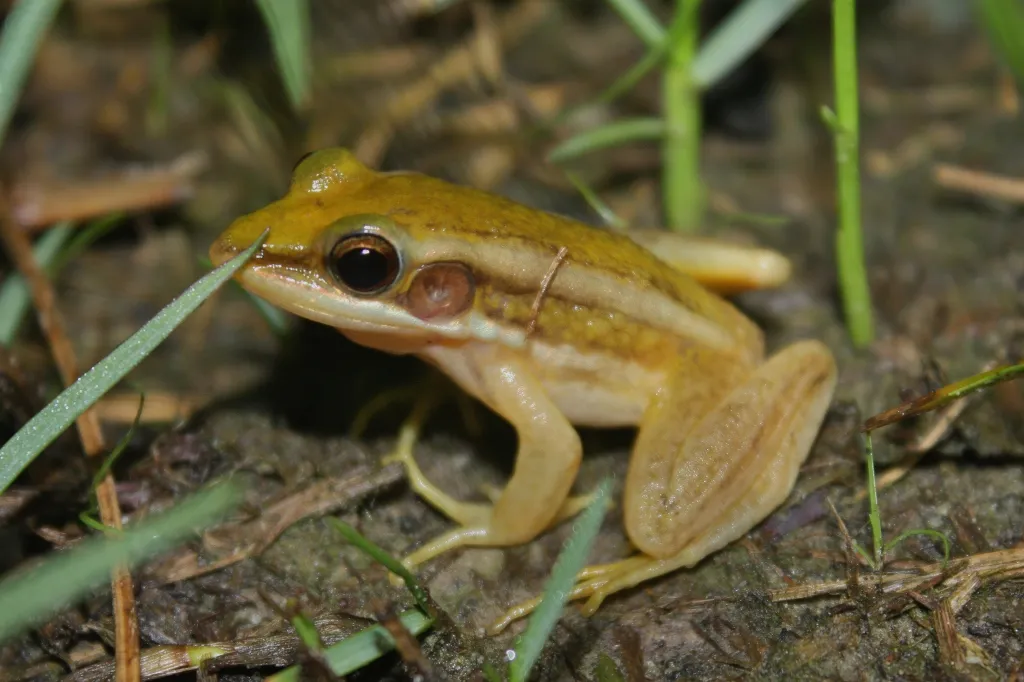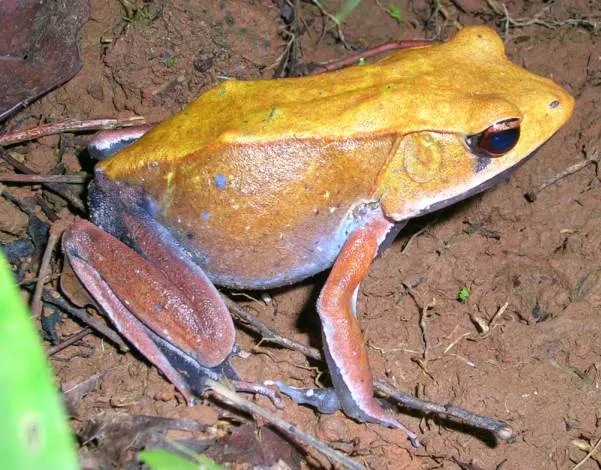
Clinotarsus curtipes, the bicolored frog or Malabar frog, is a ranid frog endemic to the Western Ghats of India. It is a forest frog of the leaf litter, and breeding adults reach 68.5 mm snout to vent2. It was described by Jerdon as Rana curtipes in 18541. Today it is one of three species in the genus Clinotarsus, whose members live in India and Southeast Asia3.
Identification
The head is large, with a short, rounded snout and a well-marked canthus rostralis, and the tympanum is nearly as large as the eye. The first finger extends beyond the second, the toes are short and nearly entirely webbed, and the tips of fingers and toes swell into very small disks. The back is described as greyish or brown, with or without blackish dots, with a blackish oblique spot or band below the eye. The limbs are dark purplish brown without cross bands. Males have an internal subgular vocal sac1.
Another description calls the frogs bicoloured: an olive-golden yellow back over uniformly black sides, limbs and belly. In one Karnataka population most backs were reddish-yellow and a few ashy grey. Black spots cover the back, and their number and pattern differ in each individual. Using those spots, the researchers told apart 160 individual frogs. A reddish parotid patch may be visible2.
In the same population, newly emerged froglets measured 15 to 18 mm2 snout to vent. The tadpoles are black and large, reaching more than 9 cm1 in total length. Among tadpoles collected along the Kali River, Lucy Lobo measured large tadpoles at 3 to 4 inches (about 76 to 102 mm), with a long and coiled gut4.
Habitat and range
The species occurs in forest from Kerala in the south to southern Maharashtra, where Yadav and colleagues reported three new populations in 2021, about 150 km north5 of the nearest known record.
In the Bisale Reserve Forest of Karnataka, the study sites lay on the western slopes of the Ghats at 350 to 860 m. The forest there is tropical rainforest with dense canopy cover and many perennial hill streams2. Capture and recapture by spot pattern there, from January 1999 to July 2001, gave a density of 0.08 to 0.1 frogs per square metre1.
In Lobo’s account, the frog is often found in small puddles within the forest and seems to prefer cool water in shade. It apparently estivates through the hot season from March to May, when the pools dry up. In the rainy season, June to September4, it is seen in large numbers.
Behaviour and breeding
In southern Maharashtra, outside the breeding season, juveniles and adults are strictly terrestrial in forested areas and adults are solitary. The breeding season begins in early June and ends by September. Eggs were found in large ponds and lakes5 from late June to September, and tadpoles aggregate in large numbers from September through March before the metamorphs emerge en masse by May. Tadpoles also form shoals in slow moving streams1.
Development is slow. In Lobo’s observations, growth and metamorphosis took 9 months, usually from July to March. The hind limbs appeared about the end of January4, and the forelimbs began to bud in the first week of February.
The tadpoles are voracious and purely vegetarian. After metamorphosis the young frog feeds on insects, and adults take low flying and crawling insects2. Young frogs start out jet black and turn brown as they age4.
Adult frogs may occasionally feign death1 to escape predators. The skin secretion contains five novel peptides of the brevinin family, named B1CTcu1 to B1CTcu57, which were active against diverse bacteria, including methicillin-resistant Staphylococcus aureus. The authors conclude that these peptides protect the frog from invading pathogenic microorganisms6.
Conservation
The bicolored frog is listed as Least Concern8 on the IUCN Red List, in the IUCN SSC Amphibian Specialist Group’s 2023 assessment. Its tadpoles are collected for local consumption1. During fieldwork in southern Maharashtra from 2007 to 2019, Yadav and colleagues observed habitat destruction, human interference, climate change and roadkills5 as major threats.
Similar species
The genus holds two other species, each with its own range: