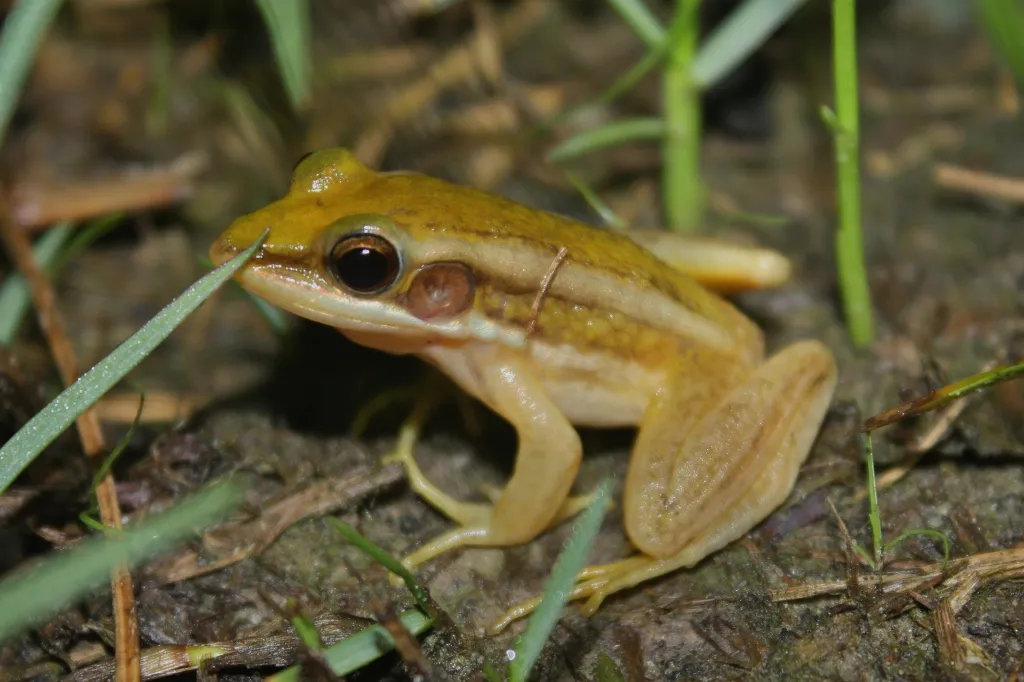
Hylarana erythraea, the common green frog, is a slender true frog native to Southeast Asia: Brunei, Cambodia, Indonesia, Laos, Malaysia, Myanmar, Singapore, Thailand and Vietnam, with introduced populations further afield. Despite its everyday name it is also known as the green paddy frog, red-eared frog, common greenback or leaf frog, names that trace the species through rice fields and garden ponds across its range. It is the type species of the genus Hylarana, a group of true frogs in the family Ranidae that this species was itself once used to help define.
Identification
Hylarana erythraea is a modestly sized frog with a clear difference between the sexes: males reach a snout-vent length of 30-45 mm, while females grow to 50-75 mm, making females around half again as long as males. Tadpoles reach up to 36 mm in length before completing metamorphosis. The frog’s skin is smooth and bright green above and along the sides, with a distinct tympanum, the visible ear disc behind the eye that gives true frogs much of their characteristic face. That plain, unbroken green is the first thing to check against the lined and spotted patterns of related species (see Similar species below).
Habitat and range
Across its native Southeast Asian range the species uses subtropical and tropical moist lowland and montane forests, freshwater lakes and marshes, including those that dry up seasonally, rural gardens, heavily degraded former forest, and irrigated or seasonally flooded agricultural land, and it has been recorded as high as 1200 m above sea level. That tolerance for farmland and gardens alongside natural wetland earns it the “paddy frog” name, and keeps the species widespread instead of confined to shrinking forest. Beyond its native countries, introduced populations are established on Sulawesi and in the Philippines, extending its range past the islands and mainland where it occurs naturally.
Behaviour and breeding
Detailed accounts of this species’ calling, courtship and egg-laying are thin in the open literature, but its choice of habitat tells part of the story. A frog equally at home in permanent freshwater marshes and lakes, intermittent wetlands that dry up for part of the year, and flooded or irrigated farmland is one that can breed opportunistically wherever standing water appears, rather than depending on a single kind of water body. The tie to rice paddies and garden ponds suggests a species that breeds readily in the human-made wetlands that replaced much of its original forest habitat, which may explain why it has spread to islands outside its native range instead of retreating as land use changed.
Conservation
The facts box gives the species’ IUCN category. A wide native range across nine countries, tolerance for degraded and agricultural land, and successful introductions beyond that range all point to a species under little pressure at present. The main gap is how thoroughly its population trends have been studied outside protected areas.
Similar species
The clearest former look-alike has already been resolved by taxonomists: frogs from northeastern India and neighbouring areas that were once classified as Hylarana erythraea are now recognised as the separate species Hylarana tytleri, also called Theobald’s ranid frog. The two are close enough in size that confusion was understandable, with H. tytleri males reaching about 33 mm and females about 45 mm in snout-vent length, close to the lower end of H. erythraea’s range. The surer mark is pattern rather than size: H. tytleri shows two whitish or yellow lines running laterally along the back and two distinct brown lines on the inner side of the latero-dorsal folds, a striped look that H. erythraea’s plain green back lacks. H. tytleri also keeps to a different range, found in eastern and northeastern India, Myanmar, Bangladesh and southern Nepal, at elevations below about 300 m, well northwest of H. erythraea’s Southeast Asian distribution, so the two rarely overlap in the field.