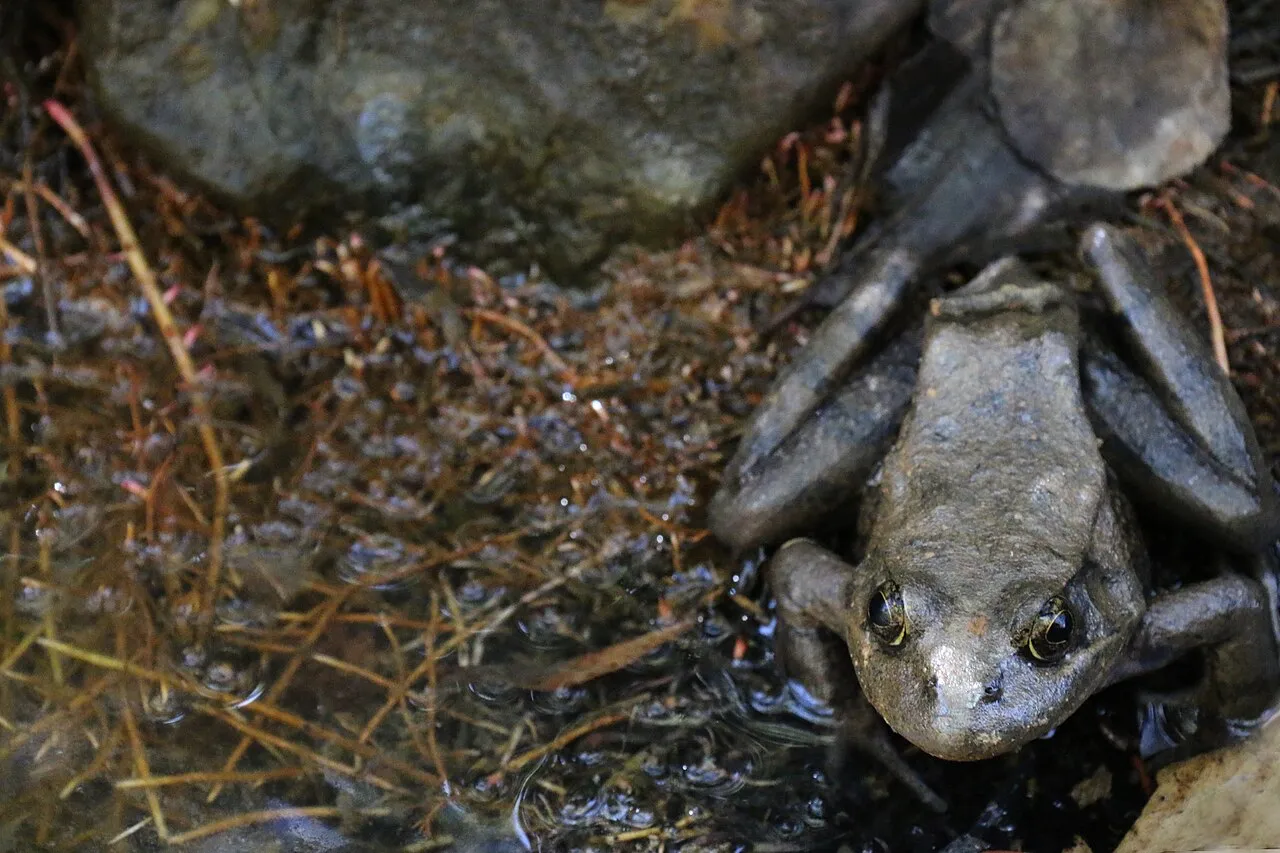
Rana draytonii, the California red-legged frog, is the largest native frog in the western United States, with a body length ranging from about 45 to 133 mm (4.5–13.3 cm). It was once widespread across California but today occupies only about 265 streams or drainages across 28 counties, roughly a 70% reduction from its former range that has made it one of the state’s better-known amphibian conservation stories.
Identification
Size alone sets this species apart from most other frogs sharing its range: adults can grow to more than 13 cm (5.2 in), well beyond the typical body length of the other native ranid frogs found alongside it in California’s ponds and streams. Even the smallest recorded adults, at around 4.5 cm, are substantial frogs by the standards of the genus. Its large hind legs give it a powerful jump and a strong swimming stroke, traits that support a mostly aquatic lifestyle in the deeper, well-vegetated water it favours, and that let it retreat quickly into cover when disturbed. The frog’s common name points to the reddish wash on the underside of the hind legs and belly, the feature most often used in the field to distinguish it from paler, smaller relatives sharing the same wetlands.
Habitat and range
The species historically ranged from Point Reyes in Marin County south to northwestern Baja California, spanning most of the length of California’s coast and inland valleys. That range has since contracted sharply: the frog has disappeared entirely from the Los Angeles area southward, and the roughly 265 drainages it still occupies represent only a fraction of the streams, ponds and marshes it once used. Within what remains of that range it favours sheltered backwaters of ponds, marshes, springs, streams and reservoirs with riparian vegetation, seeking out deep water with dense willows mixed with cattails where it can hide from predators and avoid drying out. It is not strictly dependent on permanent vegetated water, though: the species also turns up in temporary ponds and drainages lacking vegetation, provided the water lasts long enough for breeding. One firm limit on where it can live is temperature: the frog cannot tolerate water temperatures above about 29°C, which rules out many of the shallow, sun-warmed pools that other California amphibians use.
Behaviour and breeding
Adults are carnivorous, feeding mainly on insects and other invertebrates, a diet typical of mid-sized ranid frogs. Because of its unusually large size, though, this species can take prey well beyond the usual invertebrate menu: the largest individuals also take Pacific chorus frogs and California mice, making it one of the few California frogs large enough to prey regularly on small vertebrates. Tadpoles live a very different life, grazing instead on algae and detritus in the water where they hatch.
Breeding runs from November through March, with females usually laying eggs during or shortly after heavy rainfall, when ponds and streams are at their fullest. A single female lays 2,000 to 5,000 eggs in permanent water, a large clutch even by frog standards, but most of that reproductive effort is lost: tadpoles take three to seven months to complete metamorphosis, and across that long larval period under 1% of eggs survive to reach metamorphosis. The frogs that do survive grow slowly toward adulthood compared with many other frogs, with females reaching sexual maturity at about three years and males at about two years, a long juvenile period that leaves the population vulnerable to any disruption of its breeding habitat.
Conservation
The IUCN category for the California red-legged frog is given in the facts box above. In the United States, the species has carried additional federal protection for three decades, having been listed as threatened since 1996, with recovery efforts since then centred on restoring the wetland and riparian habitat it depends on. The threats behind that listing are varied: the species faces habitat loss and degradation from agriculture, urban development and logging, invasive plants, and introduced predators such as American bullfrogs and non-native fish, pressures that together explain much of the range contraction described above.
Similar species
The California red-legged frog is often confused with its northern relative, the northern red-legged frog (Rana aurora), but the two can be separated on vocal anatomy: the California red-legged frog carries a pair of vocal sacs, a structure the northern species lacks, and it also runs larger overall, with further differences in colour pattern, limb length and eye size. Within its own range it also overlaps with the foothill yellow-legged frog, a smaller species lacking the reddish undersides that give this frog its common name, and with the introduced American bullfrog, a much bulkier invasive species that competes with and preys on the smaller native frog.