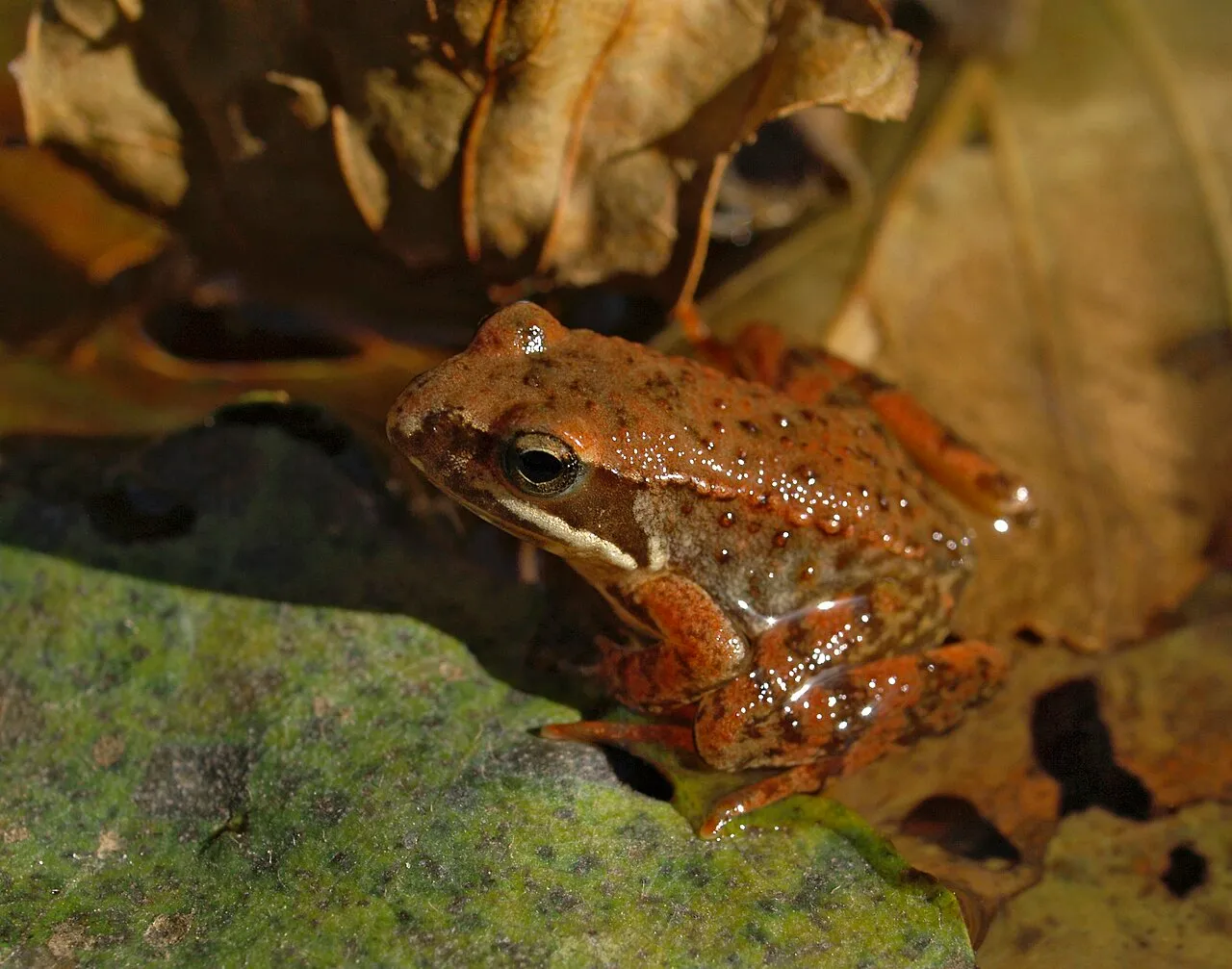
Rana iberica, the Iberian frog, is a species of true frog in the family Ranidae, endemic to Portugal and north-western and central Spain, including Galicia, León and Zamora, with further populations in the mountains of central Spain. It keeps close to slow water throughout that range and is one of the smaller brown frogs found on the Iberian Peninsula, distinguished from its relatives mainly by size, a fold of skin along its flanks and its quiet nocturnal call.
Identification
Adults are typically about 50 mm long, with a maximum of around 70 mm; females grow larger than males. The skin is mainly olive, reddish or greyish-brown, sometimes with darker markings, smooth with fine granulations. A dark streak runs between the nostril and the eye, with a white line along the upper lip, and a dorsolateral fold runs from the head to the groin, a feature that helps separate it from the common frog. The hind legs are sometimes barred with dark brown, and the hind feet are more completely webbed than those of the common frog. At night, males produce a quiet “rao-rao-rao” call at a rate of about three calls per second, a call soft enough that it is easy to miss beside running water. The size, facial markings and flank fold are the most reliable field characters for this species.
Habitat and range
The species favours slow-moving streams and rivers with overhanging vegetation, ponds and glacial lakes, at elevations up to about 2,425 m. Within that range it has been recorded from northern Portugal and Spain’s Galicia region, western León and north-western Zamora, as well as separate populations in the mountains of central Spain. It is described as an agile frog that jumps into water and swims away rapidly when disturbed, and is active by both day and night. Its diet consists mainly of beetles, flies, caddisflies, stoneflies, spiders and harvestmen.
Behaviour and breeding
Breeding timing varies across the range: November to March in Galicia and lowland Portugal, and March to May in upland areas. Pairs mate in amplexus in the water, and the female lays her eggs in small clumps wrapped in a gelatinous coat, attached to water weeds or under stones. The tadpoles take about three months to reach metamorphosis, emerging as juveniles around 1.3 cm long. Sexual maturity follows at a smaller size in males, which mature at about 3 cm, while females mature at a larger size. The species’ largest recorded adults are females rather than males.
Conservation
The species’ facts box carries its current IUCN Red List category, Vulnerable. Reported pressures on the species include habitat loss from agriculture, deforestation and non-native plantations, disturbance from tourism, introduced fish species, predation by the introduced American mink, climate change, water contamination and ultraviolet radiation. It is nonetheless present in protected areas such as the Parque Natural del Gorbea and the Parque Natural de Izki, while populations in the Sistema Central mountains and Extremadura are reported to be shrinking.
Similar species
Rana iberica belongs to the same genus as the common frog, Rana temporaria, and shares part of its range with the agile frog (Rana dalmatina) and with Pérez’s frog. Its dorsolateral fold running from head to groin separates it from the common frog; its smaller size and the dark streak between nostril and eye are the other field marks to check.