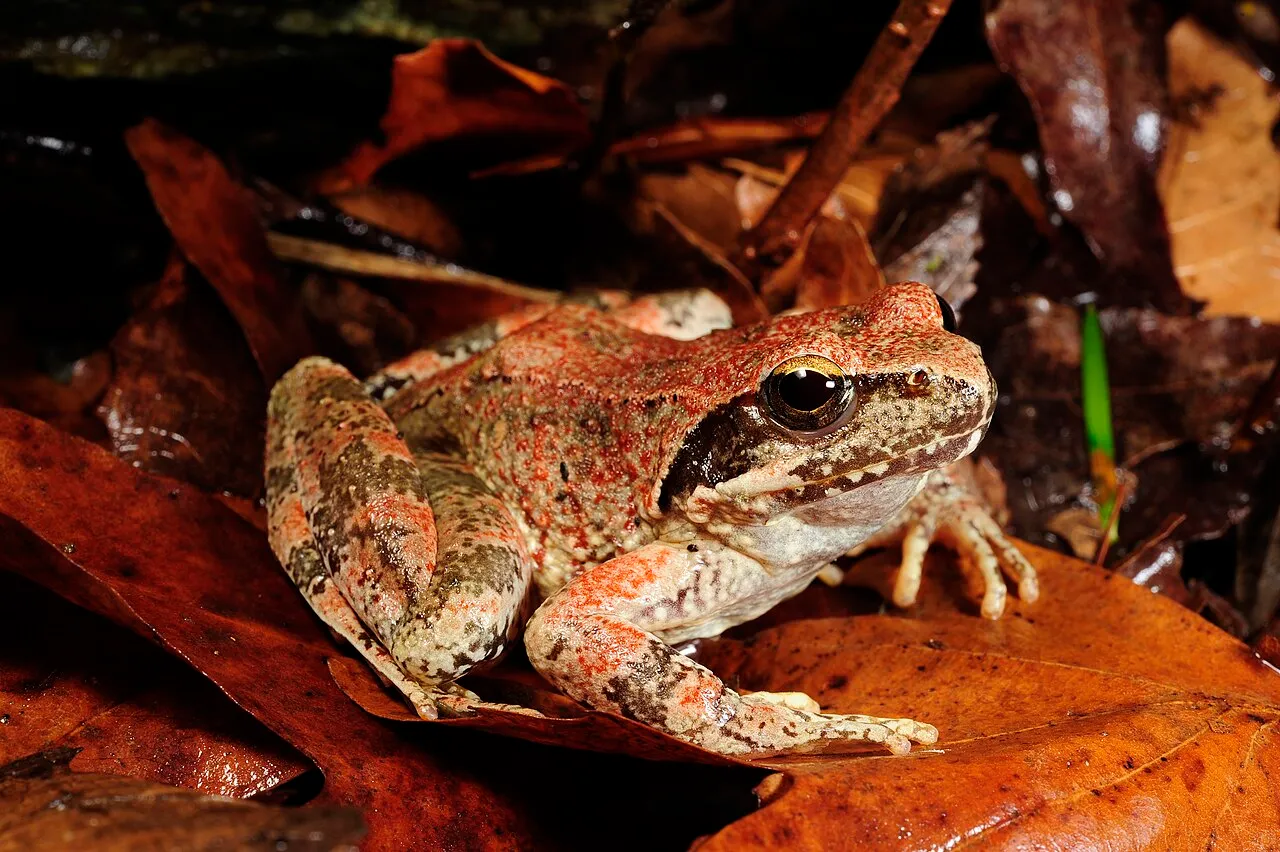
Rana graeca, the Greek stream frog or simply Greek frog, is a species of frog in the family Ranidae, found in Albania, Bosnia and Herzegovina, Bulgaria, Greece, North Macedonia, Serbia, Montenegro and Turkey. It was described by George Albert Boulenger in 1891, and, as its common name suggests, sticks close to running water throughout its range.
Identification
Documented descriptions of this species concentrate on its early life stages rather than adult markings. Its egg masses are attached to the roof of a streamside cavity and may contain anywhere from 200 to 2,000 individual eggs, each 2 to 3.5 mm in diameter and surrounded by a protective gelatinous envelope 4 to 7 mm across. The newly hatched larvae are about 9 mm long and grow up to 45 mm over two to three months, though colder water can slow that growth.
Habitat and range
The species lives in temperate forests, temperate grassland, rivers, intermittent rivers, freshwater springs and pastureland across its Balkan and Turkish range. For breeding it seeks out dark crevices in a stream bank, under roots or stones, sites that are sheltered and out of sight of predators as well as flowing water.
Behaviour and breeding
Reproduction happens only once a year, beginning shortly after hibernation in February and ending in April. Males call from either under or above the water surface, mainly at night, though they will also call during the day depending on water temperature, using the same sheltered bank crevices as calling and mating sites. Once a female has laid her eggs against the roof of such a cavity, males have been observed guarding the eggs for a period afterwards. After hatching, the larvae take two to three months to grow from about 9 mm to 45 mm, and the young frogs reach sexual maturity only after their third hibernation.
Conservation
The species’ facts box carries its current IUCN Red List category, Least Concern; the source material for this page does not report any specific threats.
Similar species
Rana graeca belongs to the true frogs of genus Rana, alongside several other brown frog species found across the Balkans and wider Europe. The cited sources for this profile do not describe adult colouring, size or other field marks that would separate it from those relatives; distinguishing it in the field depends on range, a confirmed call recording, or a current regional field guide.