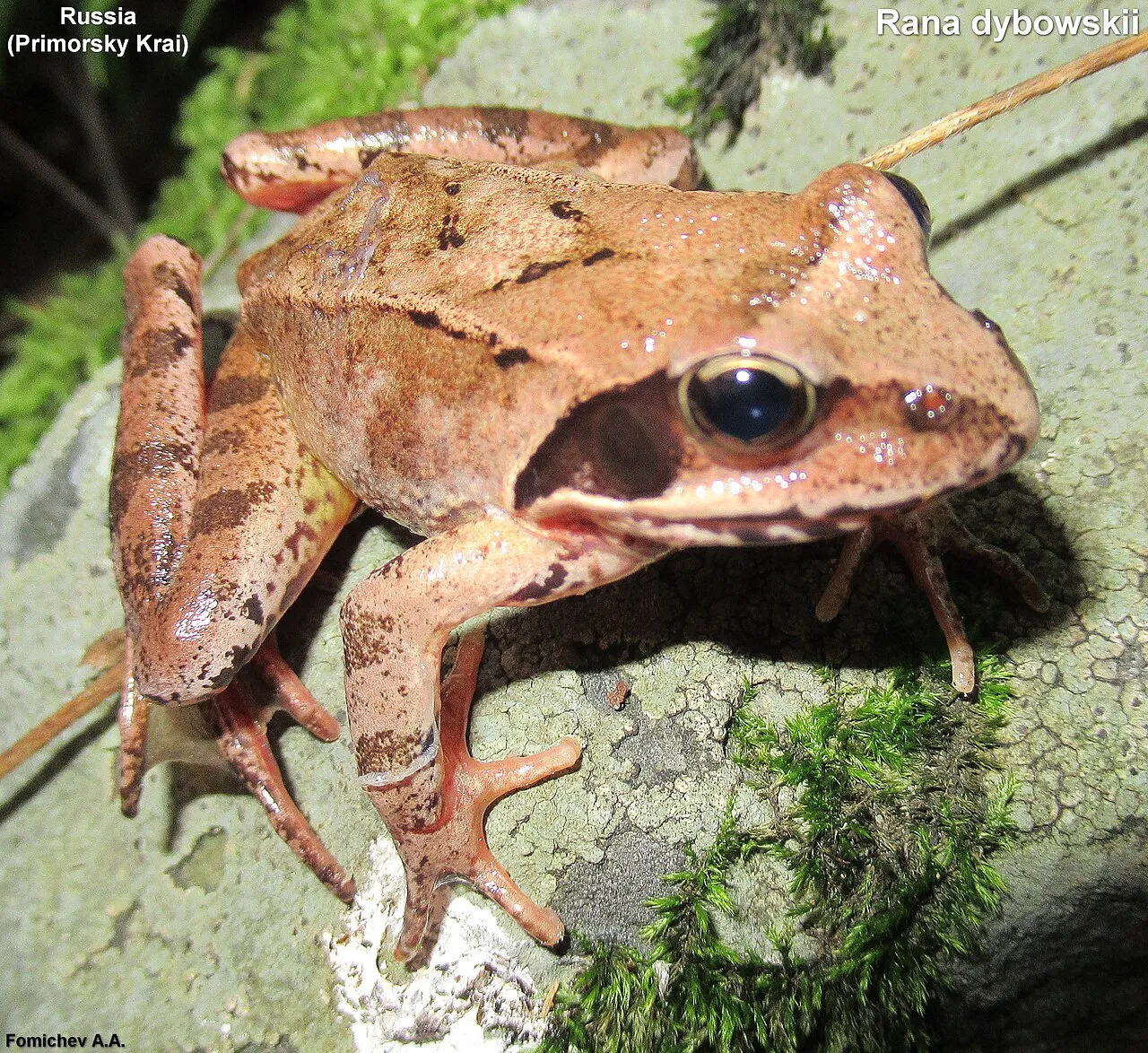
Rana dybowskii, Dybowski’s frog, is a brown frog of the family Ranidae found across East Asia. Its range runs through the Russian Far East, the Korean Peninsula and the Japanese island of Tsushima, and populations once described separately in northeastern China are now considered part of this species.
Identification
Adults measure about 45 to 75 mm in body length, a solid mid-sized true frog. Males carry vocal sacs used in breeding calls, the clearest field cue for separating the sexes during the breeding season.
Habitat and range
Dybowski’s frog breeds in slow-moving and stagnant water, and spends the rest of the year mainly in woodlands away from the breeding ponds. It tolerates elevations from sea level to about 900 m, possibly higher. Come winter, frogs move to spring-fed ponds and fast-flowing streams and rivers to hibernate, sometimes gathering in groups of up to 1,000 individuals at a single overwintering site.
Behaviour and breeding
Outside the spring push to breeding ponds and the winter move to flowing water, Dybowski’s frog lives mainly in woodlands when not breeding, returning only to slow or stagnant water to breed. Its winter aggregations in flowing water bring together frogs that spent the warmer months spread through separate patches of forest.
Conservation
The IUCN category is in the facts box above. Its Red List status has shifted recently. A 2025.2 Red List assessment lists Dybowski’s frog as Near Threatened, where an earlier 2022.2 assessment had rated it Least Concern.
Similar species
Dybowski’s frog belongs to the large and taxonomically active brown frog genus Rana, whose East Asian members are often separated mainly by range and by fine details of call and morphology rather than obvious external features. Populations once treated as a distinct species in northeastern China were folded into Rana dybowskii. Within its own range, geography is the clearest check for identity. Few other Rana species share its specific combination of Russian Far East, Korean Peninsula and Tsushima distribution.