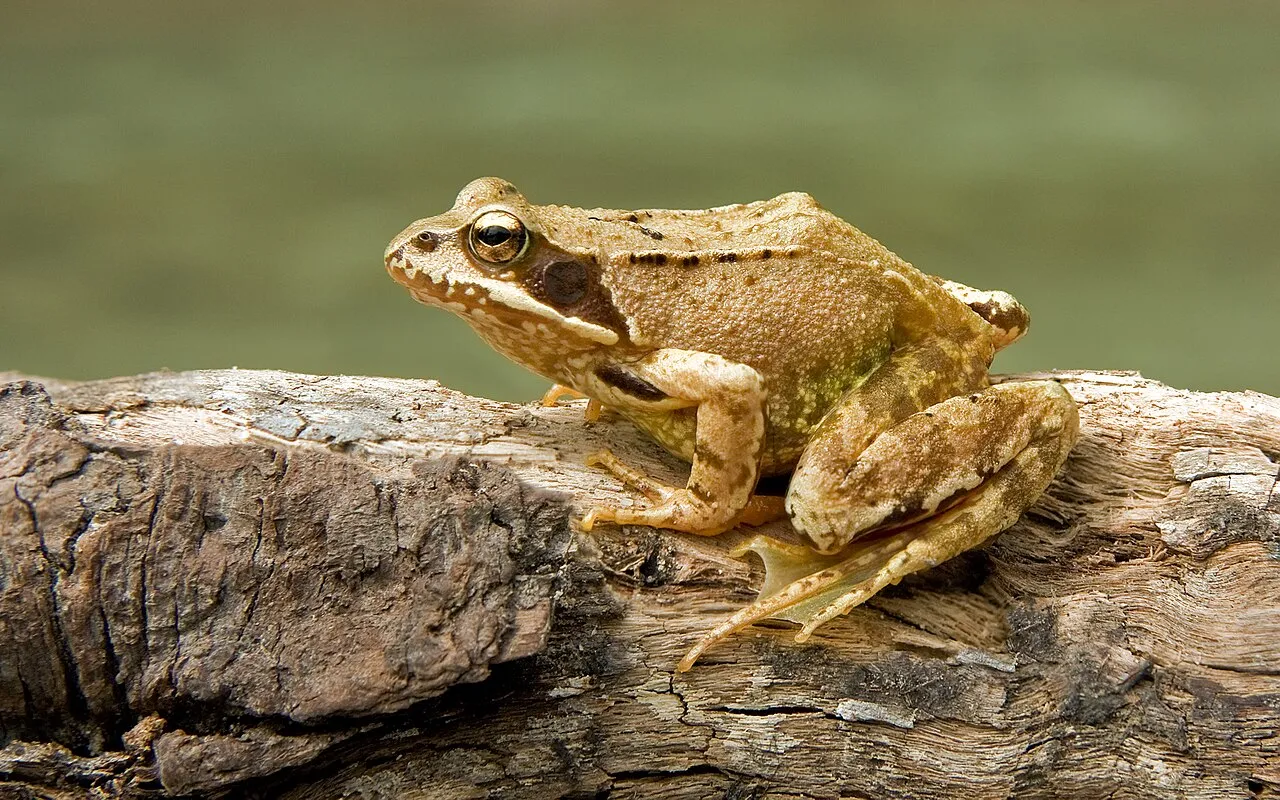
Rana temporaria, the common frog, is one of the most widely distributed amphibians in Europe. Its range covers Great Britain, continental Europe and northwestern Asia, and it reaches farther north than any other amphibian in the region, with populations recorded near the Arctic Circle in Scandinavia. Adults are a squat, short-legged frog, typically about 75-80 mm long.
Identification
The base colour runs from olive-green to brown, though yellow, pink, red, orange and even black individuals turn up regularly. The clearest field mark is a dark, triangular patch behind each eye, over the eardrum, often paired with darker banding across the back legs and irregular dark blotches on the back. Skin is smooth and moist rather than dry and warty, which separates it from toads sharing the same ponds. The sexes look different in the breeding season: females tend to be larger and yellower, sometimes with red patches on their flanks, while males develop blue patches on the back and throat for the few weeks spawning lasts. Average adult body mass is about 22.7 g, and males call with a soft croak, produced by forcing air from the lungs over the vocal cords, that carries up to 50 metres.
Habitat and range
Found in a range of damp habitats, the common frog favours cool upland forests and wet meadows, taiga and forested mountains, plus aquatic sites such as lakes, ponds, rivers and streams; it is the most abundant frog species in mountain lakes within its range. Outside the breeding season it disperses widely from the pond where it spawned, ranging up to 500 metres into surrounding woodland, scrub and rough grassland, provided the ground stays damp through summer.
Behaviour and breeding
Common frogs are mostly active after dark or in wet weather, hiding in cover through the day, and hunt by scent as much as sight: they can detect earthworms by smell and also take insects, woodlice, spiders and snails. In winter they retreat into soil and earth holes to overwinter, some submerged in the mud of ponds.
Breeding is explosive rather than spread out: lowland populations spawn in February and March, while frogs at higher altitude or farther north wait until as late as June. Many return to the same pond where they themselves metamorphosed. A pair mates in amplexus, the male gripping the female and holding on until egg-laying is complete; each female lays around 400 eggs in a gelatinous clump, and once spawning is done both parents leave the eggs to develop unattended. Eggs hatch after roughly 30 to 40 days, and the tadpoles that follow are pale gold-brown and speckled, growing hind legs before the tail is absorbed and lungs replace gills. Metamorphosis takes up to sixteen weeks, so froglets usually leave the water by early summer, occasionally as late as September further north. Both sexes reach breeding age at around three years old, and wild individuals can live up to fourteen years.
Conservation
The IUCN category for the common frog is given in the facts box above. Population trends within that category are not uniform: local breeding groups can be unstable, and a pond can lose its frogs entirely after breeding-site disturbance, an unusually hard freeze, or herbicide pollution, even while the species as a whole remains secure across its range.
Similar species
Within its range, the common frog is most often confused with the common toad, which shares the same ponds and damp woodland. The two are easiest to tell apart as tadpoles: common frog tadpoles are pale gold-brown and speckled, against the plain black tadpoles of the common toad. As adults, the common frog’s smooth, moist skin contrasts with the toad’s drier, warty texture, and its longer hind legs give it a bounding hop rather than the toad’s crawl. The dark mask behind the eye, together with the banded back legs, remains the quickest check for the common frog itself among the region’s other brown, ground-dwelling frogs.