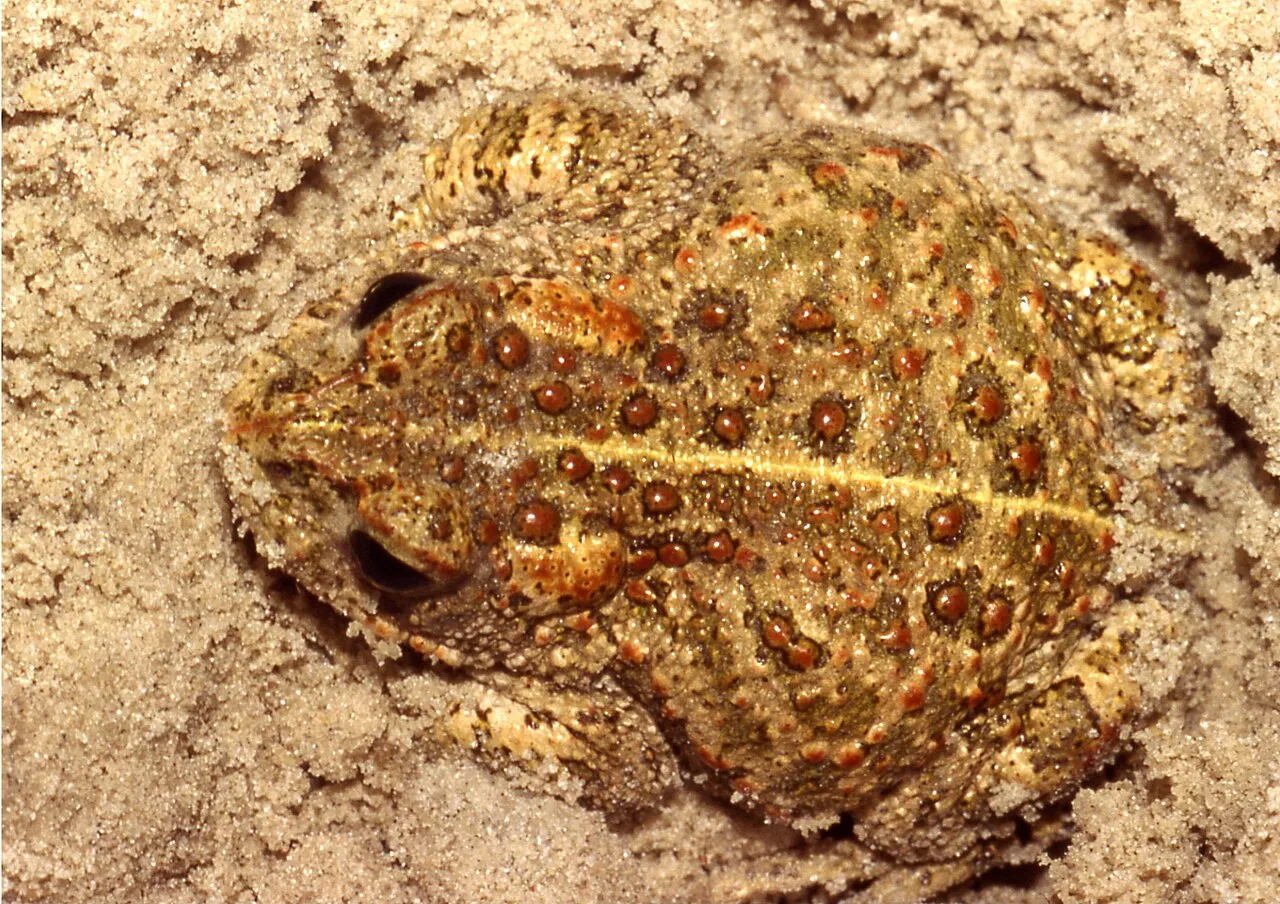
Epidalea calamita, the natterjack toad, is a small, warty toad of sandy dunes and lowland heaths, found across 17 European countries. It is best known for its very loud and distinctive mating call, amplified by a single vocal sac under the male’s chin, and for a short-legged, scurrying gait that sets it apart from other European toads.
Identification
Adults measure 60-70 mm in length, making them relatively small toads. The clearest field mark is a yellow line running down the middle of the back, paired with parotoid glands set close together on the shoulders; both features separate it at a glance from the common toad, Bufo bufo. Its legs are relatively short, which gives it a distinctive gait, contrasting with the hopping movement typical of other toads: rather than a springing hop, the natterjack moves in rapid, mouse-like runs, leaving distinctive tracks visible in loose sand. The male’s mating call is the other giveaway: a very loud and distinctive sound, amplified by the single vocal sac under his chin.
Habitat and range
The species occupies sandy and heathland areas of Europe, favouring open terrain with sparse vegetation, and breeds in shallow, warm pools with gently sloping bottoms and only sparse vegetation on the banks. In the UK it is now almost completely confined to coastal sites, among them the dune reserves of Hoylake, Ainsdale Sand Dunes, North Walney and Sandscale Haws in northwest England, with a separate Scottish population around the Solway Firth, including the reserve at Caerlaverock. In Wales the toad became extinct during the 20th century before being reintroduced under the Biodiversity Action Plan, with toads translocated from Merseyside to restock former strongholds in the sand dunes at Talacre. It is Ireland’s only native toad, restricted there to County Kerry — the Dingle Peninsula and Derrynane — with a further population introduced to a dune site in County Wexford. Elsewhere on the mainland, especially in southern Europe, it also occupies a range of inland habitats beyond the coast. Toads can move considerable distances in a single night, a trait that lets the species colonise new sites as suitable pools appear.
Behaviour and breeding
Natterjacks feed mainly on insects, especially beetles. Females lay their eggs as strings in the breeding pools. Breeding runs from the end of April through July, timed to the shallow, warm, gently sloping pools the species depends on; because these pools are temporary, tadpoles can die if the water dries before they finish developing, a risk the species compensates for by mating over an extended period each summer rather than in one synchronised burst. By September that year’s juveniles range from one to three months old as a result of that spread-out mating. Adults can live up to 15 years.
Conservation
The IUCN category is shown in the facts box above. Even so, the species has declined sharply in parts of its range: in the UK it is a protected amphibian under the Biodiversity Action Plan, the same programme under which the Welsh reintroduction described above took place. Ireland’s population is considered endangered, and a reintroduction project there had released some 6,000 toadlets into County Kerry as of July 2021. The main pressures are habitat loss from development, deterioration and loss of lowland heaths, coastal construction such as dykes and seawalls, and acidification of breeding pools from acid rain and other pollution.
Similar species
The natterjack’s closest look-alike is the common toad, Bufo bufo, which shares its warty skin and stocky build. The two are told apart in the field by the natterjack’s yellow vertebral stripe and parotoid glands set close together on the shoulders, features the common toad lacks, and by gait: the natterjack’s short legs give it a scurrying run rather than the hop typical of Bufo bufo. Voice is another giveaway where the two overlap, since only the natterjack produces the very loud, vocal-sac-amplified mating call described above. Habitat is a further clue: the natterjack keeps to open, sandy or heathland ground and breeds only in shallow pools with a very slightly sloping bottom and sparse bankside vegetation, while the common toad tolerates a much broader range of damp habitats and less specific pool shapes. Egg-laying reflects the same preference for shallow water: the natterjack deposits its eggs as strings in these temporary pools rather than in deeper, more permanent water.