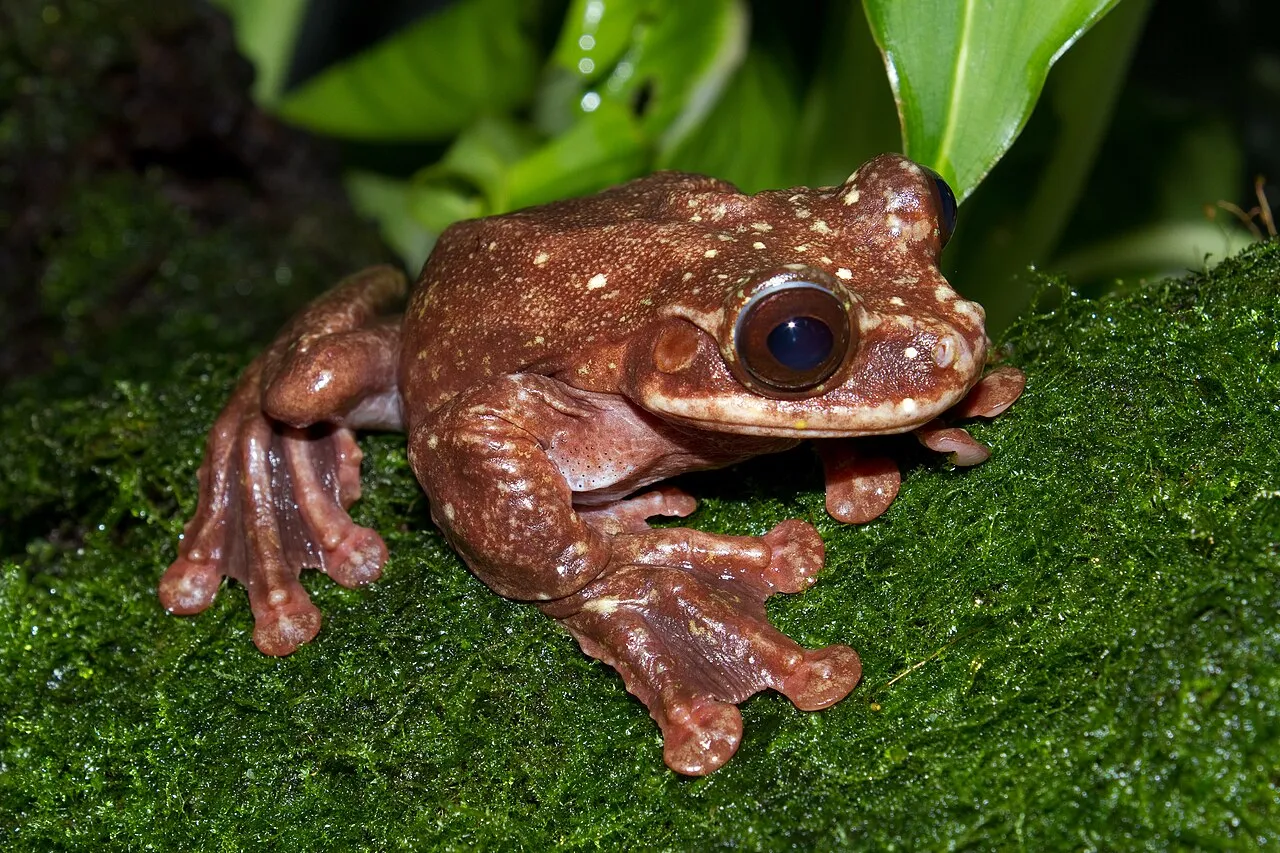
Ecnomiohyla rabborum, Rabb’s fringe-limbed treefrog, is a large treefrog in the family Hylidae, genus Ecnomiohyla. It is endemic to Panama, known only from cloud forests on the Pacific-facing slopes of the mountains above El Valle de Antón, between Coclé and Panamá provinces, at 900-1,150 m elevation, over a range of less than 100 km². That narrow range, combined with a disease outbreak described below, means the species is already considered gone from the wild.
Identification
Ecnomiohyla rabborum is one of the larger members of its genus. Males measure 62-97 mm snout-vent length and females 61-100 mm snout-vent length, overlapping ranges that make the sexes hard to tell apart by size alone. Adults are mottled brown above, with pale yellow rear thighs and white undersides speckled with irregular brown spots, a camouflage pattern suited to resting on bark and lichen-covered branches by day. The species carries the fully webbed hands and feet typical of its genus, a feature that sets the “fringe-limbed” treefrogs apart from most other hylids and gives Ecnomiohyla rabborum its common name. Tadpoles are far smaller, reaching only about 25-27 mm snout-vent length by the time their legs emerge, before they leave the water as miniature versions of the adult form.
Habitat and range
The species lives in the canopy of cloud forest, where it is nocturnal and arboreal, feeding on insects. Its fully webbed hands and feet let it glide between trees rather than descend to the forest floor, an adaptation that keeps it in the high canopy for most of its life and makes it difficult to survey even where it still occurred. Combined with the small known range above El Valle de Antón, this canopy-bound lifestyle is part of why the species was already rarely encountered before its decline.
Behaviour and breeding
Males are territorial, guarding water-filled tree holes used for breeding and mating with more than one female, so that a single hole can hold 60-200 eggs. Most strikingly, males were seen providing nutrition directly to their tadpoles, positioning themselves half-submerged in the tree hole while the tadpoles fed on skin shed from their backs, a form of parental care not documented in any other frog before this species. Calling males give a distinctive “warm up” of owl-like notes followed by a barking sound, in nightly bouts of one to two minutes that intensify around the full moon and peak during the March-May breeding season.
Conservation
Ecnomiohyla rabborum is listed as Critically Endangered and is widely treated as extinct, with no confirmed sighting in the wild since 2007. The primary cause is chytridiomycosis, a disease caused by the fungus Batrachochytrium dendrobatidis, which has driven the collapse of amphibian populations across the highlands of Panama and Central America more broadly. As the disease closed in, specimens were sent in 2006 to the El Valle Amphibian Conservation Centre, Zoo Atlanta and the Atlanta Botanical Garden in an attempt to breed an assurance population, but the captive frogs thrived without ever mating. The last wild record was a single calling male heard but not seen in 2007, the last captive female died in 2009, and the species’ final member, a male named Toughie, lived at the Atlanta Botanical Garden until his death on 26 September 2016. No wild population or assurance colony is known to survive the species today.
Similar species
Ecnomiohyla rabborum belongs to the fringe-limbed treefrogs, a small group of large hylids whose extensive webbing between the fingers and toes lets them glide short distances through the canopy, a feature shared across the genus Ecnomiohyla. The species was first collected as tadpoles in 2005 and formally described in 2008, after researcher Brian Kubicki recognised specimens initially misidentified as the related Ecnomiohyla fimbrimembra as a distinct new species, named for conservationists George and Mary Rabb. Its decline mirrors that of other high-elevation Panamanian frogs lost to chytridiomycosis around the same period, among them the Panamanian golden frog, Atelopus zeteki.