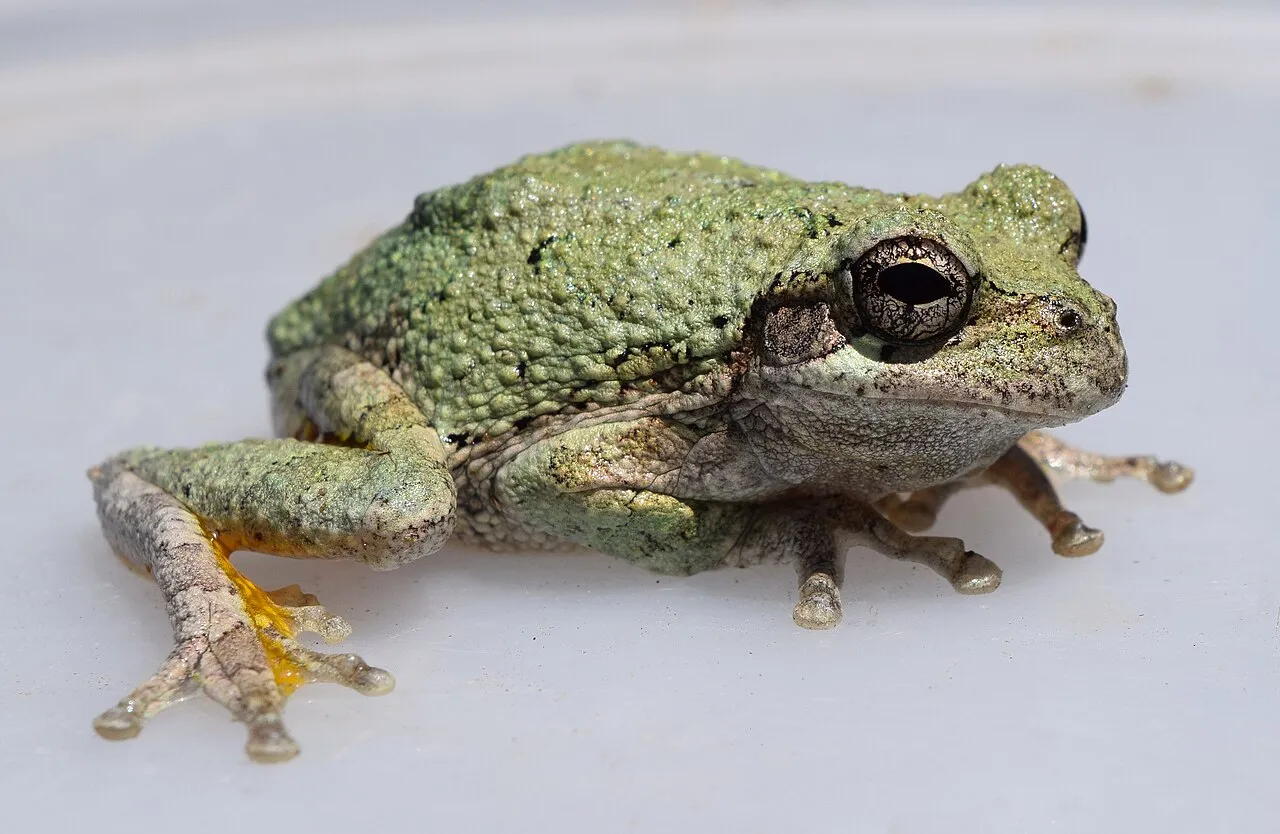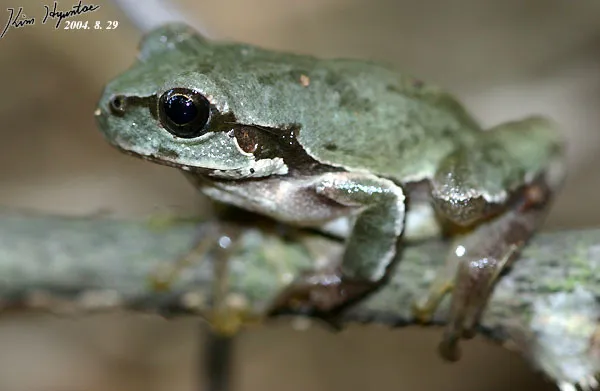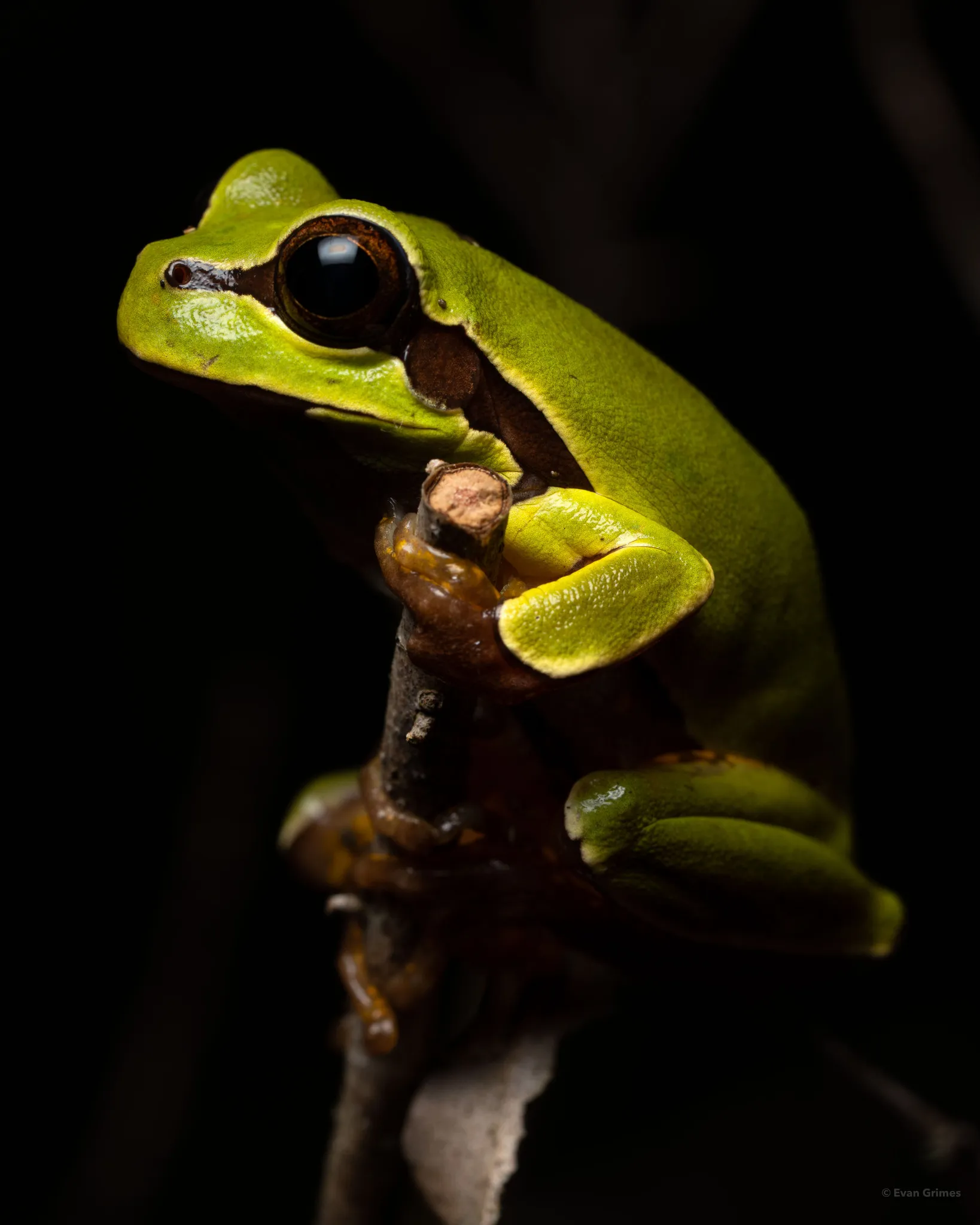
Dryophytes andersonii, the Pine Barrens treefrog, is a species of New World tree frog, first described by Baird in 1854 as Hyla andersonii. It is named for the New Jersey Pine Barrens2. The species lives in three disjunct populations3: the Pine Barrens of New Jersey, the Sandhills of southern North Carolina and northern South Carolina, and the Florida Panhandle. It is also the state frog of North Carolina1.
Identification
Adults measure about 2.8–4.3 cm1 from snout to vent. Males are smaller than females3.
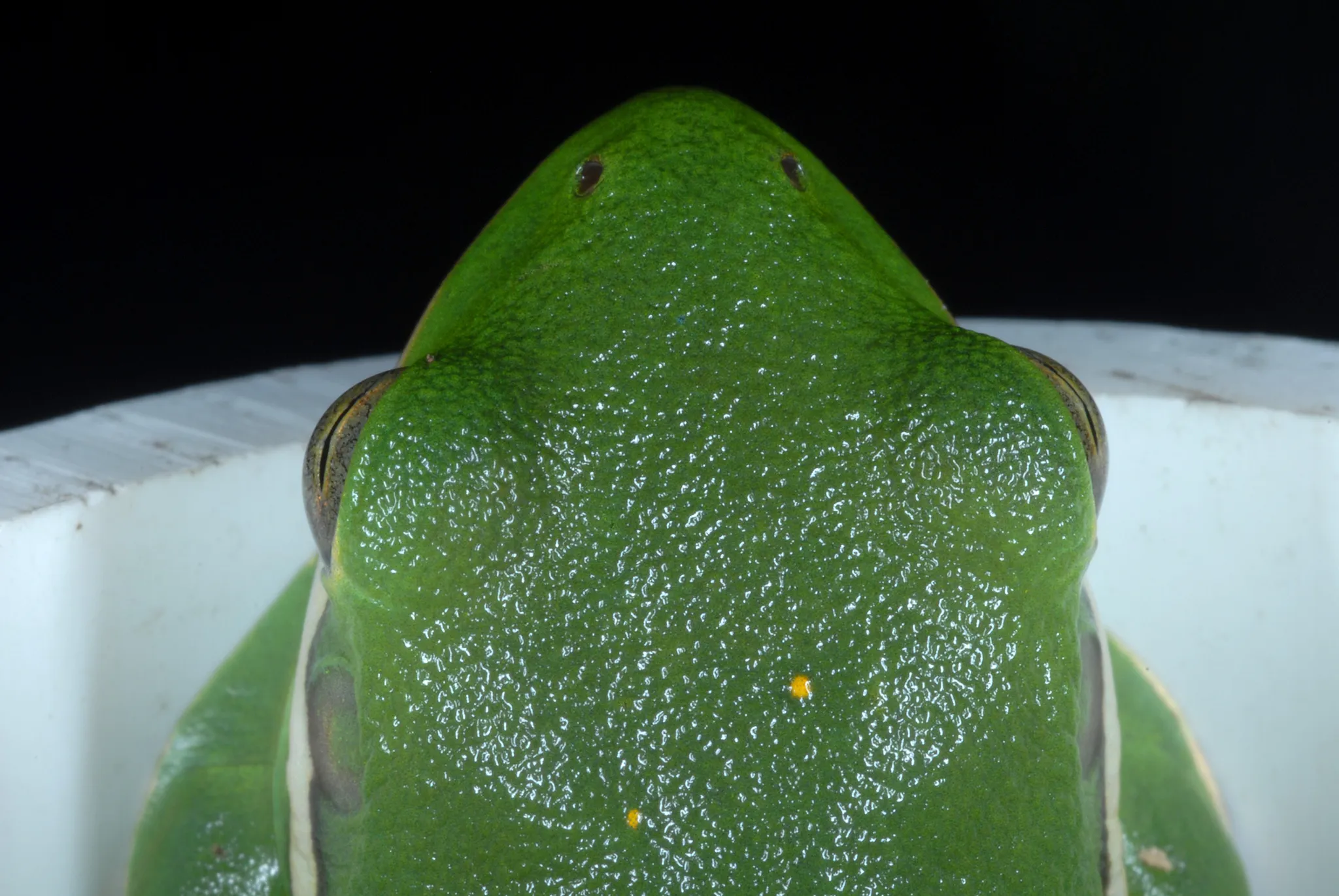
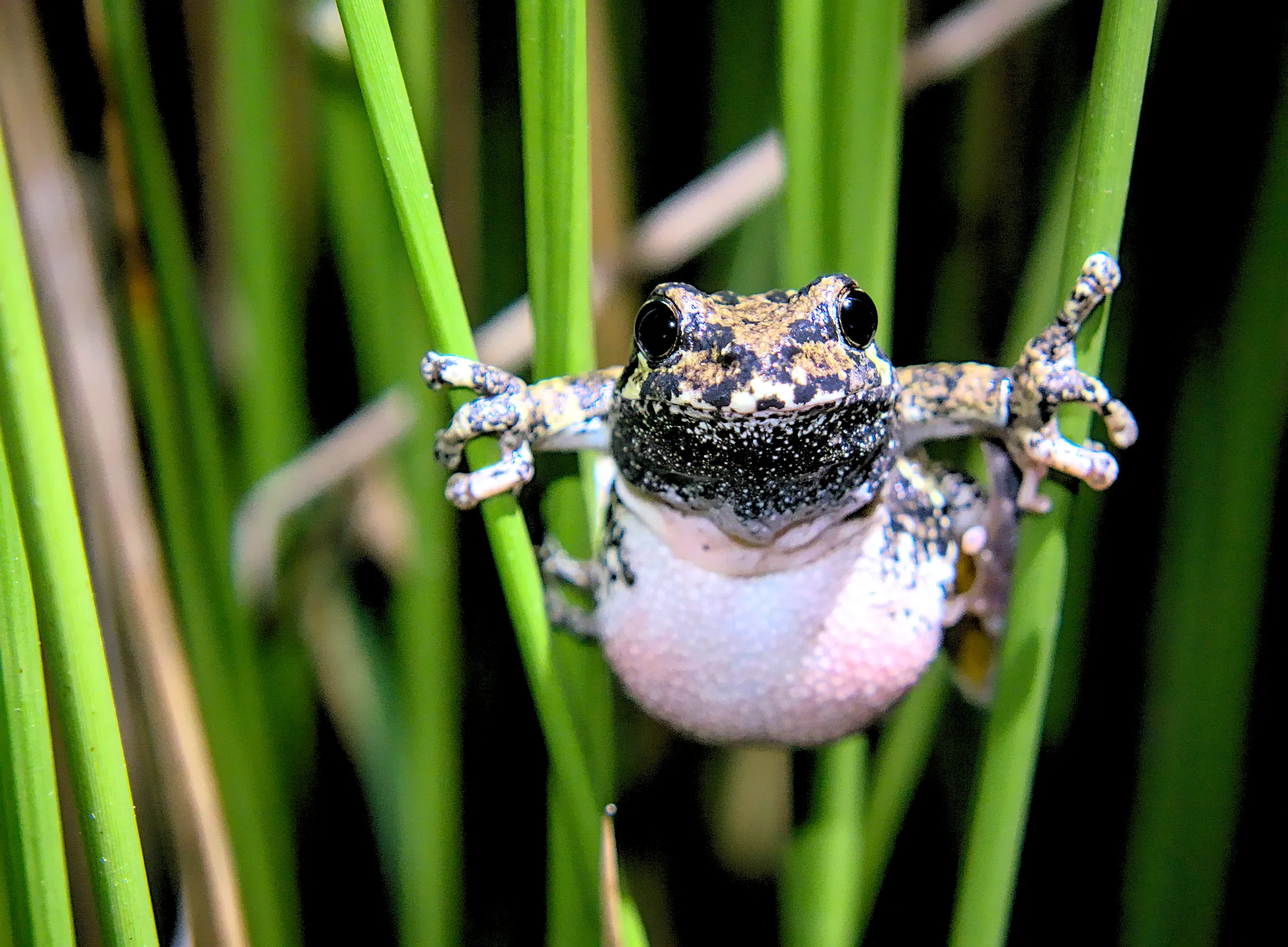
The frog is bright green with plum or lavender stripes bordered by white running along each side. Those stripes extend from the eyes down the sides, forming a mask-like look. Patches of orange sit on the inner femur and on the groin, hidden when the frog rests. The ventral surface is white. Females also carry white bordered patches of darker green on either side of the throat4, and their mouth is edged in white. The toes are partially webbed, while the fingers are free1. During the breeding season males show loose throat skin3.
The call is a nasal “waank, waank”3, lower in pitch and less far-carrying than the green treefrog’s. North Carolina’s wildlife agency hears it as a nasal “honk” or “quonk”, quickly repeated 10 to 20 times2 at infrequent intervals.
Habitat and range
The frog prefers acidic wetlands such as bogs, pocosins, Carolina Bays, and cypress swamps within pine-dominated uplands. Moist bottomland hardwood forests of the Coastal Plain may serve as marginal habitat3 but are less often occupied. It is found mainly near temporary still or slow waters dominated by shrubs or herbaceous plants; permanent waters that hold fish contain fewer and more isolated frogs1.
Its natural haunts include wet areas in pitch pine forests, intermittent streams and ponds, stream backwaters, Sphagnum bogs and Atlantic white cedar swamps. It also turns up beside cranberry bogs, vehicle ruts filled with water, flooded borrow pits, and ditches1. When pools dry up in the warmer summer months, adults live on the damp soil in dark shaded areas of raspberry bushes and other brush. Research suggests that low pH in natural ponds limits4 the species to acidic ponds.
The range lies mainly on the Atlantic Coastal Plain, split into three areas: the New Jersey Pine Barrens, the Sandhills of North and South Carolina, and the Florida panhandle and southern Alabama. The New Jersey populations are the largest recorded. One specimen is known from Richmond County, Georgia1, but no population is known to exist there. In North Carolina it has a limited distribution2, in the pine forests and sandhills of the south-central part of the state. Because its call is close to the green treefrog’s, its distribution may be under- or misreported3 where the two species overlap.
Behaviour and breeding
The species is primarily nocturnal and secretive3, seldom encountered outside the breeding season, and presumably spends its time in shrubs and trees2. Adults catch flies, small slugs, snails, beetles, butterflies or moths with the tongue, while tadpoles eat vegetation or algae in the water4.
It breeds in isolated, shallow, and acidic ponds, and the ideal pH for its eggs lies between 3.74 and 4.69. Calling begins at the end of April and can continue into August. In North Carolina, the state’s wildlife agency gives the calling season there as April to September. Males call from the ground or from shrubs or other vegetation2 near the water’s surface, and often fight one another over a female4. Adults stay within 70 metres of their breeding sites through the season, though individuals have been documented as far as 100 metres1 away.
Eggs are laid in May and June, each approximately 1.2–1.4 millimetres in diameter. Females attach eggs singly or in small clusters to Sphagnum moss, or lay them on the bottom of the wetland. After hatching, tadpoles complete metamorphosis in seven to 11 weeks2; eggs laid in May and June turn into frogs in July and August. Sexual maturity comes at 2 to 3 years old4. The late breeding season and the use of temporary water make it vulnerable to droughts and changes in water levels1.
Conservation
The IUCN lists Dryophytes andersonii as Least Concern5, having classed it as Near Threatened in 2004 and 2017 before downlisting it in 2023. The Florida population was listed as endangered by the US Fish and Wildlife Service between 1977 and 19831, when more populations were found in Florida.
The frog is not federally listed, but South Carolina lists it as a species in need of management or threatened3. New Jersey lists it as Threatened1. North Carolina’s wildlife agency gives it as state-listed as Threatened and Significantly Rare in the North Carolina Natural Heritage Program; there populations are thought to be declining due to habitat destruction and degradation2.
A restricted range and specialized habitat needs leave it vulnerable to habitat loss and degradation3, particularly wetland drainage and alteration of pine upland ecosystems. It is rarely encountered in sites where nonnative amphibians, such as bullfrogs, and nonnative fish are present, which suggests it is a poor competitor. Wetland analyses for 2001 to 20161 show woody wetlands increasing in New Jersey and Florida within the range, but declining in North Carolina and South Carolina.
Similar species
- Green treefrog, Dryophytes cinereus: the Pine Barrens treefrog has a white-bordered lavender stripe on each side of the body1, where D. cinereus has only a white stripe. The green treefrog’s side stripe is white, yellow, or occasionally iridescent and may be absent in some individuals, and its call is a loud, nasal “reeenk, reeenk, reeenk”6.