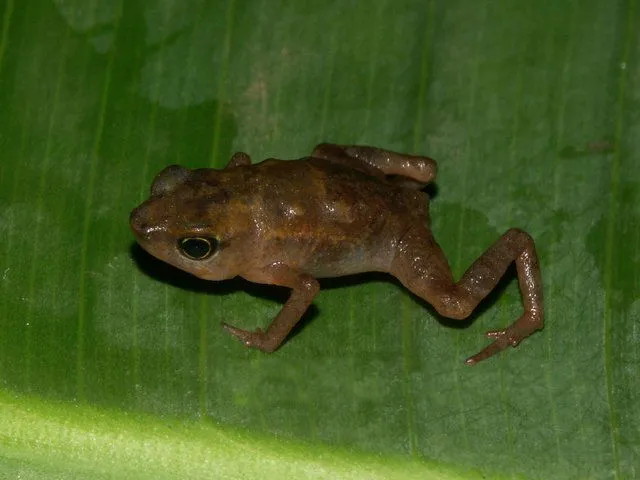
The four-digit toad, Didynamipus sjostedti, is a minute bufonid confined to a small corner of West Africa. It is the only species in the genus Didynamipus, found in three West African areas: Bioko island (Equatorial Guinea), southwestern Cameroon, and southeastern Nigeria, a patchy, forest-bound distribution that leaves it with no close relative to be confused with.
Identification
The species lives up to its common name as one of the smallest toads known: males reach about 16 mm snout-vent length, females about 19 mm, sizes that put a fully grown adult at little more than the width of a thumbnail. The facts box carries these figures alongside its Vulnerable conservation status. Its genus name points to another distinguishing trait, a reduced number of functional digits compared with most toads, which gives the species its English name.
Habitat and range
D. sjostedti lives in forest edges and clearings in moist forest at elevations of about 200-1,200 m, living both in leaf litter and perched on low vegetation; shows some tolerance of secondary forest and farmland. That tolerance of secondary growth means the toad is not confined to pristine old-growth stands, though its overall range remains narrow and split across the three areas described above.
Behaviour and breeding
The four-digit toad breeds terrestrially with direct development (eggs hatch directly into froglets, with no free-living tadpole stage), skipping the aquatic tadpole stage typical of most frogs and toads. Field observations have found individuals in mixed-sex, mixed-age aggregations near terrestrial egg masses, suggesting a degree of social clustering around breeding sites rather than the dispersed, pond-based breeding common in larger toads.
Conservation
The species’ facts box carries its current IUCN Red List category, Vulnerable. The main pressure on the four-digit toad is habitat loss from agricultural expansion, though part of its range lies within protected areas, which offers some buffer against the clearance affecting the unprotected parts of its small West African range.
Similar species
Didynamipus is a monotypic genus: D. sjostedti is the only species it contains, so it has no congener to be mistaken for. Its extremely small size and reduced digit count set it apart from the other toads sharing its West African forest range.