- Exploring the Hidden World of Centrolene medemi, Colombia's Enigmatic Glass Frog
- A Taxonomic Tale: Understanding Centrolene medemi’s Lineage
- Natural Habitat: A Symphony of Moisture and Shadows
- Physical Characteristics: The Living Glass of Colombian Canopies
- Behavioral Mysteries: Insights into Life Among the Leaves
- Ecological Roles: Guardians of Stream Ecosystems
- The Fragility of Glass: Facing Threats and Embracing Conservation
- Cultural and Scientific Significance: More Than Merely a Frog
- A Call to Conservation: Preserving Centrolene medemi’s Future
Exploring the Hidden World of Centrolene medemi, Colombia’s Enigmatic Glass Frog#
In the dense, misty forests of Colombia, enveloped in verdant moss and softly illuminated by shafts of sunlight filtering through towering trees, lives a small creature almost too magical to be true. Its body, translucent and emerald-hued, seems carved from delicate glass—revealing beneath its skin the delicate network of veins and beating heart. Known to science as Centrolene medemi, this enchanting glass frog is not merely an object of visual wonder, but also a vital part of South America’s fragile ecosystems. Yet, despite its allure and ecological importance, much remains unknown about this elusive species, casting it as one of nature’s captivating enigmas, compelling scientists and conservationists alike.
Centrolene medemi, a member of the fascinating family Centrolenidae, symbolizes both the delicate balance of biodiversity and the urgency to learn and protect what humanity has yet to understand fully. In this narrative exploration, we journey deep into the realm of this remarkable amphibian, unraveling its mysteries and uncovering the urgent call for conservation.
A Taxonomic Tale: Understanding Centrolene medemi’s Lineage#
Classifying and naming life forms has always been a meticulous yet rewarding undertaking, and glass frogs have been no exception. Centrolene medemi belongs to the Centrolenidae family, a family famed worldwide for their translucent skin and arboreal lifestyle. The family encompasses numerous genera and species, grouped together precisely because of their exquisite transparency and certain reproductive and ecological behaviors.
Centrolene medemi sits within the genus Centrolene, whose members are known for their robust bodies, uniquely patterned limb bones, and specialized habits of laying eggs on vegetation over streams. As such, our frog maintains close relations with species like Centrolene buckleyi and Centrolene geckoideum, sharing similar preferences regarding interwoven subtropical forest ecosystems and clear running streams beneath a dense canopy.
Natural Habitat: A Symphony of Moisture and Shadows#
Journeying into northwestern Colombia’s lush subtropical forests, one finds the ideal refuge of Centrolene medemi. Unlike many amphibians dwelling on forest floors, glass frogs choose a more idyllic, secluded habitat—leafy perches above pristine, flowing streams. Their homes, predominantly located within moderate to high altitudes from around 500 to 1500 meters above sea level, are shrouded in mist and nestled among lush vegetation that thrives in humid conditions.
The cool, persistent moisture of these forests provides essential hydration to their delicate translucent skin, enabling efficient respiration and serving as a primary line of defense against desiccation and pathogens. Such precise environmental conditions restrict the occurrence of Centrolene medemi to geographically narrow areas, exemplifying their high adaptability yet profound sensitivity to environmental shifts. Consequently, they make exceptional bioindicator species, alerting ecologists subtly yet clearly to disturbances in their delicate habitats.
Physical Characteristics: The Living Glass of Colombian Canopies#
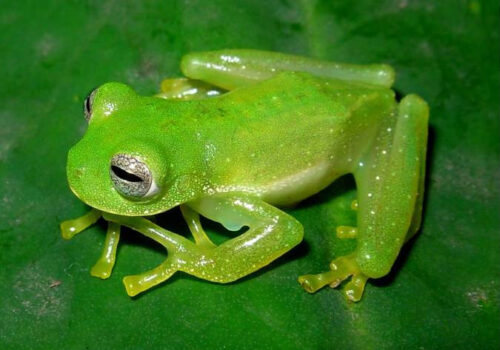
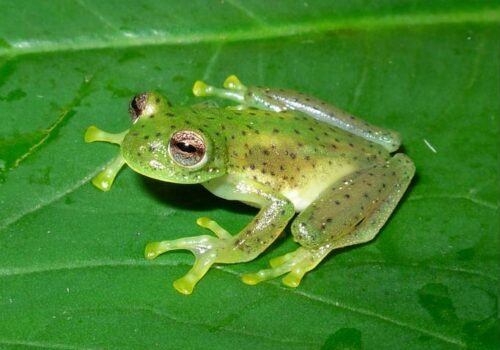
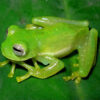
The first encounter with a Centrolene medemi is often a mixture of fascination and disbelief. Measuring only a mere 2 to 3 centimeters in length, these frogs represent nature’s testament to evolutionary adaptability. Their translucent skin, a hallmark of the glass frog family, allows us to glance inside, revealing inner organs, including the vividly beating heart—a visceral reminder of the fragility of life, symbolically mirrored by their threatened habitats.
Their subtle lime-green coloration, specked with nuanced white or pale yellow dots, serves a crucial role. By day, harmonizing perfectly with rain-drenched leaves, they achieve an exquisite camouflage, remaining virtually invisible even to the most attentive predators and prey alike. Their eyes, bold and forward-facing, grant them precise binocular vision, essential for judging distances as they leap delicately from leaf to leaf.
These captivating physical traits not only allure human observers but highlight adaptive strategies—every element of their appearance honed over eons to suit their arboreal habits.
Behavioral Mysteries: Insights into Life Among the Leaves#
Nocturnal Serenades: The Art of Courtship Calls#
As twilight descends upon Colombian forests, a secret chorus emerges—the male Centrolene medеми engaging in nightly serenades. Roosting atop gently swaying branches, these diminutive suitors call out with rhythmic, melodic trills, songs created not only to claim territories but also to resonate through humid darkness, guiding potential mates through dense foliage toward their perch. Each male carefully selects calling sites above freshwater streams, as these serve dual purposes: attracting females and providing safe stampeding grounds for future offspring.
An Intimate Affair: Unique Reproductive Strategies#
The life cycle of the Centrolene medemi encapsulates extraordinary evolutionary innovation. Females seek out calling males, guided by their pulsating vocalizations, and upon selecting a suitable mate, deposit a clutch of eggs on leaves positioned strategically over water. This remarkable strategy ensures their eggs’ safety from aquatic predators and accidental inundation.
After laying the eggs, typically numbering between twenty and thirty carefully positioned gelatinous orbs, the males demonstrate a more profound role, displaying uncharacteristic parental behaviors. They vigilantly guard the clutch, often remaining in proximity for days, warding off predators and ensuring adequate moisture through strategic resting positions. Tadpoles hatch weeks later, instinctively dropping into the stream below, where they continue life underwater until undergoing metamorphosis into adults, completing an intricate cycle steeped in natural ingenuity.
Ecological Roles: Guardians of Stream Ecosystems#
The ecological niche occupied by Centrolene medemi illustrates a finely honed natural balance. As predators, they maintain insect populations, particularly preying upon mosquitoes, flies, and ants. This ecological contribution provides human-beneficial pest control and helps maintain forest health by aiding in control of herbivorous insect populations.
Meanwhile, as prey, they sustain larger fauna like birds, spiders, and snakes, rendering them a fundamental link within complex food webs. By their delicate presence—and alarming absence— researchers can quickly assess the integrity of ecosystems in which these frogs dwell, underscoring their role as bioindicators vital to scientific studies on forest health, ecosystems stability, and climate implications.
The Fragility of Glass: Facing Threats and Embracing Conservation#
Regrettably, the glasslike fragility of Centrolene medemi echoes a haunting similarity to their conservation status. Listed as Vulnerable by the International Union for Conservation of Nature (IUCN), these frogs face mounting threats from rapidly shrinking habitats, primarily due to widespread deforestation, agricultural expansion, logging, and human encroachment into previously untouched forests.
Moreover, diseases such as chytridiomycosis increasingly threaten amphibian populations globally, and climate change alters rainfall and temperature patterns, bringing unforeseen challenges to already-sensitive ecosystems inhabited by Centrolene medemi. Consequently, conservation efforts become paramount, demanding initiatives ranging from habitat protection, sustainable land-use community education, and stringent legal actions preserving Colombia’s biodiversity.
Cultural and Scientific Significance: More Than Merely a Frog#
Colombian communities have historically revered diverse amphibian species within rich folklore and traditions, attributing symbolic meanings or mystical attributes. Glass frogs, with their enchanting appearance, embody purity, transparency, and ecological vitality, symbolizing the essential interconnectedness between humans and nature.
Scientifically, these frogs offer critical insights into biological processes, environmental health indicators, evolutionary mechanics, and reproductive strategies. Their presence and health form part of broader narratives surrounding biodiversity, climate action, and conservation science, echoing beyond biology into discussions of policy, educator curricula, and public engagement with environmental stewardship.
A Call to Conservation: Preserving Centrolene medemi’s Future#
Ultimately, exploring the delicate existence of Centrolene medemi demands acknowledgment and respect for the fragility of ecosystems. Education and awareness represent potent tools toward empowering action—fresh voices aligned in promoting sustainable practices, habitat protection, and advocacy for biodiversity conservation.
In immersing ourselves into the lush Colombia forests and peering through the translucent skin into their mesmerized hearts, we cannot help but empathize: the shimmering, ethereal frog surviving quietly yet determinedly within Colombia’s canopy offers humanity a profound lesson in resilience, adaptability, and vulnerability. It is a lesson we would genuinely heed, for in protecting these fragile denizens of our natural world, we undeniably protect our shared home.