- Centrolene quindianum: Discovering Colombia's Enchanting Glass Frog
- Taxonomy and Classification
- Natural Habitat: A Life Dreamed Amidst Cloud Forests
- A Window Beneath the Skin: The Physical Remarkability of the Glass Frog
- Life on a Leaf: Behaviors and Life Cycle of Centrolene quindianum
- An Essential Link: Ecological Role of Centrolene quindianum
- A Fragile Future: Threats and Conservation Efforts
- From Forest Folklore to Laboratory Insight
- A Call to Wonder and Stewardship
Centrolene quindianum: Discovering Colombia’s Enchanting Glass Frog#
Hidden within the misty, verdant forests of Colombia’s mountainous regions lives a creature unlike most others—a tiny amphibian whose delicate, translucent body offers a remarkable glimpse into the intricate workings of life itself. The Quindío glass frog, scientifically known as Centrolene quindianum, is a captivating member of the Centrolenidae family, renowned for its transparent skin which reveals its delicate internal organs. This intriguing feature has rightfully earned glass frogs widespread admiration among biologists, naturalists, and curious observers. Far more than a novelty, Centrolene quindianum plays a critical ecological role, captivating audiences with its appearance and revealing deep truths about environmental health. Yet, despite its undeniable charm, this little frog remains relatively understudied, its future threatened by human-driven habitat destruction and climate change. Step gently into its rainforest domain, and discover the fascinating secrets and profound ecological importance of Colombia’s mesmerizing glass frog.
Taxonomy and Classification#
Centrolene quindianum, commonly termed the Quindío glass frog, belongs within the family Centrolenidae—a distinctive group of amphibians often collectively called glass frogs due to their unique translucent abdominal skin. This family contains over 150 species, typically found throughout Central and South America. Within the larger classification, Centrolene quindianum belongs to the genus Centrolene, characterized by its agile and restricted distribution, primarily in montane cloud forests.
Described scientifically in 1985 by herpetologists Ruiz-Carranza and Lynch, the species earned its name from the region it inhabits, the lush department of Quindío in Colombia. Its close relatives within the genus, such as Centrolene buckleyi and Centrolene geckoideum, share similar physical traits and ecological adaptations, yet each species boasts distinct behaviors and specific habitat preferences.
Natural Habitat: A Life Dreamed Amidst Cloud Forests#
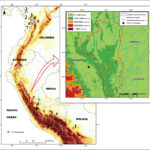
Picture mist-cloaked mountains, lush moss-draped canopies, and the gentle trickle of forest streams carving their way through every crevice and valley—this is the realm of the Quindío glass frog. Endemic to the high-altitude cloud forests along Colombia’s Central Andes, Centrolene quindianum flourishes at elevations ranging from roughly 1,800 to 2,400 meters above sea level. Remote and undisturbed, these forests offer a perfect haven where stable temperature, high humidity, and pristine freshwater streams abound.
Within this extraordinary world, the glass frog leads a primarily arboreal life, rarely descending from the foliage layer. For the Quindío glass frog, dense broadleaf vegetation near flowing streams provides the ideal refuge. Nightfall prompts them to venture closer to the water, as the cool darkness encourages feeding and breeding activities. The presence and abundance of these frogs often indicate healthy, well-preserved forest habitats—an invaluable asset as humanity looks toward sustainable conservation strategies.
A Window Beneath the Skin: The Physical Remarkability of the Glass Frog#
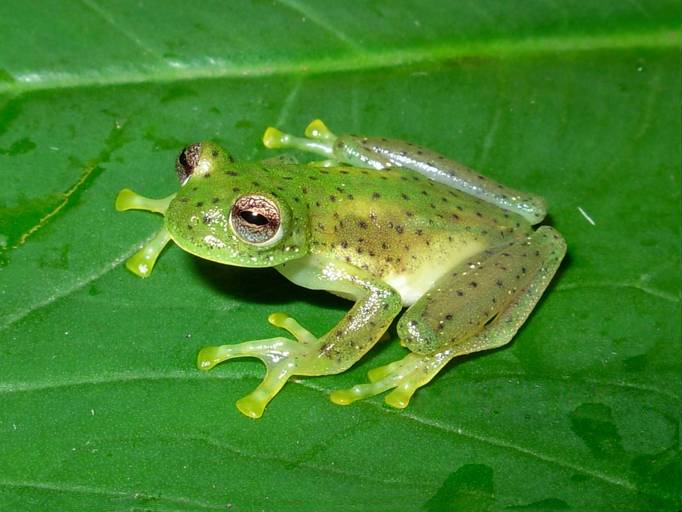
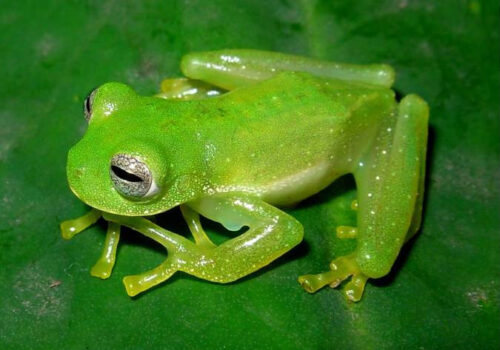
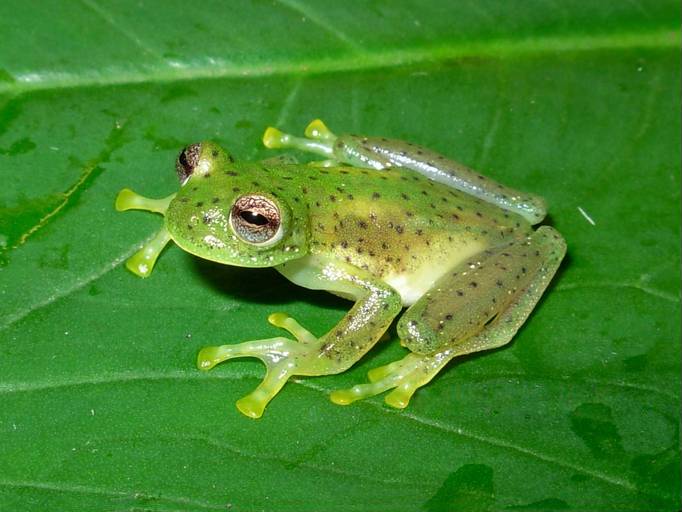
One of nature’s more mesmerizing masterpieces, the Quindío glass frog’s delicate body measures no more than two to three centimeters from snout to vent—a striking blend of fragility and natural elegance. Its coloring is a vibrant mixture of lime and emerald greens, dotted with subtle patterning that resembles leaves wet with dew. But it’s their uniquely transparent abdomen that captures our imagination. Through their translucent skin, observers can behold the rhythmic pulse of their tiny hearts, delicate arteries brimming with blood, and other internal organs functioning harmoniously in full view.
This astonishing transparency is not merely beautiful—it serves as ingenious camouflage. Perched gently on the underside of leaves, sunlight filtering above illuminates the frog in shades indistinguishable from its surrounding vegetation, hiding it effectively from predators peering upward from below. Additionally, slender limbs tipped with expanded toe pads and small suction disks enable confident movements through the slippery and wet foliage. Silver and gold-shaded eyes, large relative to their tiny bodies, provide the acuity needed to hunt prey and evade threats in the dim night.
Life on a Leaf: Behaviors and Life Cycle of Centrolene quindianum#
Nighttime, cloaked in darkness and amplified by the calming hum of nocturnal insects, is when the Quindío glass frog transforms from passive observer into active participant of their ecosystem. Adult frogs meticulously hunt small insects and arthropods such as ants, mites, and flies, often waiting motionlessly before launching sudden, accurate strikes to secure their meals. Their predatory habits contribute significantly to controlling insect populations, maintaining ecosystem balance.
Fascinating Breeding Rituals#
But perhaps more captivating than their hunting prowess are their enchanting breeding rituals. In the rainy seasons when moisture saturates every surface, males perch strategically on vigorous leaves overhanging forest streams. Under moonlit skies, they emit soft, tinkling calls—a melodic chorus echoing through the forest—that aim to both ward off competitors and attract desirable mates. Once charmed by a male’s serenade, a female joins him in a sensitive courtship dance, laying clusters of delicate, gelatinous eggs strategically on the leaf undersides, suspended dangerously close to flowing water.
A Parent’s Gentle Watch#
Most remarkably, male glass frogs exhibit dedicated paternal care, guarding their clutch fiercely against predators and parasites. They meticulously cover their precious offspring in moisture to thwart desiccation, remaining vigilant until the emergence of their tadpoles. As the offspring mature, tadpoles wriggle free from their leaf-bound nurseries, tumbling gently into awaiting waters below—thus beginning their ephemeral yet enthralling aquatic life stage, completing a critical cycle of renewal and regeneration in their small, mist-laden ecosystem.
An Essential Link: Ecological Role of Centrolene quindianum#
The Quindío glass frog is far more than simply a captivating spectacle—it is a keystone species, fundamentally influencing the biodiversity and health of its native habitats. As predator, prey, and sentinel, it occupies a specialized niche within its delicate mountain ecosystem. Its predation check on insect populations supports the delicate balance of rainforest life cycles, while concurrently, as prey, it provides sustenance for birds, snakes, and larger amphibians, thereby maintaining intricate ecological interactions and relationships.
Moreover, glass frogs are excellent environmental indicators. Due to their permeable skin and dependence upon pristine waters and forests, their presence and population health effectively provide clues to scientists about overall habitat conditions and ecological integrity.
A Fragile Future: Threats and Conservation Efforts#
Despite their ecological importance and charm, populations of Centrolene quindianum face mounting threats that endanger their survival. Habitat loss and degradation, driven by deforestation, agriculture expansion, livestock grazing, and logging, represent some of the gravest threats. Additionally, climate change threatens to disrupt temperature and rainfall patterns crucial to their breeding ecology, while diseases such as chytridiomycosis further exacerbate conservation concerns.
The International Union for Conservation of Nature (IUCN) currently lists Centrolene quindianum as “Endangered,” reflecting the urgency and imperativeness of targeted conservation initiatives. Protective legislation, establishment of preserves, and sustainable land-use practices all hold potential in safeguarding the future existence of this breathtaking species. Greater education, scientific research, and community involvement are essential to preserving these frogs and their invaluable natural habitats.
From Forest Folklore to Laboratory Insight#
Beyond biological intrigue, glass frogs hold symbolic meaning in many regional cultures in South America, symbolizing rainforest vitality, renewal, and life’s intrinsic interconnectedness. Scientifically, the glass frog’s unusual anatomy offers valuable biological insights, possibly influencing medical research, bioengineered materials, and environmental health markers. Its transparency inspires inquiry and wonder, underscoring vital interconnections between humans, wildlife, and ecosystems.
A Call to Wonder and Stewardship#
Centrolene quindianum represents an exquisite balance between vulnerability and resilience, revealing nature’s fragility and fortitude simultaneously. As we delight in the discovery of this wondrous species, we must acknowledge our responsibility to protect its existence and habitat for future generations. Let this tiny frog’s translucent beauty inspire curiosity, conservation action, and an unwavering commitment to ensuring life thrives within Colombia’s extraordinary cloud forests.