Centrolene antioquiense: Illuminating the Hidden World of Antioquia’s Glass Frog#
Deep within the lush, misty forests of Colombia’s Antioquia region dwells one of nature’s most enchanting amphibians—the Antioquia Glass Frog, scientifically known as Centrolene antioquiense. Like tiny, living sculptures crafted from delicate green glass, these frogs have captured the imagination of naturalists and wildlife enthusiasts worldwide, heralded not merely for their striking appearance but also for the invaluable ecological role they play amid mountainous rainforest streams. Transparent bellies, emerald hues, and eyes brimming with intrigue—Centrolene antioquiense offers a rare glimpse into the delicate fragility and remarkable resilience of tropical biodiversity.
Taxonomy and Classification#
The Antioquia Glass Frog belongs to the family Centrolenidae, a remarkable lineage of frogs distinguished by their translucent skin. Within this family, it resides in the genus Centrolene, home to a diverse assembly of glass frog species known for their arboreal nature and intimate reliance on pristine flowing waters. Officially described by researchers in the early 1990s, Centrolene antioquiense quickly distinguished itself through unique molecular markers, vocalizations, and subtle morphological characteristics.
In the world of herpetology, delineating species within this family requires meticulous attention to anatomy, genetics, and behavior due to their cryptic appearance and similar ecological niches. Although initially recognized through subtle physical and acoustic differences, modern genetic analyses have reinforced Centrolene antioquiense’s classification, reaffirming its distinct identity amidst the closely related Andean glass frogs.
Natural Habitat#
Native exclusively to the cloud forests of Colombia’s Antioquia department, Centrolene antioquiense flourishes in dense, high-elevation rainforests between 1,500 and 2,500 meters above sea level. Here, mist drapes the tree canopy in perpetual moisture, and crystalline streams trickle down moss-laden trunks and rocks—a world perpetually cloaked in green and perpetually kissed by moisture.
Primarily arboreal, the Antioquia Glass Frog frequents branches and broad leaves that overhang swift, clear, well-oxygenated streams. Its life revolves around these tiny waterways, whose health and purity directly influence the frog’s survival. Within their secluded microhabitat, these glass frogs take advantage of excellent camouflage; blending seamlessly into dew-dappled leaves, they remain hidden from predators and curious eyes alike. Their presence often indicates an ecosystem in delicate yet balanced health, as they succumb readily when waters degrade or forests retreat. In this way, glass frogs act as vital sentinels—guardians whose disappearance can signal serious ecological disturbance.
Physical Characteristics#
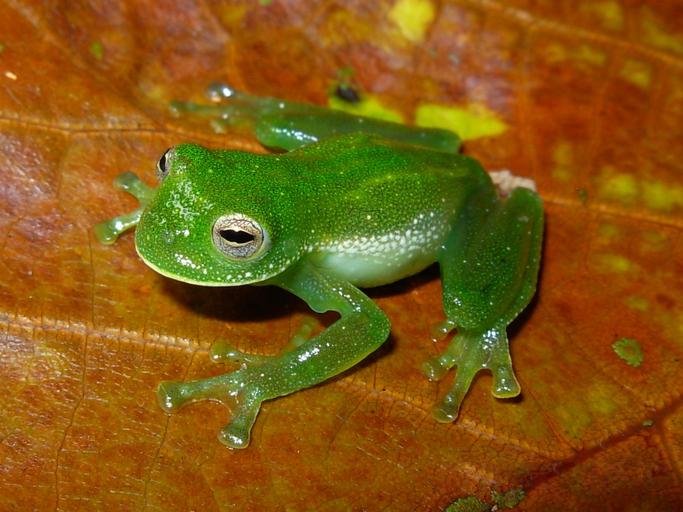
The delicate beauty of Centrolene antioquiense immediately captivates observers. Adults measure scarcely more than 25 millimeters, their dainty stature only amplifying their fragility and charm. The name “glass frog” aptly illustrates their unique feature: semi-transparent undersides that reveal internal organs, bones, and veins—a mesmerizing biological display that offers insights into amphibian anatomy unlike any other species.
The dorsal side scintillates in gentle shades of emerald green, blending seamlessly with the vibrant foliage. Tiny pale-green or cream-colored dots may speckle their backs, mimicking droplets of moisture and dappled sunlight. This remarkable shade of green, aided by translucent skin, serves a primary purpose: impeccable camouflage. When resting, the Antioquia Glass Frog tucks its limbs beneath its slender frame, mimicking the motionless tranquility of a leaf glistening in morning dew.
Huge, expressive eyes protrude delicately above their heads, strikingly golden or bronze-colored, and adapted for impeccable nocturnal vision. A subtle pattern of veins and transparent tissues within their iris enhances their mysterious allure, creating an almost ethereal appearance under low moonlight or gentle rainforest showers. Such meticulous evolutionary adaptations ensure their secretive survival amid vibrant forests teeming with predators.
Behavior and Life Cycle#
Nocturnal Activities and Diet#
At dusk, the elusive Antioquia Glass Frog emerges from daytime concealment to hunt. Using precise leaps and ambush tactics, this insectivorous amphibian preys on small invertebrates, including moths, flies, ants, and tiny beetles populating the forest canopy. Endowed with keen eyesight and lightning-fast tongues, they showcase impressive hunting efficiency despite their diminutive size.
Mating Rituals and Parental Care#
Reproduction unfolds amidst gentle nighttime symphonies, with males vocalizing characteristic melodic calls to attract receptive females. Male glass frogs select leaves hanging strategically above swiftly flowing streams, forming communal breeding sites—areas bustling with the quiet drama of courtship and competition. Successful courtship commences with delicate physical initiation, elaborate vocalizations, and assertive postures by the male.
Upon pairing, the female deposits clusters of eggs securely along leaf undersides or directly suspended over water. Remarkably, male Antioquia Glass Frogs engage in devoted parental behaviors, guarding egg clusters diligently against fungal infections, parasites, or predators like snakes and wasps. Vigilantly nocturnal, these proud fathers periodically hydrate eggs through gentle, rhythmic kicking motions—an extraordinary feat of care and protection in a diminutive species that underscores their evolutionary sophistication.
Once eggs hatch—often triggered by rainfall—tiny tadpoles plunge into the awaiting oxygen-rich flowing streams below. Rapid adaptation to aquatic life occurs instantly, where canyon-like streams shelter them as they navigate towards metamorphosis, eventually emerging as perfect miniatures of their transparent parents.
Ecological Role#
Though small and cryptic, the Antioquia Glass Frog maintains immense ecological significance. As insectivores, their diet regulates populations of insects and arthropods, notably species that may otherwise proliferate and impact forest health or human agriculture. Simultaneously, glass frogs represent an essential prey source, readily available to snakes, birds, and small mammals, reflecting their intricate integration within intricate food webs.
Perhaps their most significant ecological value, however, lies in their status as indicator species. Highly sensitive to environmental changes like pollutants, deforestation, climate shifts, and water contamination, their presence—or absence—delivers crucial information to conservationists and policy-makers alike. Maintaining healthy populations of these fragile amphibians therefore directly mirrors broader environmental health and the condition of Andean forest habitats.
Threats and Conservation Status#
Globally assessed by the International Union for Conservation of Nature (IUCN), Centrolene antioquiense currently maintains a precarious status of “Vulnerable.” The Antioquia region has experienced rapid deforestation, habitat fragmentation, and agriculture-driven land-use changes in recent decades. Pollution from agricultural runoff and industrial development has also compromised water quality within critical habitat streams, exacerbating population declines.
Climate change further complicates matters, altering precipitation patterns, threatening pristine cloud forest ecosystems, and transforming frogs’ delicate breeding habitats. Disease, particularly chytridiomycosis—caused by the lethal fungus Batrachochytrium dendrobatidis—poses yet another grave risk, having devastated amphibian populations globally.
Conservation groups and volunteers now strive to safeguard this species by creating reserves, educating locals on land-use practices that preserve forests, and conducting ongoing ecological research. These combined actions, though challenging, remain crucial for preventing extinction and ensuring these captivating creatures survive for future generations to marvel at.
Cultural and Scientific Significance#
In local Colombian folklore, glass frogs hold symbolic significance, representing purity, transparency, and delicate environmental harmony. Increasingly, the species has drawn attention in global scientific circles for unique physiological characteristics, especially its transparent tissues, providing insights into studies of genetics, evolutionary biology, and amphibian conservation strategies. Glass frogs, with their unique translucent bodies, offer invaluable clues about evolutionary adaptations, anatomy, and ecological processes unexplored in more opaque species.
Conclusion#
The Antioquia Glass Frog—Centrolene antioquiense—represents more than just an ecological wonder; it’s an emblem of the fragility and interconnectedness of life, highlighting the urgent global conversation around biodiversity conservation. Protecting these gems of the forest reaffirms humanity’s responsibility towards nature, reminding us that even the smallest amphibian warrants our deepest care and attention.
Whether you are inspired by wildlife’s inherent beauty or the profound lessons nature imparts, join the global effort to protect this extraordinary frog, ensuring that future generations can continue to admire the radiant marvel that is the Antioquia Glass Frog.