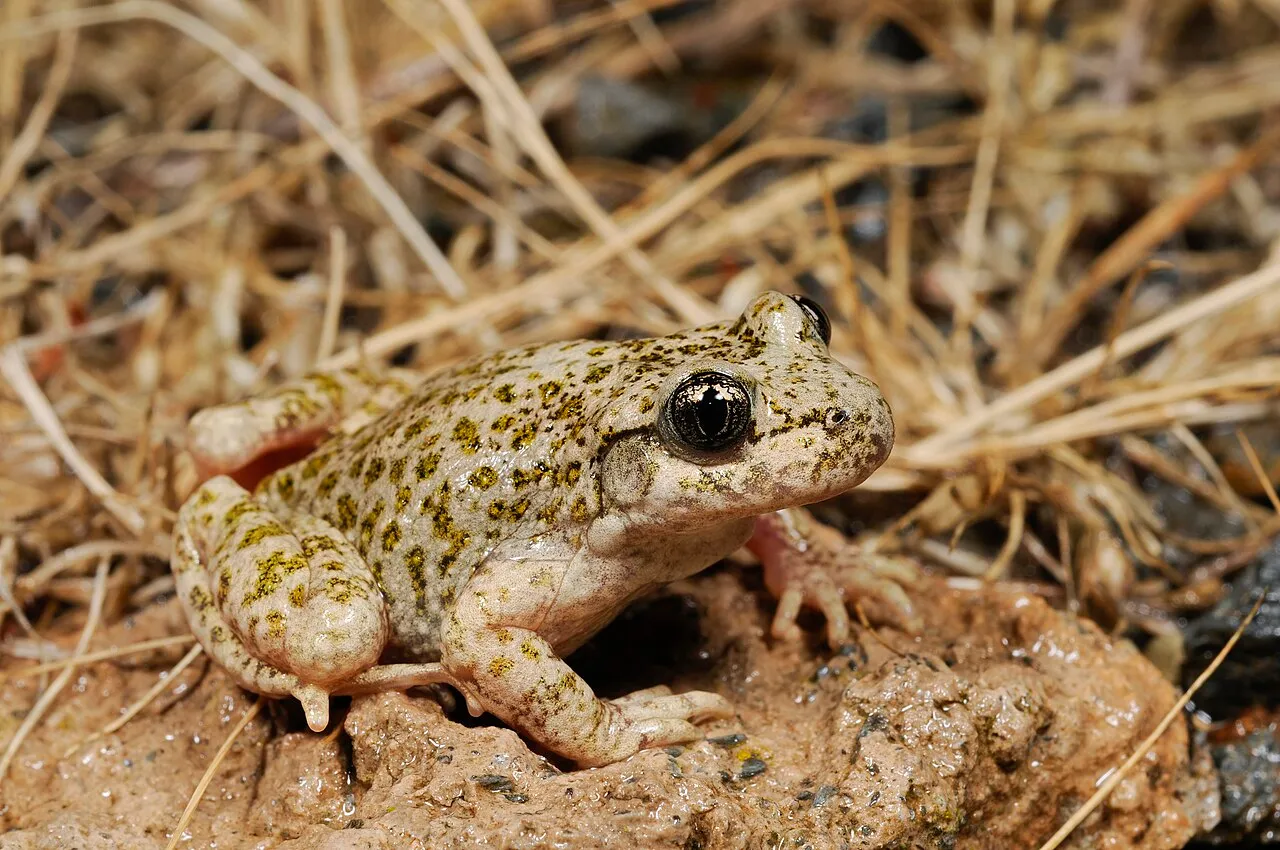
Alytes dickhilleni, the Betic midwife toad, is a small, stocky toad of the family Alytidae, endemic to the Sierra Nevada and nearby ranges of southeastern Spain, with fragmented populations across the Sierras de Alcaraz, Segura, Cazorla, Filabres, Baza and Gador. Like its relatives in the genus Alytes, it takes its common name from the male’s habit of carrying the fertilised eggs on his own body until they are ready to hatch.
Identification
The toad is grey, finely mottled with dark and pale specks, and reaches about 35 mm in length. It has prominent, bulging eyes with vertical, slit-shaped pupils and a distinctive grey area between the eyes, a trait shared with other Alytes species and one that separates the genus at a glance from Europe’s round-pupilled true toads. Its parotoid glands are relatively small, and the species shows a lateral line of whitish glandular tubercles on the body but lacks the orange glandular spots found in other members of the genus, a useful feature for telling it apart from close relatives where ranges come close.
Habitat and range
The species lives in oak and pine forests and rocky, predominantly limestone terrain at elevations of 700–2,000 m; drier populations cluster near springs for water. It is nocturnal, hiding under rocks and in crevices during the day, emerging after dark to feed and, in season, to breed. Its range is confined to the Sierra Nevada and the nearby Sierras de Alcaraz, Segura, Cazorla, Filabres, Baza and Gador in southeastern Spain, making it one of the most range-restricted amphibians on the Iberian Peninsula.
Behaviour and breeding
As in other members of the genus, the male carries the eggs: he coils the fertilised egg mass around his hind legs and carries it until the developing tadpoles are ready to hatch, sheltering under rocks and in crevices by day while he does so. Once released into standing water, the tadpoles develop slowly and may overwinter before completing metamorphosis, a pattern suited to the short, cool breeding season at altitude in these mountain ranges.
Conservation
The IUCN category is shown in the facts box above. The main pressures on the species are a diminution in the number of suitable breeding sites caused by drought, water abstraction and changes in agricultural practices, together with vulnerability to the chytridiomycosis fungal disease and the fragmentation of its already small, scattered mountain populations.
Similar species
Alytes dickhilleni belongs to a small genus of five living species, all sharing the male’s egg-carrying habit but replacing one another geographically. The common midwife toad, Alytes obstetricans, occupies France, the Low Countries, western Germany, Switzerland and parts of the Iberian Peninsula; the Iberian midwife toad, Alytes cisternasii, occupies Portugal and western Spain; the Moroccan midwife toad, Alytes maurus, is found only in Morocco; and the Mallorcan midwife toad, Alytes muletensis, survives only on the Balearic island of Mallorca, where it has evolved a flatter body suited to narrow rock crevices. None of these relatives reach the Betic midwife toad’s mountains in southeastern Spain, and within that range its lack of orange glandular spots and grey, finely speckled skin set it apart from any other Alytes it might be confused with.