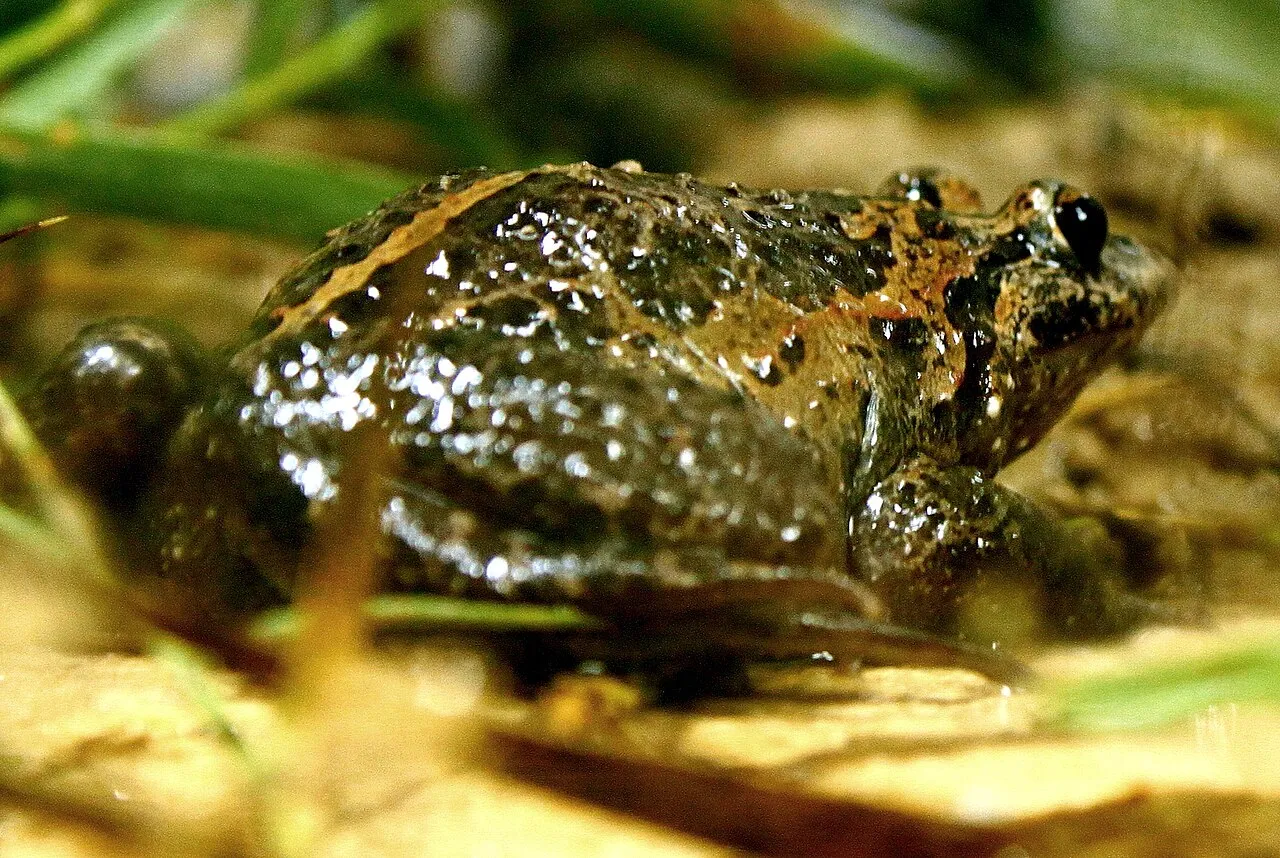
Latonia nigriventer, the Hula painted frog, is a squat, semiaquatic frog endemic to the Hula Valley in northern Israel, the only living species left in its genus. It was first described in 1943 from specimens collected on Lake Hula’s eastern shore in March 1940, then declared extinct in the wild in 1996, the first amphibian ever given that IUCN designation, before a ranger’s chance find in 2011 brought it back.
Identification
Females range from about 40.0 to 128.4 mm in length and weigh around 26 g on average; males are somewhat smaller, ranging from about 66.6 to 121.3 mm and weighing around 13 g on average, with webbing on the feet slightly weaker in females than males. The frog is ochre above, grading into dark olive-grey to greyish-black on the sides, with a band of lighter colour running down the middle of the back toward the hind section; its belly is dark, giving the species its Latin name, “nigriventer” (black-bellied), and carries small white spots that become more numerous with age. Rows of warts pattern the upper surface. The head is flattened and about as wide as it is long, with the eyes set further apart than in the related Mediterranean painted frog, Discoglossus pictus, and the tongue is roundish and triangular, with smooth edges and no furrows. Both sexes have unusually robust arms for a frog, an adaptation for digging and feeding, and the hind legs are longer than the snout-to-vent length. Tadpoles are small, measuring about 14 mm at Gosner stage 25 and 24 mm at stage 34, medium brown with golden speckling and a net-like pattern of black lines, a translucent belly, and a tail around 169% the length of the rest of the body.
Habitat and range
The species is endemic to the Hula Valley in northern Israel, with an extremely restricted range of under 2 square kilometres, known from only two localities roughly 1 km apart: the Hula Nature Reserve and a drainage ditch near the village of Yesud HaMa’ala. Fossil remains found at the Ubeidiya prehistoric site date to the Calabrian stage, around 1.5 million years ago, showing the frog or a close relative once ranged more widely across the Jordan Valley. It is semiaquatic but mainly terrestrial, living in damp, peaty soil under 20 to 30 cm of decomposed leaf litter among thickets of common reed, holy bramble and occasional fig trees; at Yesud HaMa’ala it occupies a single slow-flowing drainage ditch about 600 m long and up to about 150 cm deep, fed by a permanent spring and thickly vegetated with common reed, water lettuce and duckweed.
Behaviour and breeding
The frog is mostly nocturnal and solitary, and more easily startled by human disturbance than related species; when threatened it retreats to water or a burrow, or increases the mucus secreted by its skin, and a captured individual will freeze before slowly jumping or walking away. It digs head-first into soil using its robust arms, reinforced skull and stout upper body. It is carnivorous: the gut of one road-killed specimen held four Caracollina lenticula snails and a woodlouse, Porcellionides pruinosus, prey its reinforced skull and powerful jaw muscles are suited to crushing; unlike most frogs, it does not use its tongue to catch prey, and cannibalism has been recorded in captivity, where one individual swallowed a smaller one.
Breeding is thought to run at least from March to June, and possibly from February to September; males develop prominent nuptial pads and other keratinous outgrowths during the breeding period, and a dissected female carried several hundred greyish-black oocytes, each about 1.5 to 2 mm across. Mating itself has not been observed, but is presumed to mirror Discoglossus, in short, intense periods of inguinal amplexus. Males give an advertisement call at the water surface lasting 725 to 1212 milliseconds, made of an expiratory note of about 671 ms followed by an inspiratory note of about 291 ms, with a dominant frequency around 775.5 Hz; lacking external vocal sacs, the call carries only short distances. Both sexes also give a separate distress call when handled.
Conservation
The facts box above carries the species’ current IUCN Red List category, Critically Endangered. The Hula Valley’s marshes were drained in the 1950s, and only five individuals were ever found before the frog was presumed extinct; in 1996 the IUCN classified it as extinct in the wild, the first time an amphibian had received that designation. A ranger’s discovery in 2011 reversed that: by 2016 several hundred individuals had turned up across 17 of 52 surveyed water holes, and a 2018 survey estimated 234 to 235 potentially reproducing adults. Predation pressure on young frogs appears heavy: 28% of 112 surveyed medium-to-large individuals at Yesud HaMa’ala showed injuries, and recorded predators include dragonfly nymphs, ground beetles, western mosquitofish and white-throated kingfishers. A breeding group was moved to the Jerusalem Biblical Zoo in 2023, which achieved the first captive breeding of the species in 2026.
Similar species
The Hula painted frog’s closest living relatives are the painted frogs of genus Discoglossus, in the same family, Alytidae. The Mediterranean painted frog, Discoglossus pictus, can be told apart by its more closely spaced eyes and a more protruding snout; it also lacks the robust digging arms and reinforced skull that mark Latonia nigriventer. Latonia itself is otherwise known only from fossils, including the extinct species Latonia seyfriedii: fossils of the genus are known across Europe from the Upper Oligocene until the Early Pleistocene, making the Hula painted frog the sole living survivor of a lineage that predates its own rediscovery by tens of millions of years.