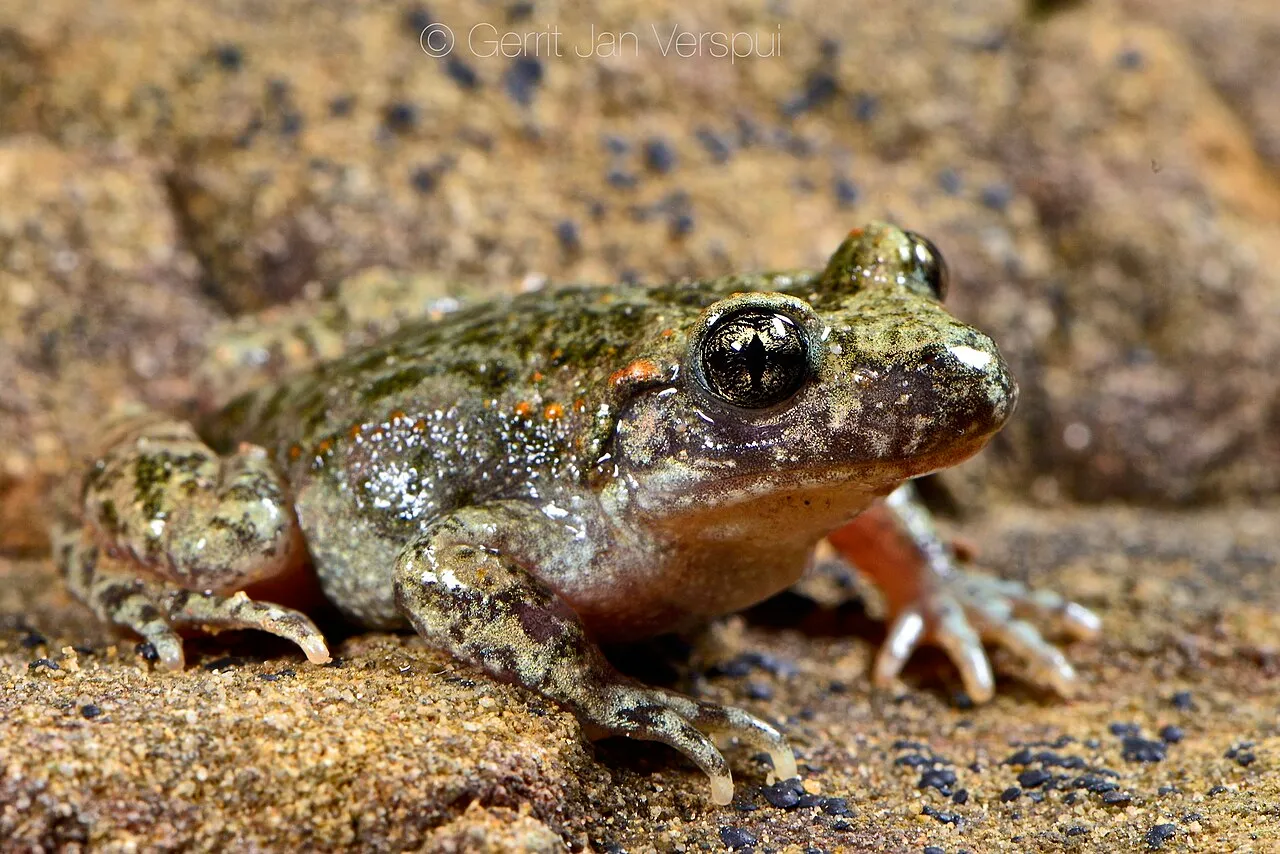
Alytes maurus, the Moroccan midwife toad, is a toad-like frog of the family Alytidae, endemic to Morocco. Like the other four living species in its genus, it owes its common name to the male’s habit of carrying the fertilised eggs on his own body until the tadpoles are ready to hatch.
Identification
A confirmed snout-vent length for this species could not be verified on an openable academic or official source, so the figure is omitted here. As in the rest of the genus, Alytes maurus is a toad-like frog with small warts covering its back that secrete an odorous poison, and a round, flattened tongue (the family’s former name, Discoglossidae, means “round tongue”). These genus-wide traits separate it at a glance from Morocco’s true frogs and toads; finer marks specific to this species could not be confirmed on the sources available for this guide.
Habitat and range
The species occupies temperate forests, Mediterranean-type shrubby vegetation, rivers, freshwater marshes, freshwater springs, rocky areas and rural gardens. Like other members of the genus, it is likely a shy, nocturnal animal that gives away its presence by its ringing call, hiding under stones and logs or in tunnels by day and returning to the same hiding place before dawn, though this is documented for the genus as a whole, not confirmed for Alytes maurus specifically. Its range is confined to Morocco, making it, alongside the Mallorcan midwife toad, one of the most range-restricted species in its genus.
Behaviour and breeding
As in the rest of the genus, breeding here almost certainly follows the midwife toad pattern: the female expels a strand of eggs that the male fertilises externally and then wraps around his legs to protect them from predators in the water, carrying them until he wades into shallow water and allows the tadpoles to leap out of their eggs. Outside the breeding season, genus members typically hibernate in a hole or burrow deserted by a small animal. No breeding account specific to Alytes maurus was available on an openable source for this guide; the details above are genus-level, not species-confirmed.
Conservation
The IUCN category is shown in the facts box above. The main pressures on the species are habitat fragmentation, water pollution, climate change and the introduction of chytrid fungus into its ecosystems, which are narrowing the species’ already limited range.
Similar species
Alytes maurus belongs to a small genus of five living species, all sharing the male’s egg-carrying habit but replacing one another geographically. The common midwife toad, Alytes obstetricans, is found across Belgium, France, Germany, Luxembourg, the Netherlands, Portugal, Spain, Switzerland and the United Kingdom; the Iberian midwife toad, Alytes cisternasii, occupies Portugal and western Spain; the Betic midwife toad, Alytes dickhilleni, is restricted to the mountains of southeastern Spain; and the Mallorcan midwife toad, Alytes muletensis, survives only on the Mediterranean island of Mallorca, where it has evolved a flatter body suited to narrow rock crevices. None of these relatives reach North Africa, so within its own continent Alytes maurus has no congener to be confused with; its closest relatives by range are across the Strait of Gibraltar in Spain and Portugal.