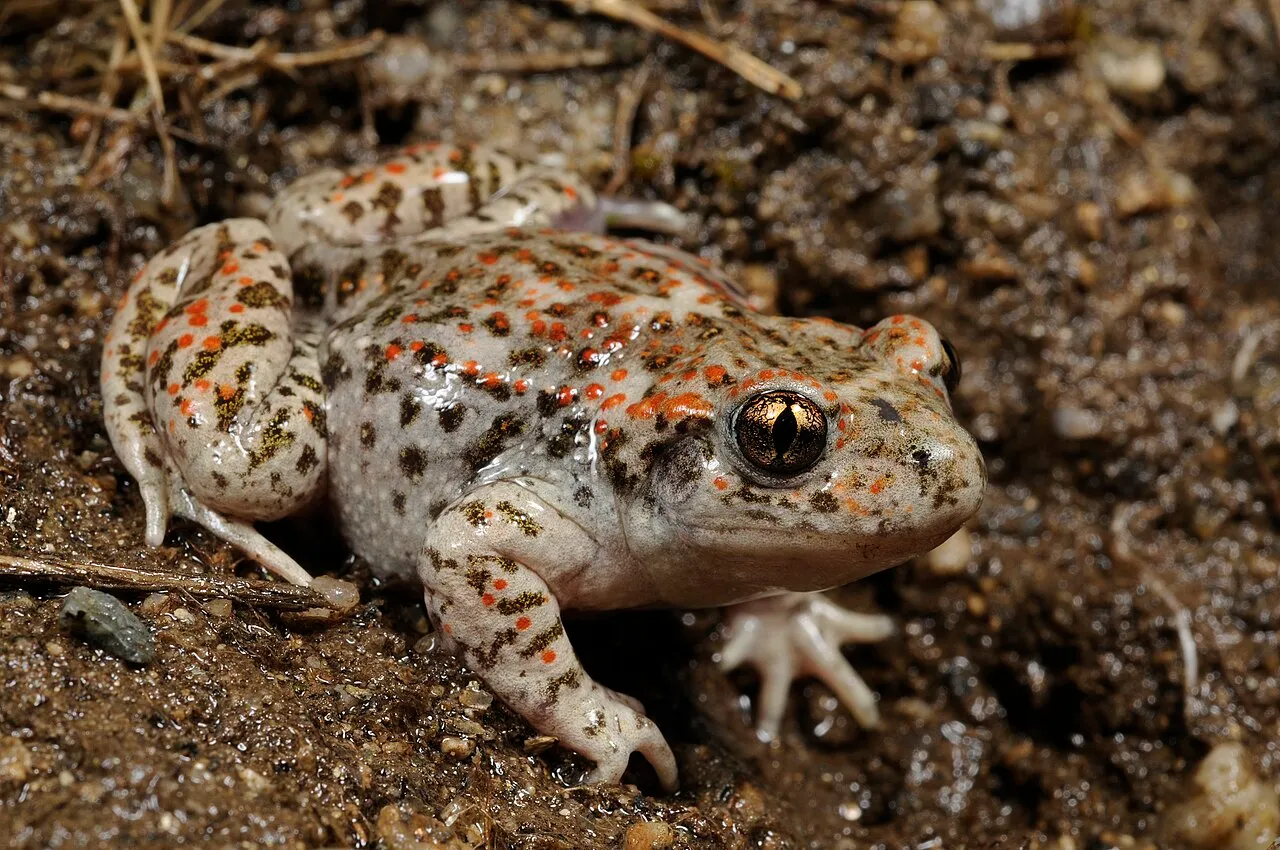
Alytes cisternasii, the Iberian midwife toad, is a small, stocky toad of the family Alytidae, native to Portugal and western Spain, occurring at altitudes up to 1,300 m above sea level. Like its relatives in the genus Alytes, it takes its common name from the male’s unusual habit of carrying the fertilised eggs on his own body until they are ready to hatch.
Identification
The toad grows to a length of about 40 mm, with males somewhat smaller than females. Its upper surface is brownish-grey with dark spots and often reddish warts, while the underside is unspotted greyish-white. The head carries a rounded snout and large eyes with vertical slit pupils, a trait shared with other Alytes species and one that separates the genus at a glance from Europe’s round-pupilled true toads. Small orange warts sit on the upper eyelids, alongside small parotoid glands and distinct tympani, and the fairly short-limbed body is covered in tubercles, with glandular concentrations under the arms, in the groin and around the ankles.
Habitat and range
The species prefers Mediterranean-type scrub, rough grazing land and light oak woodland, including open meadows and open oak forest. Its range covers Portugal and western Spain, reaching altitudes of up to 1,300 m, putting it further west than its closest relative, the common midwife toad, which in the Pyrenees reaches 5,000–6,500 ft (about 1,500–1,980 m), a somewhat higher elevation.
Behaviour and breeding
Mating takes place on land in autumn, after which the male winds the egg mass around his legs and carries it, sometimes taking on as many as 180 eggs from four separate clutches laid by different females. He keeps the eggs moist until they are ready to hatch, then releases the tadpoles into suitable standing water. Metamorphosis follows about four months later, once the tadpoles have grown to around 70 mm in length, a notably large size for a tadpole at the point it completes its development.
Conservation
The IUCN category is shown in the facts box above. Wikipedia lists the main pressures on the species as habitat degradation and pollution that reduce the number of breeding pools, together with invasive American red swamp crayfish, non-native predatory fish and the chytridiomycosis fungal disease.
Similar species
Alytes cisternasii belongs to a small genus of five living species, all sharing the male’s egg-carrying habit but replacing one another geographically, so range alone identifies most individuals. The common midwife toad, Alytes obstetricans, occupies France, the Low Countries, western Germany, Switzerland and parts of the Iberian Peninsula; the Betic midwife toad, Alytes dickhilleni, is restricted to south-eastern Spain; the Moroccan midwife toad, Alytes maurus, is found only in Morocco; and the Mallorcan midwife toad, Alytes muletensis, survives only on the Balearic island of Mallorca, where it has evolved a flatter body suited to narrow rock crevices. Where its range meets that of Alytes obstetricans in parts of Iberia, range and habitat remain the most reliable way to tell the two species apart.