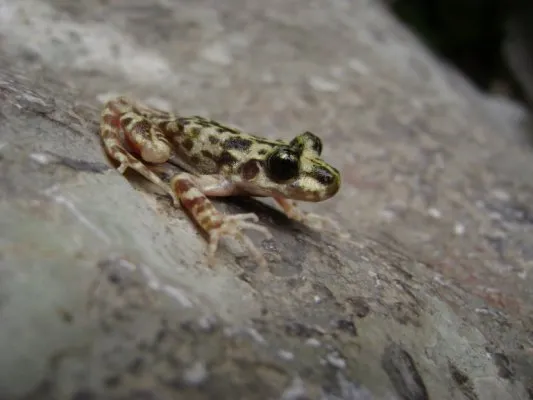
Alytes muletensis, the Majorcan midwife toad, is a small toad of the family Alytidae endemic to the Serra de Tramuntana mountains in northwestern Mallorca, in Spain’s Balearic Islands. It is known as a Lazarus taxon: it was first described from fossil remains in 1977, as the species Baleaphryne muletensis named by Sanchiz and Adrover, and only found alive again in 1979, after having been presumed extinct.
Identification
Adults are small, with snout-vent length about 34.7 mm in males and 38 mm in females, making females the larger sex. The head and legs are large in proportion to the rest of the body, and the toad has evolved a flatter body than its mainland relatives, an adaptation that lets it squeeze into narrow crevices in the rocks of its habitat. Like other members of its genus, it has a round, flattened tongue, a feature that gave the family its older name Discoglossidae (“round tongue”), and its back is covered in small warts that release an odorous poison when the toad is handled or attacked. This flattened body shape, combined with its very restricted range, makes it straightforward to identify in the field: no other amphibian shares its gorges.
Habitat and range
The species is confined to isolated mountain streams and torrents in limestone gorges of the Serra de Tramuntana, including streams inside limestone caverns, where adults hide under boulders and stones. Human alterations such as dams and canals that change water levels or quality in these streams reduce the toad’s ability to find suitable habitat, which is one reason the species remains so narrowly distributed. Tadpoles often develop in small, rain-filled puddles on rock ledges rather than in open ponds, a consequence of the deep, narrow canyons of the northern mountains being the only habitat available to the species. The wild population has been estimated at only a few hundred to about 1,500 breeding pairs, confined to this single mountain range, and the species is reported to have disappeared from most of the rest of the island where it once presumably ranged more widely.
Behaviour and breeding
Like the rest of its genus, the male takes over parental care once the eggs are laid: the female expels a strand of fertilised eggs, which the male wraps around his legs to protect them from predators in the water, carrying them until he wades into shallow water and allows the tadpoles to leap free. In Alytes muletensis this mating and egg-carrying happens mainly during May and June. Once hatched, tadpoles feed on vegetable matter and, lacking the adult’s skin poison, are vulnerable to fish and insects. Courtship is unusual even among midwife toads: both sexes call to each other, and females compete for males, sometimes grappling with rival females to secure a mate, a reversal of the more passive female role typical of most frogs and toads; like other midwife toads, they are shy, nocturnal animals that give away their presence with a ringing call. The species also breeds readily in captivity, a trait that has made ex-situ conservation programmes possible.
Conservation
The IUCN category is shown in the facts box above. The species’ precarious status stems from a combination of pressures specific to its single mountain range. Introduced viperine snakes can cause up to a 90% decline in some midwife toad tadpole populations, while Perez’s frogs, introduced to Mallorca roughly 2,000 years ago, compete with and prey on the toad. A chytrid fungus outbreak, detected in 1991, was eliminated from the population by 2015 through treatment with the antifungal itraconazole. Habitat alteration from dams and canals, discussed above, adds further pressure, and several new habitat sites built for reintroductions are reportedly poorly maintained. Conservation responses have included reintroduction programmes running since 1988 that have established many new breeding populations, now well established, supported by captive breeding at Durrell Wildlife Park (Jersey Zoo), which has bred the species successfully for release back into the wild.
Similar species
Alytes muletensis is one of five living midwife toads, all sharing the male’s egg-carrying habit but separated geographically. The Iberian midwife toad, Alytes cisternasii, lives in Portugal and western Spain; the Betic midwife toad, Alytes dickhilleni, is restricted to southeastern Spain; the Moroccan midwife toad, Alytes maurus, occurs only in Morocco; and the common midwife toad, Alytes obstetricans, ranges across Belgium, France, Germany, Luxembourg, the Netherlands, Portugal, Spain and Switzerland, with an introduced population in Britain. None of these relatives reach Mallorca, so any midwife toad found in the island’s mountain gorges can be identified as Alytes muletensis by location alone; its flattened body, evolved for life in narrow rock crevices, sets it apart from its rounder mainland cousins even where ranges might otherwise be confused.