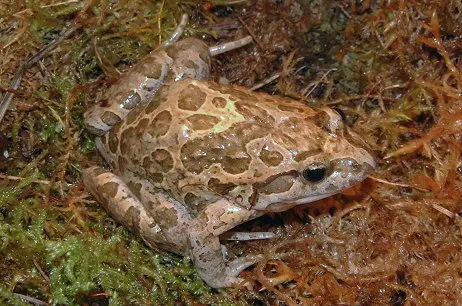
Discoglossus pictus, the Mediterranean painted frog, is a small frog of the family Alytidae native to northeastern Morocco, northern Algeria and Tunisia, and the islands of Sicily and Malta, with introduced populations now established in northeastern Spain and southwestern France. It belongs to a small genus of frogs found only around the western Mediterranean, all sharing the disc-shaped tongue that gives the group its name. Two subspecies are recognised, D. p. pictus and D. p. auritus; a third Moroccan population, once treated as a subspecies here, is now recognised as the separate species Discoglossus scovazzi, and later fieldwork confirmed that the two species occur alongside each other in parts of Morocco.
Identification
The frog has a stout body and a flat head that is wider than it is long, with pupils shaped like an upside-down droplet rather than the round or slit pupils of many other European amphibians. Colouring is variable: three pattern types occur in the species — animals that are almost uniformly coloured, animals with large dark spots edged in a brighter tone, and animals marked with two dark brown stripes running the length of the back, all over a whitish belly. Glands along the back are arranged in rows running the length of the body, though in some individuals they are absent altogether. Newly hatched tadpoles measure about 3 mm and grow to roughly 33 mm before metamorphosing into froglets about 10 mm long. An adult figure for body length is not given in the sources checked for this page, so it is left out here rather than guessed; the facts box lists only what is confirmed.
Habitat and range
Across its natural range the species occupies seasonal ponds and swamps. Sicilian populations favour man-made water bodies such as stone-sided cisterns, irrigation pipes and canals cut through farmland, while in North Africa the frog is found in subhumid northern regions and pre-Saharan oases. Beyond its native range in Morocco, Algeria, Tunisia, Sicily and Malta, established introduced populations now occupy parts of northeastern Spain and southwestern France. In North Africa the species is very abundant, especially across the subhumid northern regions where it is most at home, though the more isolated Maltese and Sicilian populations depend heavily on the artificial water bodies described above.
Behaviour and breeding
In North Africa, mating has been recorded from January through early November. Males clasp females around the lumbar region; the clasp lasts about two hours in Moroccan populations, though Spanish specimens have been observed copulating for as little as 35 seconds to two minutes. A female lays her eggs in small clumps of about 20 to 50 per copulation, depositing 500 to 1,000 eggs in total over the course of one night; each egg measures 1.0 to 1.5 mm across, wrapped in a gelatinous envelope about 3.7 mm wide. Eggs typically hatch within 2 to 6 days, and the tadpoles complete metamorphosis in 1 to 3 months.
Conservation
The IUCN category is shown in the facts box above. The species is nonetheless listed among the Strictly Protected Fauna of the Bern Convention, and faces local pressure from agricultural intensification, falling groundwater levels, notably on Malta, and competition from introduced Levant water frogs (Pelophylax bedriagae) sharing the same aquatic habitats. These pressures are local rather than range-wide: the species remains very abundant across much of its North African range, and it is the more isolated island populations that face the closest scrutiny.
Similar species
Discoglossus pictus is one of six species in its genus, all painted frogs of similar build but separated mainly by range. The Iberian painted frog, Discoglossus galganoi, is found in Portugal and Spain, the Spanish painted frog, Discoglossus jeanneae, occurs only in Spain, the Corsican painted frog, Discoglossus montalentii, is restricted to Corsica, the Tyrrhenian painted frog, Discoglossus sardus, lives on Sardinia, Corsica and the Tuscan Archipelago, and the Moroccan painted frog, Discoglossus scovazzi, is found in Morocco and the Spanish enclaves of Ceuta and Melilla. None of these relatives overlaps with the North African, Sicilian or Maltese range of Discoglossus pictus; the one exception is in Spain and France, where the introduced population shares ground with a wild relative.