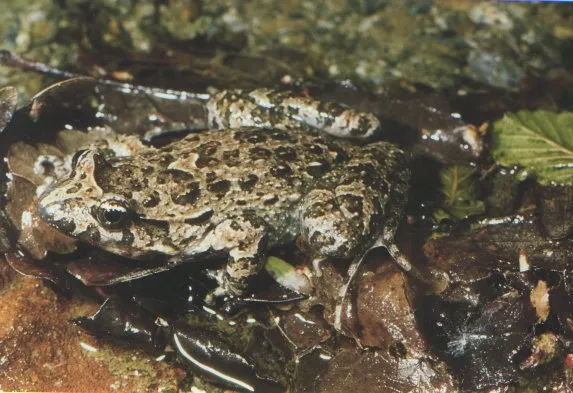
Discoglossus sardus, the Tyrrhenian painted frog, is a small frog of the family Alytidae endemic to the Tyrrhenian Sea basin in the western Mediterranean, found on Sardinia, Corsica, the Tuscan Archipelago and the Monte Argentario peninsula in Tuscany, Italy. It belongs to a small genus found only around the western Mediterranean, and was only recognised as a species distinct from its close relative Discoglossus montalentii in the late 20th century, which is why some aspects of its biology are still thinly documented.
Identification
Adults reach about 50-75 mm in length, with a robust build. Colouring ranges from dark brown to grey, black or reddish brown, usually with lighter spots, including a large pale patch between the shoulders and a darker patch between the eyes with a straighter front edge; plain, unspotted individuals are rare. The snout is slightly pointed and more thinned-out than in the related Discoglossus montalentii, and a bright crescent-shaped mark can appear on top of the head between the snout and the midpoint of the eyes. The pupil is shaped like an upside-down droplet, with the iris split between a lighter golden upper half and a darker lower half, over a yellowish to cream-white belly. The skin is usually smooth, though males grow dry, rough skin during the mating season, with soft warts on the neck and limbs often arranged in lines; the fourth front finger is spatulate rather than tapering, and the hind legs are shorter than in related species. Eggs are brownish-black, 1-1.5 mm in diameter, wrapped in a thick gelatinous casing.
Habitat and range
The species occupies temperate forests, coastal plains, forest streams, maquis shrubland, upland coniferous forests, rivers and intermittent rivers, and freshwater or brackish marshes, from sea level to more than 1,700 m altitude. It is absent from the central highlands of Sardinia and Corsica, where the climate and terrain favour its mountain-specialist relative Discoglossus montalentii instead. The frog tolerates brackish water and can endure slight pollution, which helps explain its presence in coastal marshes as well as clear forest streams across its island range.
Behaviour and breeding
Like other members of its family, the frog feeds on small invertebrates. Breeding takes place in slow streams and pools; females are believed to lay their eggs in small groups or singly on the streambed rather than in the large clumps seen in some relatives. Much of this detail remains tentative, since the species’ breeding biology was not studied in its own right until after it was split from Discoglossus montalentii in the late 20th century.
Conservation
The IUCN category is shown in the facts box above. The species is fully protected in France and Italy and listed in Annex II of the EU Habitats Directive, and faces degradation of its woodland and aquatic habitats and habitat loss from urbanisation, alongside susceptibility to chytridiomycosis, a skin disease affecting amphibians worldwide. Populations on Corsica and Sardinia appear stable, but mainland populations are declining, and the smaller island populations may suffer from low genetic diversity, which is why conservation bodies in both countries continue to treat the species as fragile despite its Least Concern listing.
Similar species
Discoglossus sardus is most easily confused with the Corsican painted frog, Discoglossus montalentii, with which it shares part of its range on Corsica; the two were only separated as distinct species in the late 20th century, and D. sardus can be told apart by its more thinned, pointed snout. Elsewhere in the genus, the Mediterranean painted frog, Discoglossus pictus, lives in northeast Morocco, northern Algeria and Tunisia, as well as Sicily and Malta, the Iberian painted frog, Discoglossus galganoi, is found in Portugal and Spain, and the Moroccan painted frog, Discoglossus scovazzi, is restricted to Morocco and the Spanish enclaves of Ceuta and Melilla. None of these ranges overlaps with the Tyrrhenian islands that Discoglossus sardus calls home.