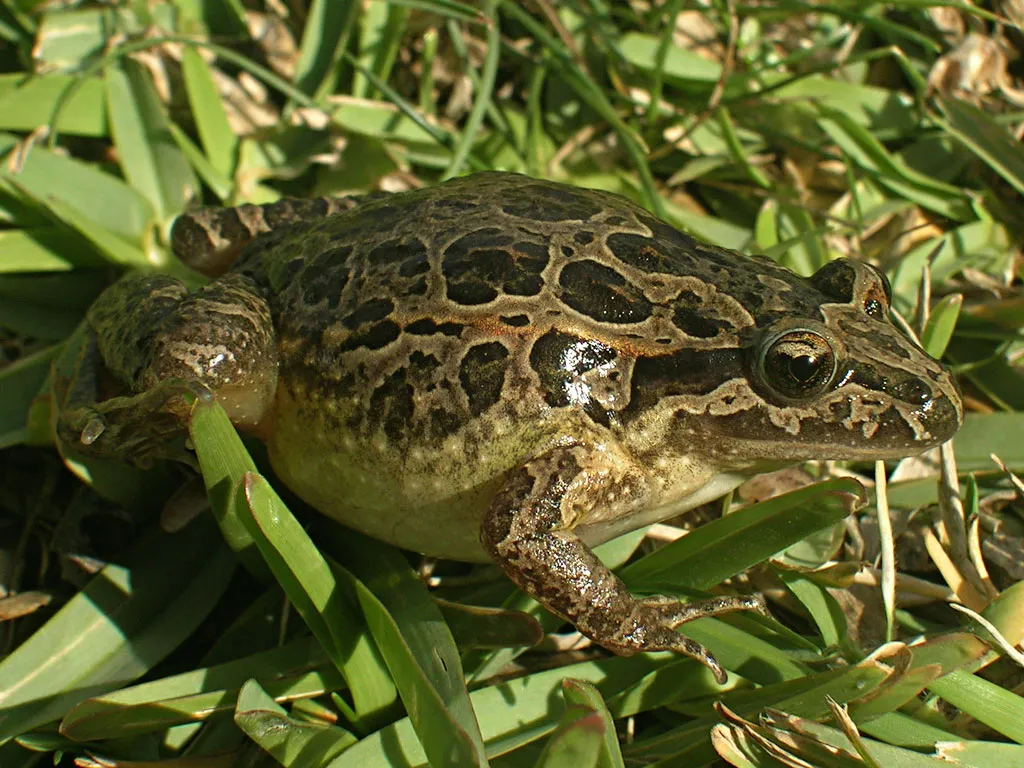
Discoglossus galganoi, the Iberian painted frog, is a small frog of the family Alytidae endemic to the Iberian Peninsula, occurring across most of Spain and Portugal. It belongs to a small genus found only around the western Mediterranean, all sharing the disc-shaped tongue that gives the group its name. The species was formally described in 1985, by Capula, Nascetti, Lanza, Bullini and Crespo; an earlier name for the same animal, Discoglossus hispanicus, dates to 1879 but is no longer used. Populations further east in Spain, once named as the subspecies Discoglossus galganoi jeanneae in 1986, are now classed as the separate species Discoglossus jeanneae.
Identification
The frog has a broad head and a stout body, with pupils shaped like an upside-down droplet rather than the round or slit pupils of many other European amphibians. The back usually shows longitudinal rows of warts, though these are not present in every individual. Colouring is variable: some animals are a plain greyish-brown, others carry large dark spots with pale rims, and others show bright dorsal and lateral bands set against a darker ground colour. An adult body-length figure is not given in the sources checked for this page, so it is left out here rather than guessed; juveniles measure about 1 cm when they leave the water after metamorphosis.
Habitat and range
Discoglossus galganoi is endemic to the Iberian Peninsula, occurring across most of Spain and Portugal, and has been recorded at altitudes up to 1,940 m. It occupies a broad range of habitats, including temperate forest, shrubland, Mediterranean-type vegetation, rivers, swamps, freshwater marshes, sandy shores, arable land and grassland. Within this range it favours open areas, rough grassland, thickets, woodland verges, swamps and gullies, usually in or near water, making it one of the more habitat-tolerant members of its genus. That tolerance stands in contrast to island relatives such as Discoglossus pictus, whose more isolated populations depend on man-made cisterns and irrigation channels; the Iberian painted frog’s mainland range gives it a wider choice of wetlands to fall back on.
Behaviour and breeding
Breeding takes place from October to December. A female may lay as many as 5,000 eggs across several clutches in a season, depositing them singly or in small groups on the bottom of the water or attached to plants. Eggs hatch within 2 to 6 days depending on water temperature, and tadpoles complete metamorphosis after 22 to 60 days, emerging as juvenile frogs about 1 cm long.
Conservation
The IUCN category is shown in the facts box above. The population is common across most of its range and slowly declining, chiefly from habitat loss, but the rate of decline has not been judged steep enough to warrant a more threatened category. Its broad tolerance of habitat types, from woodland streams to arable land and sandy shores, means it is less dependent on any single wetland type than some of its island relatives.
Similar species
Discoglossus galganoi is one of six species in its genus, all painted frogs of similar build but separated mainly by range. The Spanish painted frog, Discoglossus jeanneae, occurs further east in Spain and was itself once named as a subspecies of Discoglossus galganoi before being raised to full species status. The Mediterranean painted frog, Discoglossus pictus, is native to Morocco, Algeria, Tunisia, Sicily and Malta, with introduced populations in northeastern Spain and southwestern France; where that introduced range meets the Iberian Peninsula is the one place the two species’ ranges come close to overlapping. The Corsican painted frog, Discoglossus montalentii, is restricted to Corsica, the Tyrrhenian painted frog, Discoglossus sardus, lives on Sardinia, Corsica and the Tuscan Archipelago, and the Moroccan painted frog, Discoglossus scovazzi, is found in Morocco and the Spanish enclaves of Ceuta and Melilla. None of the other five species shares the Iberian Peninsula with Discoglossus galganoi outside that narrow zone of contact with introduced Discoglossus pictus.