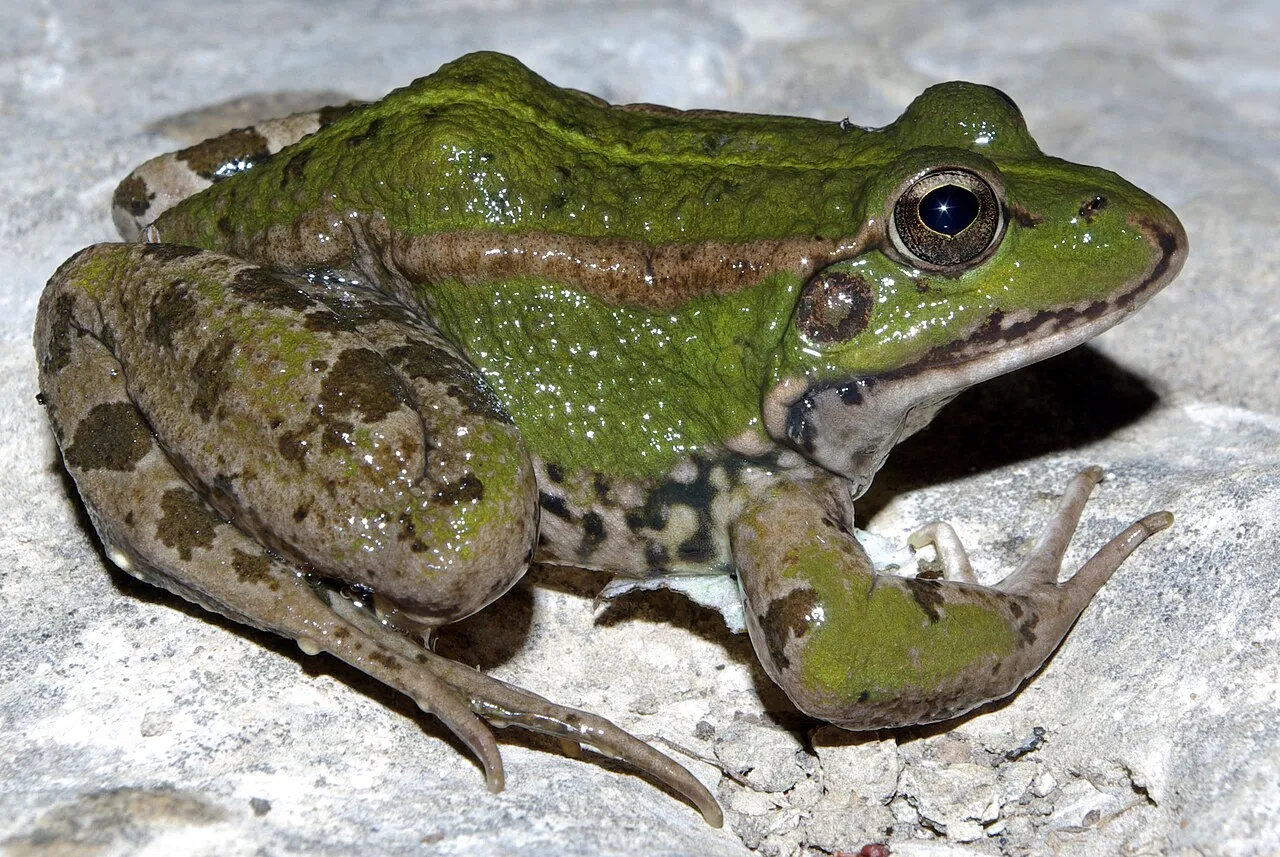
Perez’s frog, Pelophylax perezi, also called the Iberian waterfrog, Iberian green frog or Coruña frog, is a water frog of the family Ranidae, native to southern France, Portugal and Spain and introduced to the Canary and Balearic Islands, Madeira, the United Kingdom and the Azores. Widespread and common throughout the Iberian Peninsula, it is one of the most familiar amphibians of the region.
Identification
Open, measured descriptions of its size and colouring are hard to come by, but its naming history says a lot about how easily it is mistaken for relatives. When Spanish naturalist Victor López-Seoane first described it in 1885, he believed it was only a subspecies of the edible frog and named it accordingly. Decades later, German herpetologist Robert Mertens instead treated it as a subspecies of the marsh frog, a classification that stuck for decades afterward. Only in 1974 did Swiss herpetologist Hansjürg Hotz argue it was a distinct species in its own right, a view later confirmed by biochemical study and genetic analysis. That century-long back-and-forth reflects a genus of green water frogs that look very alike across most of Eurasia.
Genetically, P. perezi’s closest living relative is the Sahara frog, P. saharicus, of northern Africa, rather than any of its European neighbours. A 2024 study estimated the two lineages diverged either about 16 million years ago, near the end of the Miocene’s Burdigalian age, or about 5.3 million years ago, at the start of the Pliocene’s Zanclean age. Both timings coincide with the Betic Crisis and the Messinian salinity crisis, two episodes when changing sea levels reshaped the western Mediterranean and could have split the two frogs apart.
Habitat and range
P. perezi occupies a wide range of aquatic and semi-aquatic environments, including temperate forests, temperate and Mediterranean-type shrubland, rivers and intermittent rivers, swamps, freshwater lakes and marshes, sandy shores, arable land and urban areas. Within its native southern France, Portugal and Spain it is especially common across the Iberian Peninsula, and the introduced populations on the Canary and Balearic Islands, Madeira, the Azores and in the United Kingdom show it can establish itself well outside that native range too.
Behaviour and breeding
Like other members of its genus, P. perezi stays close to water for most of its life. Its most distinctive behavioural trait, though, is reproductive: where its range overlaps that of the marsh frog, P. ridibundus, in southern France and parts of the Iberian Peninsula, the two interbreed to produce Graf’s hybrid frog, Pelophylax kl. grafi, a fertile hybrid that reproduces by hybridogenesis in a so-called P–G system. Frogs in this hybrid complex mate via amplexus, with females laying 800 to several thousand eggs in several clusters in shallow water or near vegetation.
Conservation
The species’ facts box carries its current IUCN Red List category. Perez’s frog is not considered threatened and is classed as Least Concern, consistent with its wide native range and its success establishing introduced populations well beyond it.
Similar species
The clearest look-alike is the hybrid it helps sustain, Graf’s hybrid frog, Pelophylax kl. grafi, found alongside it across southern France and the Iberian Peninsula; separating the two in the field is difficult without genetic or bioacoustic evidence, since the hybrid carries P. perezi’s own genome. Historically, taxonomists repeatedly confused P. perezi with the edible frog and the marsh frog, both green water frogs of the same genus, before genetic work settled its status as a distinct species. Its true closest relative, the Sahara frog, P. saharicus, lives across the Mediterranean in northern Africa and so is not encountered in the field alongside it.