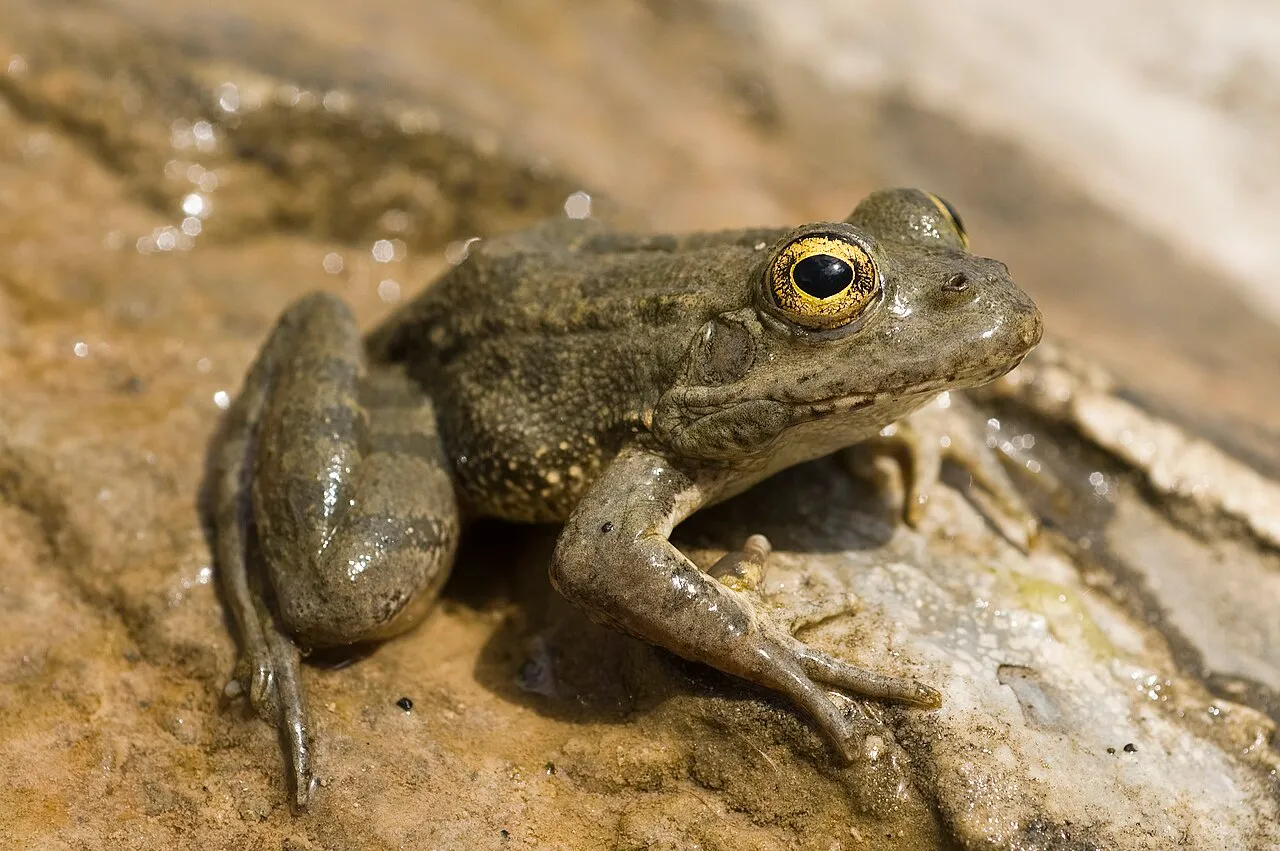
The Karpathos frog, Pelophylax cerigensis, is a water frog found only on and around two Greek islands in the South Aegean Sea. It was long feared to be one of the rarest amphibians in Europe, surviving in a handful of streams on Karpathos, until surveys turned up further populations on the neighbouring island of Rhodes, prompting the IUCN to downgrade the species from Critically Endangered to Endangered.
Identification
P. cerigensis belongs to the green water frog genus Pelophylax, and in general appearance it closely resembles the widespread Levant water frog, Pelophylax bedriagae. The species was already described as distinct in 1994, and when a population was later found on Rhodes its identity was unclear until mitogenome analysis placed it with the Karpathos frog rather than with P. bedriagae, so a reliable field identification rests on locality and genetics rather than colour or shape alone.
Habitat and range
The species is endemic to the Greek islands of Karpathos and Rhodes in the South Aegean Sea. On Karpathos it is now confined to four localities within an area of less than 10 km2 near the village of Olympos, while it is more widespread on Rhodes, where populations were only discovered later and changed the picture of how threatened the species is. Its estimated area of occupancy is 128 km2 and extent of occurrence 2,835 km2, though the Karpathos population itself remains very small and restricted.
Behaviour and breeding
P. cerigensis preys on beetles, spiders, isopods and various hymenopterans. Dry spells that shrink its pools also bring it into closer contact with the native Levantine water crab, which preys on the frog and whose impact grows as drought and water abstraction force both species into the same shrinking pools.
Conservation
The species’ facts box carries its current IUCN Red List category. The frog was downgraded from Critically Endangered to Endangered after the discovery of additional populations on Rhodes, but it remains under pressure. The main threats are habitat loss, excessive water abstraction for agriculture and livestock, fires and climate change, with water scarcity forcing frogs into closer contact with predators such as the Levantine water crab.
Similar species
The Karpathos frog is easily confused with the Levant water frog, Pelophylax bedriagae, which it resembles in general appearance but from which it is a genetically distinct species; on Rhodes, where both lineages come into question, mitogenome analysis is what settles which population belongs to which species. Outside Karpathos and Rhodes, any green water frog resembling P. cerigensis is far more likely to be P. bedriagae, which is native across the wider eastern Mediterranean.