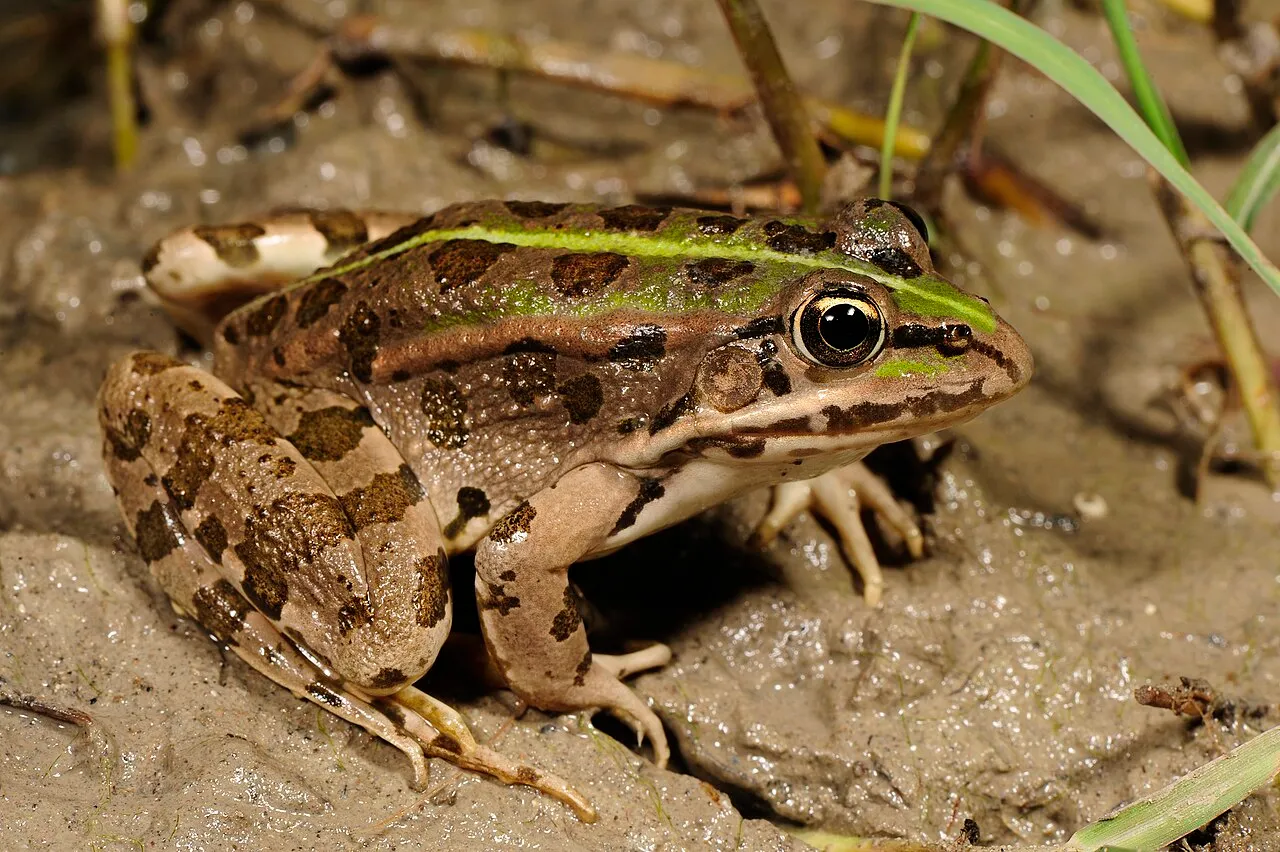
The Epirus water frog, Pelophylax epeiroticus, is a green water frog found in small, fragmented populations across western Greece and southern Albania, including the island of Corfu (Kerkyra). It belongs to the same genus as the widespread Levant and pool frogs, but its patchy distribution and distinct call set it apart from its more common relatives.
Identification
Like other members of the genus, P. epeiroticus shows the usual green water frog build, but with a clear size difference between the sexes: males reach up to about 74 mm snout-vent length, while females grow larger, up to about 84 mm. This marked female-biased size dimorphism is one of the more reliable field clues alongside locality, since water frogs across the Balkans can otherwise look very similar to one another.
Habitat and range
The species occurs in western Greece and southern Albania, including Corfu, but its populations are small and fragmented rather than continuous across this range. It favours Mediterranean-type shrubby vegetation near rivers, swamps, freshwater lakes and marshes, and it also turns up around plantations, suggesting some tolerance of land altered for agriculture as long as water bodies remain nearby.
Behaviour and breeding
Spawning runs from late April to early May, though the exact timing shifts with latitude, altitude and local weather. Males call mainly from about 9 a.m. until midnight, with a longer pause around dusk, producing short, creaky pulsed calls: at 15°C a call runs to around 32 pulses over roughly 616 milliseconds, with pulse rate rising and overall call duration falling as temperature increases. That temperature sensitivity is typical of frog calls generally, where warmer conditions speed up the pulses but shorten each call.
The species’ taxonomic history reflects how recently its identity was settled: it was described in 1984 as Rana epeirotica from a specimen collected at Lake Pamvotida, then moved to the genus Hylarana in 2005, and finally placed in its current genus, Pelophylax, in 2006.
Conservation
The species’ facts box carries its current IUCN Red List category. Its scattered, fragmented populations across a limited range in western Greece and southern Albania leave it more exposed to local habitat loss than a more continuously distributed water frog would be, even where the overall category is not the most severe.
Similar species
The Epirus water frog shares its genus with several other Balkan and Mediterranean water frogs, including the pool frog, Pelophylax lessonae, and the Levant water frog, Pelophylax bedriagae, both of which overlap parts of its broader region. As with other Pelophylax species, reliable identification in the field rests on locality and, where ranges meet, on call or genetic evidence rather than colour pattern alone.