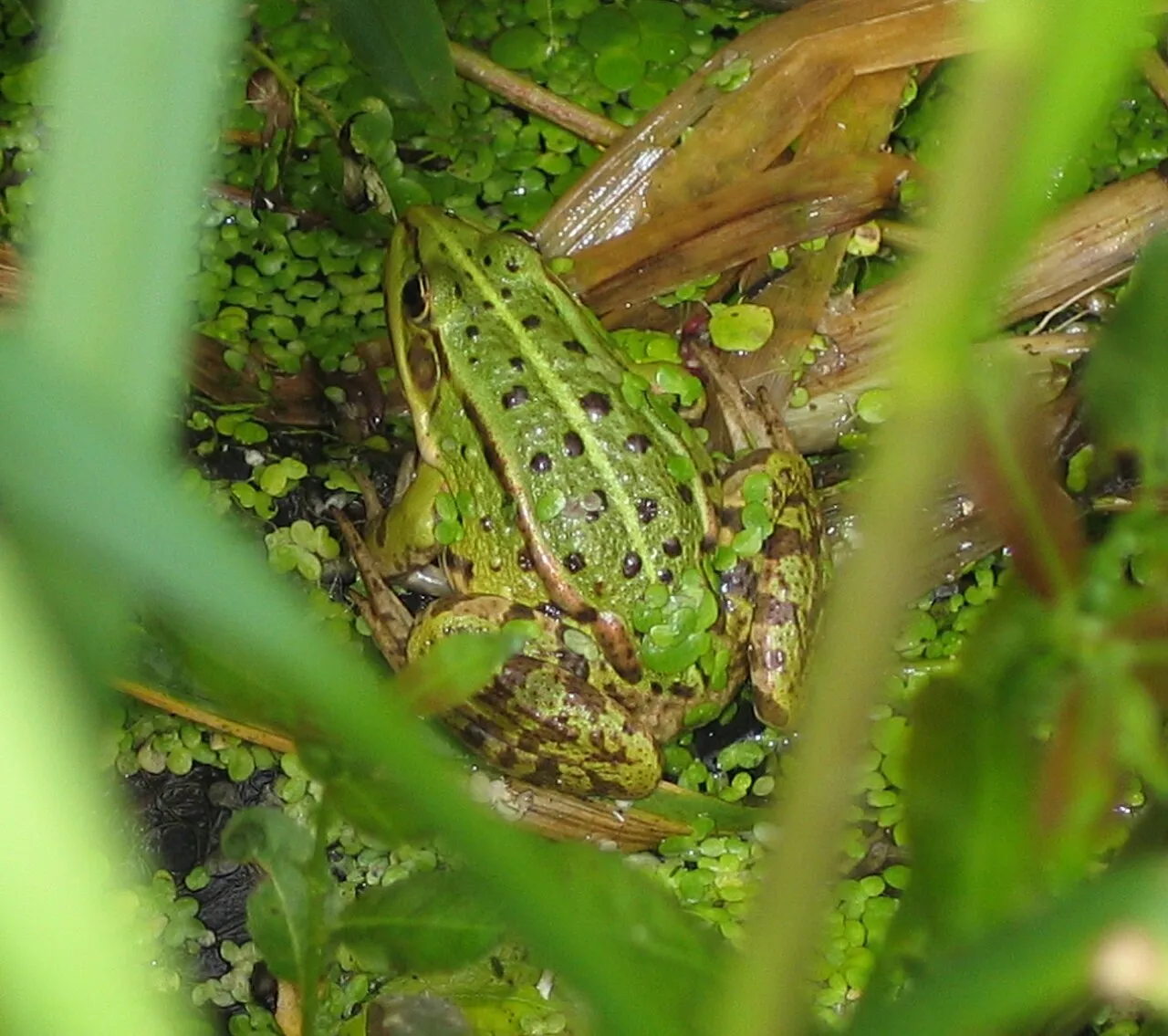
Pelophylax lessonae, the pool frog, is a medium-sized water frog of the family Ranidae, found across most of central Europe from the west coast of northern France to the Ural Mountains in western Russia, with small populations also in Sweden, Norway and East Anglia, England. It typically grows 4 to 7 cm (1.6 to 2.8 in) long, and is one of three closely related European water frogs alongside the marsh frog and their natural hybrid, the edible frog.
Identification
Colouring is highly variable, typically light or dark green, though some individuals — particularly in the species’ northern populations — are mainly brown with a pale stripe down the back. The clearest field mark in the hand is the male’s vocal sacs: they are white, where the edible frog’s are grey and the marsh frog’s dark grey to black. Compared with its two relatives the pool frog also has a shorter, blunter snout, shorter hind legs, and a large, symmetrical, semi-circular metatarsal tubercle on the foot. Tadpoles are 4 to 8 cm long, brown or olive at first and becoming greener with age.
Habitat and range
The species occupies stagnant and shallow bodies of water such as ditches, ponds and lakes, often with dense vegetation, across forests, heathland, meadows and fens, and it tolerates some agricultural modification of the land. It ranges from sea level up to 1,500 m in the southern part of its range, and its northern populations are more specialised, largely restricted to nutrient-poor, oligotrophic ponds and fens. The isolated East Anglian population is genetically part of the species’ native stock rather than an introduction, DNA evidence has shown the East Anglian frogs to be native rather than introduced.
Behaviour and breeding
Pool frogs are active by day and night and, across most of the range, from March to October; outside that season they hibernate on land, burrowed 3 to 7 cm below the soil of the surrounding woodland. That habit comes with an unusual physiological trick: hibernating pool frogs can survive 8 to 12 hours of overnight freezing. Diet is mostly terrestrial invertebrates — in one Croatian study, 77.6% of prey items were terrestrial, and arthropods made up 90 to 97% of the diet overall; tadpoles, by contrast, feed mainly on plant matter. Breeding runs from May to June, needing water between 14 and 26°C for mating and at least 16°C before eggs are laid; a female can lay up to 4,500 eggs in a season, each 6 to 8 mm across including its jelly capsule. Males hold territories and call to attract females before pairing up in amplexus; researchers have documented four distinct call types, whose fine structure shifts with water temperature and carries regional “accents” that appear to be genetically determined.
Pool frogs regularly hybridise with the marsh frog, P. ridibundus: their cross is the edible frog, P. esculentus, which persists as a population only by repeatedly backcrossing with pool frogs, a reproductive strategy called hybridogenesis.
Conservation
The species’ facts box carries its current IUCN Red List category, Least Concern globally. That global picture masks steep local declines. In England the species was historically documented in Norfolk by 1820, with colonies known at Rockland All Saints and Stow Bedon by the mid-1800s and at Fowlmere Fen, Cambridgeshire, from 1843; it was last recorded at its final English site in 1994 and was formally declared extinct in England by 2005, despite being a native rather than introduced population. A reintroduction begun in 2005 using frogs translocated from Sweden had built a population of 67 adults by 2016 at the original release site, helped by a headstarting programme, rearing tadpoles to a late stage before release, that started in 2012; a second English site was seeded with headstarted eggs between 2015 and 2021. Norway’s population, first recorded in 1986, tells the opposite story: it peaked at 130 adults before falling 85% to just 17 adults by 2019, a decline severe enough that the northern clade is listed as Critically Endangered in Norway, and a captive-breeding programme at Kristiansand Zoo has run since 2017.
Similar species
The pool frog is most often confused with the other two members of Europe’s water frog complex. The marsh frog, P. ridibundus, is larger with longer hind legs and darker vocal sacs; the edible frog, P. esculentus, their natural hybrid, has grey rather than white vocal sacs and intermediate proportions. All three can interbreed, so vocal-sac colour, snout shape, hind-leg length and the shape of the metatarsal tubercle together are more reliable than any single feature for telling a pool frog apart from its relatives in the field.