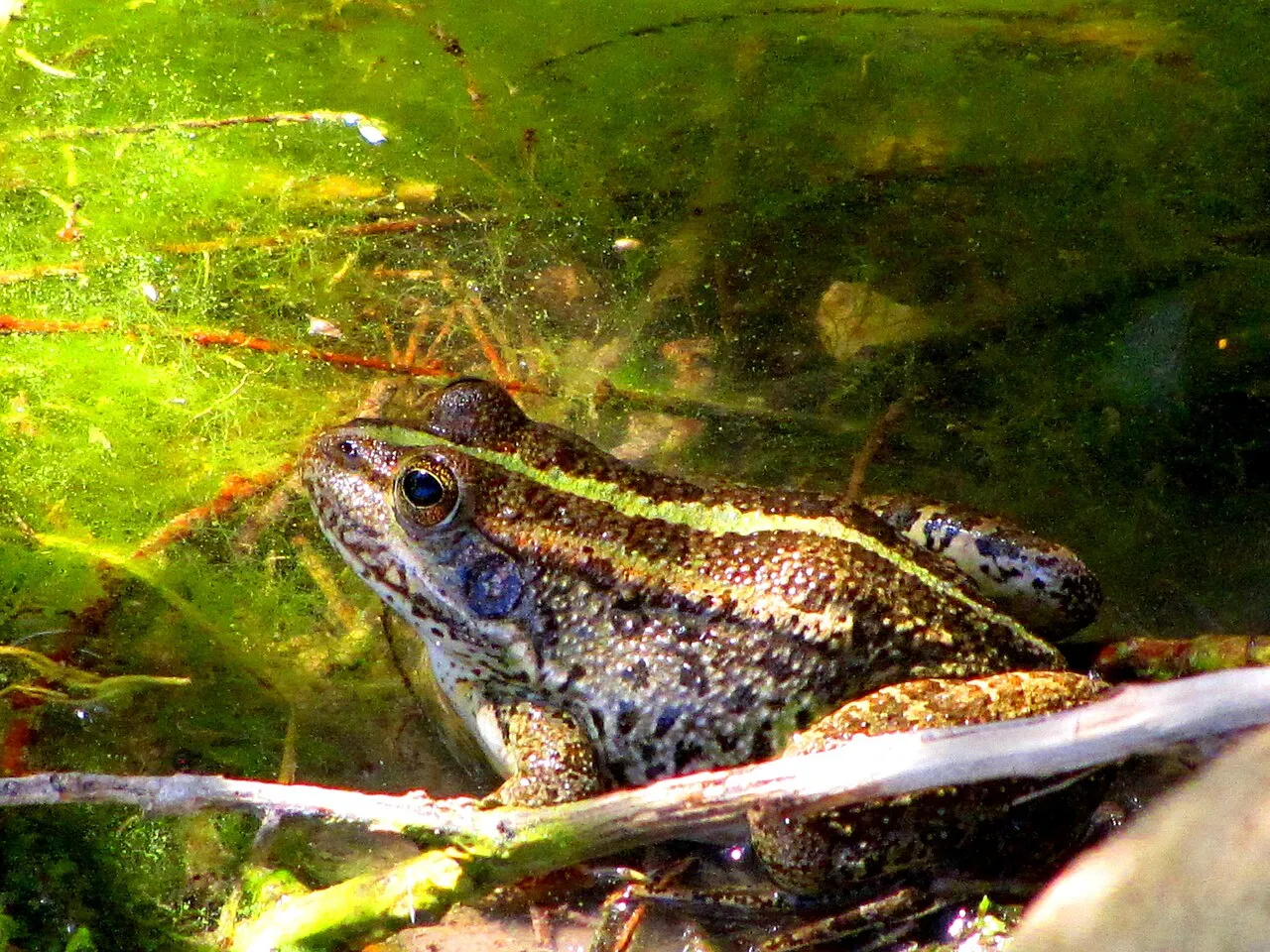
The Levant water frog, Pelophylax bedriagae, is a green water frog of the eastern Mediterranean, named after the nineteenth-century herpetologist Jacques von Bedriaga and originally described under the genus Rana before water frogs were moved into Pelophylax. It is native to a band of countries around the eastern Mediterranean, but people have also carried it far beyond that range, and the Global Invasive Species Database now tracks it as an established alien in ponds from Belgium to Egypt, spread mostly through the ornamental pond and pet trade.
Identification
P. bedriagae is a large water frog with a highly variable, greenish or brownish back marked by a narrow, light-yellowish mid-dorsal stripe, a pattern also described as green to brown with dark blotches on the back. Females outgrow males: adult males average about 78.8 mm in length, while adult females average about 92.8 mm. Like other water frogs it is non-toxic and spends most of its time in the water rather than ranging far onto land, and it is mainly active by day, with some nocturnal activity.
Habitat and range
The species is native to the eastern Mediterranean: Cyprus, Greece’s Aegean region, Israel, Lebanon, Syria and Turkey. It lives in humid areas up to about 1,500 m elevation, typically in wetlands, ponds, rain pools, streams, rivers, irrigation channels, reservoirs, marshes, springs and modified habitats, always needing a constant supply of fresh water nearby.
Beyond its native range, the frog has become established as an alien species in Belgium, Egypt, France, Jordan, Malta, Palestine and Switzerland. In Malta it arrived first through the pet trade and was then deliberately released into freshwater pools on Gozo during the 1990s; there it has proved prolific and invasive, though its dependence on permanent fresh water stops it spreading naturally across the drier parts of Mediterranean islands.
Behaviour and breeding
Seasonal breeding happens in permanent waterbodies, timed to local climate: in the native range this falls in March and April, but stretches from May to September where the species has been introduced further north in Europe. A female can lay 5,000 to 10,000 eggs, which hatch within 3 to 6 days; tadpoles then complete metamorphosis in 45 to 75 days. Adults can live to about 8 years.
Adults hunt terrestrial arthropods and other small invertebrates, occasionally taking small vertebrates, while the herbivorous, detritus-feeding tadpoles graze on plant matter and decaying organic material in the water. Where the species has spread outside its native range, established populations can compete with local amphibians for food and mates and prey on local insects, with documented impacts in Malta and Belgium; within its native range, in turn, its own populations are under pressure from habitat loss, the fragmentation of freshwater habitat and predation by introduced fish such as the wels catfish, Silurus glanis.
Conservation
The species’ facts box carries its current IUCN Red List category. No prevention measures are currently in place against its spread as an alien species, and a ban on trading live animals has been recommended to stop further introductions.
Similar species
Across much of its range, P. bedriagae overlaps with other green water frogs of the genus Pelophylax, whose members are hard to tell apart by colour and shape alone. The mid-dorsal stripe and blotched back and the size difference between the sexes are useful starting points, but a confident field identification usually needs a closer look at call and locality, since the species remains, like its relatives, an aquatic, non-toxic water frog.