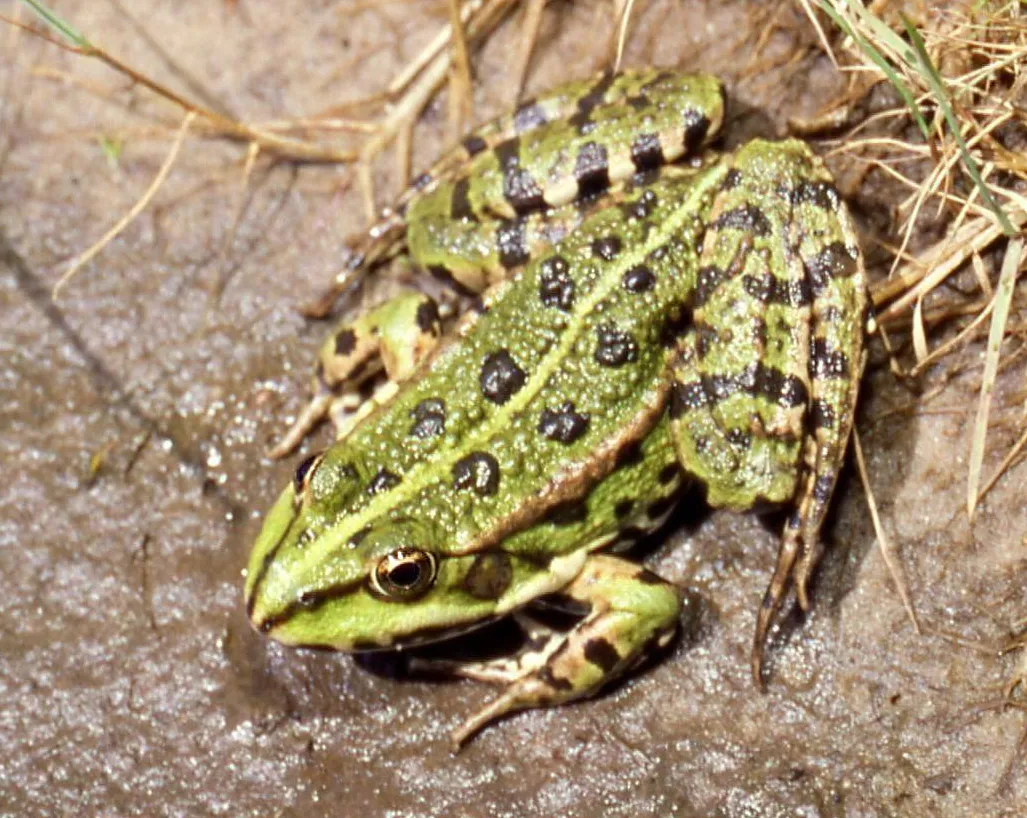
The marsh frog, Pelophylax ridibundus, is a green water frog of the Western Palaearctic. It was first described by Peter Simon Pallas in 1771 from the Atyrau district of western Kazakhstan, which remains the species’ formal type locality — a fact that later became central to a 2024 dispute over which frogs actually deserve the name P. ridibundus.
Identification
This is a big water frog: adults can reach a snout–vent length of up to 15 cm, and females usually grow slightly larger than males. Colour is variable, running from dark green or nearly black through paler green to brown or grey, often with a bright green stripe along the back. Water frog researchers have long used body size to separate P. ridibundus from its smaller relative P. lessonae, a distinction already in use by the mid-20th century.
Three features help with a frog in the hand. Adult males have a pair of vocal sacs, one under each eardrum, usually dark grey or black, where the edible frog’s are lighter grey and the pool frog’s white, although a few marsh frogs have unusually pale sacs. The hind legs are long: pulled forward along the body, the heel often reaches past the snout, while a pool frog’s reaches only the eye. The hard lump on the foot, the metatarsal tubercle, is low and asymmetrical, and a 2020 study found its size and shape the most reliable single feature for separating marsh frogs from edible and pool frogs.
Habitat and range
P. ridibundus is a wide-ranging water frog found across the Balkans, Anatolia, the Caucasus, Central Europe and Central Asia, reaching east to western Kazakhstan, the species’ type locality, and north into Siberia. In Europe it is native to the centre, east and south-east but absent from Scandinavia, and it has been introduced to Switzerland, Belgium, Spain, Sardinia, the United Kingdom and Kamchatka.
It is most at home in large water bodies such as deep ponds and flowing rivers, yet it adapts to almost any still or moving water from puddles to lakes, especially warm, well-vegetated sites. It occurs up to 2,500 m above sea level in forest, grassland, steppe and even desert, and, unusually for an amphibian, it tolerates brackish water, breeding in pools along the Caspian and Black Sea shores.
Taxonomy: a century of splitting, and a 2024 re-think
For most of the 20th century, water frogs across this range were treated as two species — small-bodied P. lessonae and large-bodied P. ridibundus — whose natural hybrid was itself originally described as a third species, P. esculentus. From the 1990s onward, researchers split P. ridibundus further: Schneider, Sinsch and Nevo named the Middle Eastern population P. bedriagae in 1992, and a decade later Plötner and colleagues proposed two more segregate species, P. caralitanus from Anatolia and P. cypriensis from Cyprus. Of these, P. caralitanus has since been formally synonymised back into P. bedriagae.
A 2024 mitochondrial DNA study of Georgian populations reopened the question of where P. ridibundus ends and P. bedriagae begins. Comparing Georgian frogs against 89 published sequences from Turkey, Kazakhstan, the Balkans and Central Europe, the authors found Georgian populations differed from Kazakh ones by only 0 to 4 percent of their mitochondrial sequence, and from Greek populations by 1 to 5.5 percent — far less than the roughly 14 to 15 percent divide separating either group from P. lessonae. Because western Kazakhstan is the species’ own type locality, and because mating calls from Kazakhstan, Armenia and Central Europe are indistinguishable from one another while differing from Middle Eastern calls, the study’s authors argued that most of the range previously assigned to P. bedriagae — the Balkans, Anatolia, the Caucasus and Central Asia — should revert to P. ridibundus, with the name P. bedriagae reserved only for frogs from the Levant.
Behaviour and breeding
Marsh frogs usually hibernate from about October to February, mostly underwater in the mud of the pond or river bed. Breeding follows in late spring or early summer, generally once the water is warmer than 18 °C; males call to attract females and clasp them in amplexus while the eggs are laid. The spawn goes down in clumps of 144 to 645 eggs fixed to underwater plants in the shallows, and a female may spawn two to seven times in one season. Tadpoles can hatch within 2 to 4 days; how long they take to become frogs depends on temperature, from 45 to 65 days in the Turkish provinces of Adana and Mersin to 90 to 120 days in Anatolia.
Adults eat mostly arthropods and other invertebrates, but also small fish, other amphibians including their own species, reptiles, small birds and rodents; in 53 adults examined in Thrace, flies made up 40% of the diet and beetles 20%.
P. ridibundus also hybridises with the smaller pool frog, P. lessonae. Their cross is the edible frog, P. esculentus, and most edible frogs pass on only marsh frog genes, so their populations persist by mating back with pool frogs. A genetic study of invasive marsh frogs in Belgium found interbreeding between nominal P. ridibundus and P. ‘bedriagae’, evidence the 2024 Georgian review cites as further reason the two are not reproductively isolated.
Conservation
The species’ facts box carries its current IUCN Red List category. Outside its native range the marsh frog can itself be the pressure: where it has been introduced it may threaten native water frogs by diluting their gene pool, although the same source notes evidence that this hybridisation does not greatly affect the overall population.
Similar species
Its closest look-alikes are the frogs it was once split from. There are no fixed morphological characters separating P. ridibundus from P. bedriagae — the two are told apart mainly by mating call, not body shape or size. Outside that complex, the edible, pool and Epirus water frogs it lives alongside all have shorter, blunter snouts than its long, pointed one; vocal-sac colour, hind-leg length and the metatarsal tubercle described above complete the check.