- The Bold Guardian of Green Canopies: Exploring <em>Espadarana audax</em>
- Taxonomy and Classification: Placing Espadarana audax in Froggy Context
- Natural Habitat: Life Among Rain-Soaked Leaves and Misty Clouds
- Physical Characteristics: Inside the Transparent Marvel
- Behavior and Life Cycle: An Intricate Mosaic of Survival and Reproduction
- Ecological Role: Guardians of Balance and Indicators of Health
- Threats and Conservation Status: Preserving Transparency
- Cultural and Scientific Significance: From Forest Myths to New Discoveries
- Conclusion: Ensuring a Transparent Future
The Bold Guardian of Green Canopies: Exploring Espadarana audax#
The twilight atmosphere of a dense tropical forest in Central America comes alive with an orchestra of amphibian calls—trills, whistles, hums, and croaks blending harmoniously into nature’s nightly concert. Hidden among mossy branches and lush, rain-bedewed foliage lives a frog whose very existence seems sculpted by evolution with artful precision—the transparent-skinned marvel known scientifically as Espadarana audax. Commonly referred to as the Bold Glass Frog, this remarkable amphibian invites us into a world translucent as glass yet utterly vibrant with ecological mysteries.
Consider for a moment the wonder of seeing through a living creature, observing intimately the delicate rhythm of its heartbeat or the gentle heave of its breathing. Such transparency captivates not only scientists but anyone fortunate enough to glimpse these forest jewels in the wild, epitomizing nature’s intricate elegance.
Taxonomy and Classification: Placing Espadarana audax in Froggy Context#
Espadarana audax belongs to the family Centrolenidae—a fascinating lineage commonly referred to as “Glass Frogs.” Within this family, the genus Espadarana comprises species distinguished by their semi-transparent skin, unique skeletal structures, and specific mating behaviors. Originally described by Lynch and Duellman in 1973, E. audax was previously known under the genus Centrolene, but recent molecular studies have provided clarity about its evolutionary relationships, prompting its reclassification.
Closely related species often share similar physical and ecological traits, revealing subtle differences in their distribution, calls, and parental behaviors. Such nuanced categorizations are essential not only to taxonomy but illuminate the evolutionary journey of these glassy amphibians across millions of years in Neotropical rainforests.
Natural Habitat: Life Among Rain-Soaked Leaves and Misty Clouds#
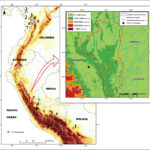
The Bold Glass Frog thrives primarily in the cloud forests and moist, mid-elevation rainforests spanning from Panama through Colombia. These habitats—marked by persistent mist banks, high humidity, and luxuriant flora—present the ideal environmental niches for E. audax. Their affinity for dense foliage positioned over clear, swift-flowing streams provides critical advantages for breeding, feeding, and predator avoidance.
Beneath an emerald canopy of leaves glistening with moisture, the gentle trickle of streamwater creates an alluring soundscape suited for amorous encounters. Here, at elevations typically ranging from 500 to 1,500 meters above sea level, the frogs spend most of their lives in the arboreal paradise, rarely descending from their high vantage points above rushing waters. Their fragile-looking limbs enable graceful movement across slick leaves, adapting perfectly to life in the lush arboreal realm.
Physical Characteristics: Inside the Transparent Marvel#
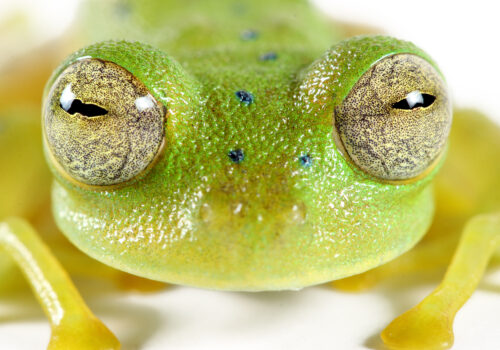
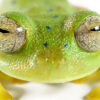
Holding true to the captivating hallmark of glass frogs, Espadarana audax displays exceptional transparency. While exhibiting a vibrant, mossy-green dorsal coloration flecked with subtle yellows and pale greens that perfectly mimic leafy surroundings, their ventral surfaces are astonishingly clear. Observers gazing upwards through the delicate belly frequently distinguish the frog’s internal organs, the subtle pulsations of the heart being particularly poignant.
Adult E. audax measure roughly between 23 to 27 millimeters, making them modest-sized amphibians whose presence becomes noticeable mostly due to their striking translucency. Their large, expressive, forward-first eyes possess golden irises with sculpted pupils perfectly adapted for nocturnal vision, alert to both predator and prey in the darkness of night amongst dense leaves.
Their limbs, thin and sinuous, terminated by delicate, webbed digits topped by adhesive pads, equip them dramatically for climbing slippery branches or leaping unhindered from leaf to leaf with graceful, acrobatic ease. Adapted perfectly to arboreal living, the physical attributes of E. audax illustrate a stunning balance of aesthetic elegance and evolutionary practicality.
Behavior and Life Cycle: An Intricate Mosaic of Survival and Reproduction#
Nocturnal Predators and Efficient Hunters#
Espadarana audax is primarily nocturnal, stepping into full activity during twilight’s dim glow and continuing throughout the evening. The darkness provides cover against predators like birds and snakes, allowing these frogs ample opportunity to hunt. They feed predominantly on small insects, such as flies, moths, and beetles—prey items abundant within their arboreal realms. Watching an E. audax hunt reveals nature’s immense meticulousness—a stealthy approach followed by a sudden, accurate strike, capturing prey with their flexible tongues.
The Romantic Serenades of Espadarana audax#
The reproductive cycle begins during rainy seasons when males gather near favored stream sites, establishing prominent territories. Possessed of a distinctive, melodious, whistle-like mating call that gently permeates the rainforest ambiance, males wait patiently for receptive females, boldly advertising their suitability as potential mates.
Following courtship rituals—careful approaches punctuated by gentle calls and cautious territorial posturing—the female deposits gelatinous egg masses delicately beneath leaves overhanging water. This strategic egg-laying position ensures protection against terrestrial predators and desiccation. When developing embryos are ready, hatched tadpoles drop delicately into the water below, continuing their aquatic development safe underwater.
Remarkable Parental Care#
Espadarana audax exhibits intriguing parental behaviors. Males attentively guard egg masses, diligently patrolling their territories against rival frogs or predators. This dedicated paternal behavior significantly increases offspring chances for survival, vividly illustrating one of nature’s remarkable investments in the continuity of life. It’s a behavior that invites contemplation, revealing deep layers beneath the apparent simplicity of amphibian existence.
Ecological Role: Guardians of Balance and Indicators of Health#
The importance of Espadarana audax extends beyond their immediate, breathtaking presence. In ecosystems, these frogs play multifaceted roles: controlling insect populations, providing nourishment for predators, and—perhaps most crucially—serving as early-warning indicators of environmental degradation. Amphibians’ delicate, highly permeable skin makes them exceptionally vulnerable to pollution and climatic shifts. Thus, fluctuations in their populations or distributions signal subtle environmental threats invisible through conventional monitoring methods.
By maintaining equilibrium within forest food webs, Espadarana audax and similar species contribute silently yet significantly to their ecosystems’ overall health and stability. Protecting these biological treasures means safeguarding entire rainforests, vital watersheds, and countless interconnected species.
Threats and Conservation Status: Preserving Transparency#
Unfortunately, Espadarana audax faces increasing pressure from habitat disturbance, deforestation, and climate-driven alterations in rainfall patterns. Forest fragmentation alone drastically alters microhabitat humidity and temperature—the delicate environmental stability essential to their survival. Though not yet formally assessed under IUCN standards at a global scale, regional assessments suggest population declines indicative of underlying threats potentially placing future populations at risk.
Local conservation projects focus heavily on habitat conservation and restoration. Protected reserves, community-based eco-tourism initiatives, and public education campaigns highlight their magnificent biodiversity, aiming to inspire local and international stakeholders to embrace conservation priorities. Future efforts concentrating on ecological research, habitat protection, and public engagement hold immense potential to safeguard Espadarana audax and other glass frogs long into the future.
Cultural and Scientific Significance: From Forest Myths to New Discoveries#
In many local Central American cultures, glass frogs like Espadarana audax capture imaginations, symbolizing purity, vulnerability, and environmental vitality—capturing quite elegantly within their transparent skin the essence of the rainforest itself. Their unique biology invites scientific inquiry, providing essential insights into fields such as anatomy, developmental biology, and ecology.
Recent medical research inspired by their intriguing biology observantly probes concepts of organ transparency and dynamics, seeking novel ways to visualize tissues and gain deeper understanding possibly useful in human medicine. Thus, beyond their immediate aesthetic marvel, Espadarana audax opens compelling windows into broader biological mysteries, underscoring yet another layer of their invaluable existence.
Conclusion: Ensuring a Transparent Future#
Espadarana audax symbolically represents everything we stand to lose—or gain—in the preservation of tropical environments. Their brilliant translucency underscores the precious fragility of ecosystems we barely understand and reveals intricate natural connections we cannot easily replace. As you conclude this exploration, allow the delicate translucent form of Espadarana audax to make transparent the pressing need for collective environmental action.
Let’s join hands—scientists, educators, conservationists, and nature enthusiasts alike—to ensure the continued harmonious calls and subtle heartbeats of these extraordinary creatures resonate through rainforested nights for countless generations to come.