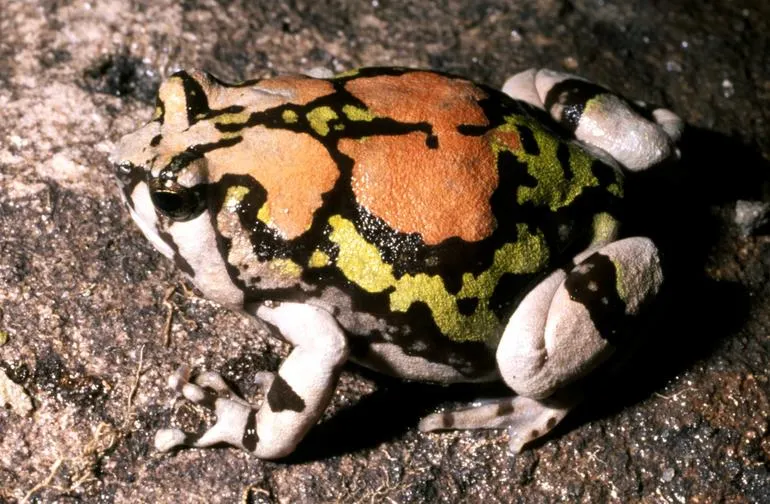
Scaphiophryne gottlebei, the red rain frog, is a small microhylid endemic to the Isalo Massif in south-central Madagascar, where it lives nowhere else on Earth. It shelters in narrow sandstone canyons rather than open forest, and its life is built around a short, violent breeding window after the first heavy rains of the wet season.
Identification
The frog carries a distinctive white, orange-red, green and black pattern on its back, with each colour area clearly delineated from the next, on skin that is very smooth, while the grey belly is rougher. It has a rounded snout, prominent eyes, inconspicuous tympani and short, robust limbs with webbed hind feet. Two adaptations mark its canyon lifestyle: horny tubercles on the underside of the hind feet for burrowing, and claws on the forefeet for clinging to vertical canyon walls. Females reach 26-40 mm snout-vent length, males are smaller at 20-34 mm, with newly metamorphosed young about half to one-third the size of adults.
Habitat and range
The species is confined to the Isalo Massif, at elevations of roughly 700-1,000 m, including sites within and south of Isalo National Park. Its canyons are cool for the tropics, relatively dark with little or no vegetation, and very humid, typically running 19-22 degrees C, with a wider overall range of 13-35 degrees C. By day the frog digs into sandy areas bordering streams or shelters in holes and crevices in the rock walls; at night it may climb the rock walls, reaching several metres high, using the claws on its forefeet to grip the stone. It shares this terrain with the blue-legged mantella, Mantella expectata, an endangered frog of the same canyons that prefers more open, sun-exposed areas than the shade the red rain frog favours.
Behaviour and breeding
Breeding is explosive and seasonal, triggered by the first heavy rains of November and December. Frogs gather in aggregations of tens of individuals, typically with more males present than females, and lay their eggs in temporary pools, where they hatch into tadpoles after about three days. The tadpoles have a stout, oval body with a flattened underside, appearing black by day but brownish-grey at night. They are detritivores and filter feeders, spending the day with their heads submerged in bottom sediment and their tails angled upward, then swimming and filter-feeding at night; reared in captivity, they have been fed ordinary fish food from Gosner stage 25 until near metamorphosis. Many tadpoles never finish developing where they hatched: rainy-season torrents sweep them away, and some complete metamorphosis elsewhere. Adults themselves disperse from their home canyons, especially in cold weather, and the species is short-lived, typically reaching only about two years of age. The snake Leioheterodon modestus is thought to be an important natural predator of the frog.
Conservation
The facts box above carries the species’ current IUCN Red List category, Endangered, a downgrade from Critically Endangered, applied between 2004 and 2008. The species is listed on CITES Appendix II, requiring an export permit rather than banning trade outright. Its narrow canyon range faces habitat loss from wood extraction, fire, overgrazing, mining and tourist disturbance, and the pet trade once took a heavy toll: as recently as the 2000s, thousands were captured every year, until the export quota was cut to zero by 2014, making wild capture illegal. Despite this, the population trend is believed to be decreasing, even where the frog remains locally abundant.
Similar species
Scaphiophryne gottlebei belongs to a genus of nine Madagascar-endemic species that range from strikingly marked to highly cryptic, all rather plump, ground-dwelling burrowers. The clearest comparison is Scaphiophryne marmorata, found across both the rainforests and drier western regions of Madagascar rather than confined to one massif: it is bright green with darker green and black patches, turning more olive in the west, a plainer look than S. gottlebei’s sharply delineated red, white and black pattern, and slightly larger, with females around 40 mm and males around 30 mm. It also keeps to leaf litter on forest floors and low vegetation up to 1,000 m rather than bare canyon rock. Within its own canyons, S. gottlebei is more easily confused by habitat than by looks with the sympatric Mantella expectata, a small, boldly coloured mantellid that favours the sunnier, open stretches the red rain frog avoids.