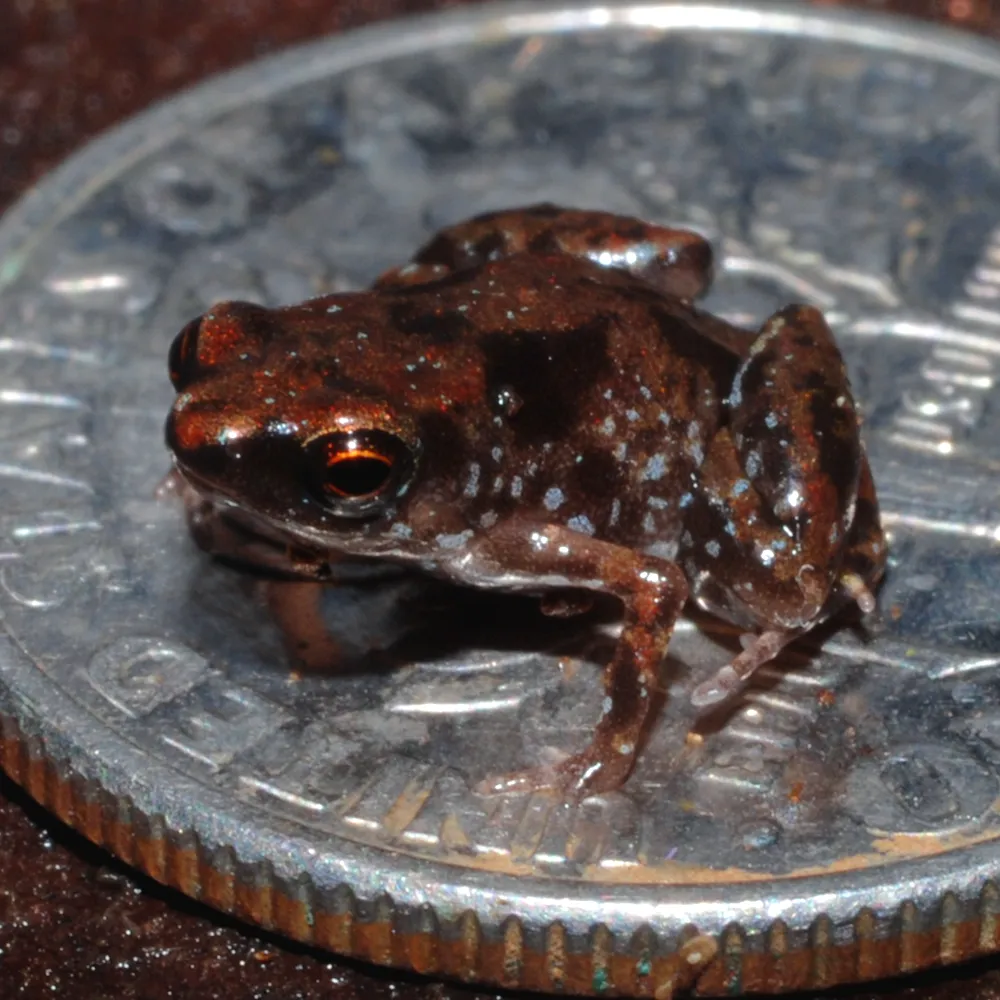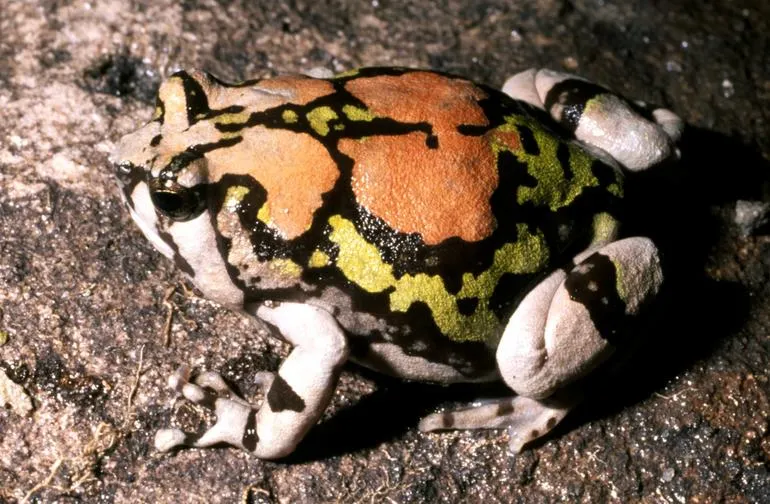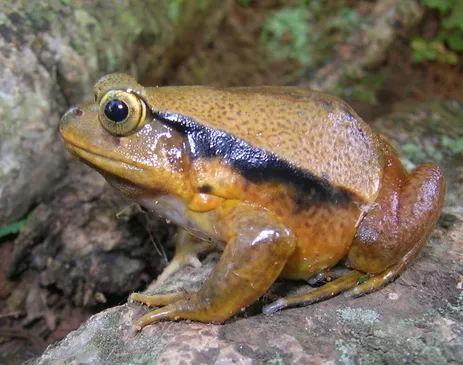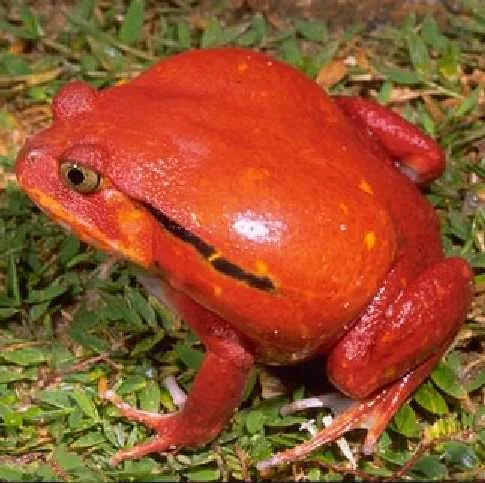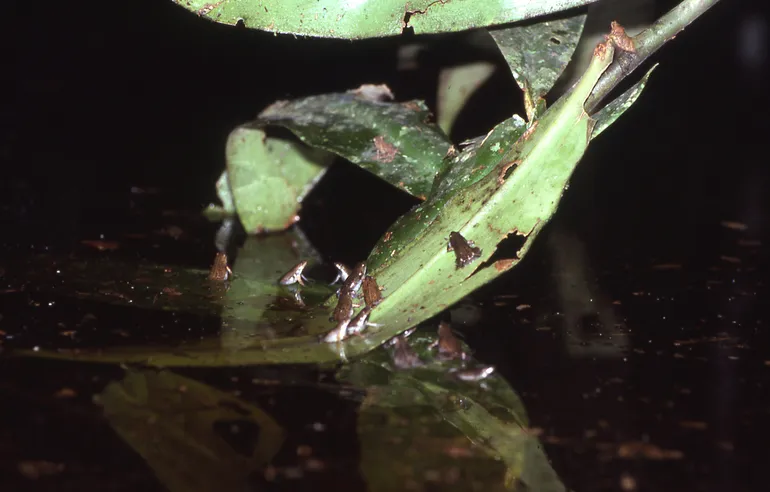
Chiasmocleis ventrimaculata, the dotted humming frog, is a small frog of the family Microhylidae found in Bolivia, Brazil, Colombia, Ecuador and Peru1. In southeastern Peru it has been seen in close association with a burrowing tarantula, and researchers suggested that the spider recognises the frogs by chemical cues2.
Identification
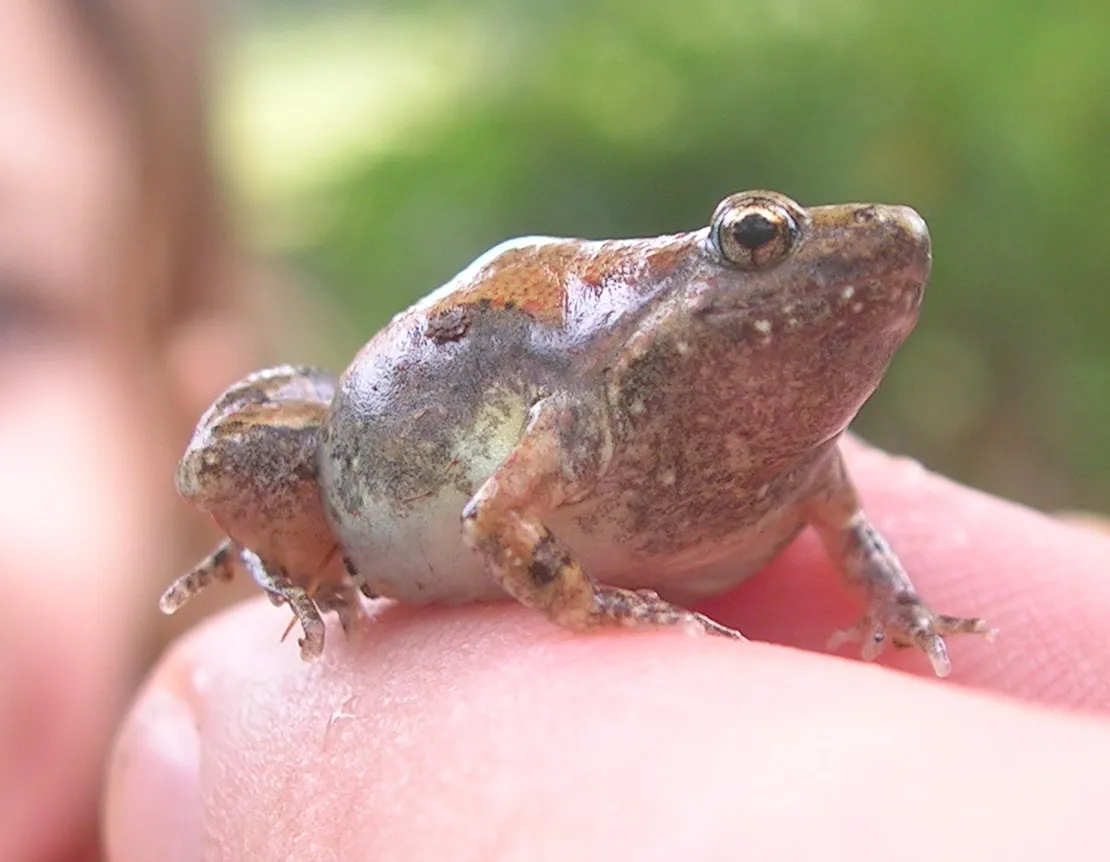
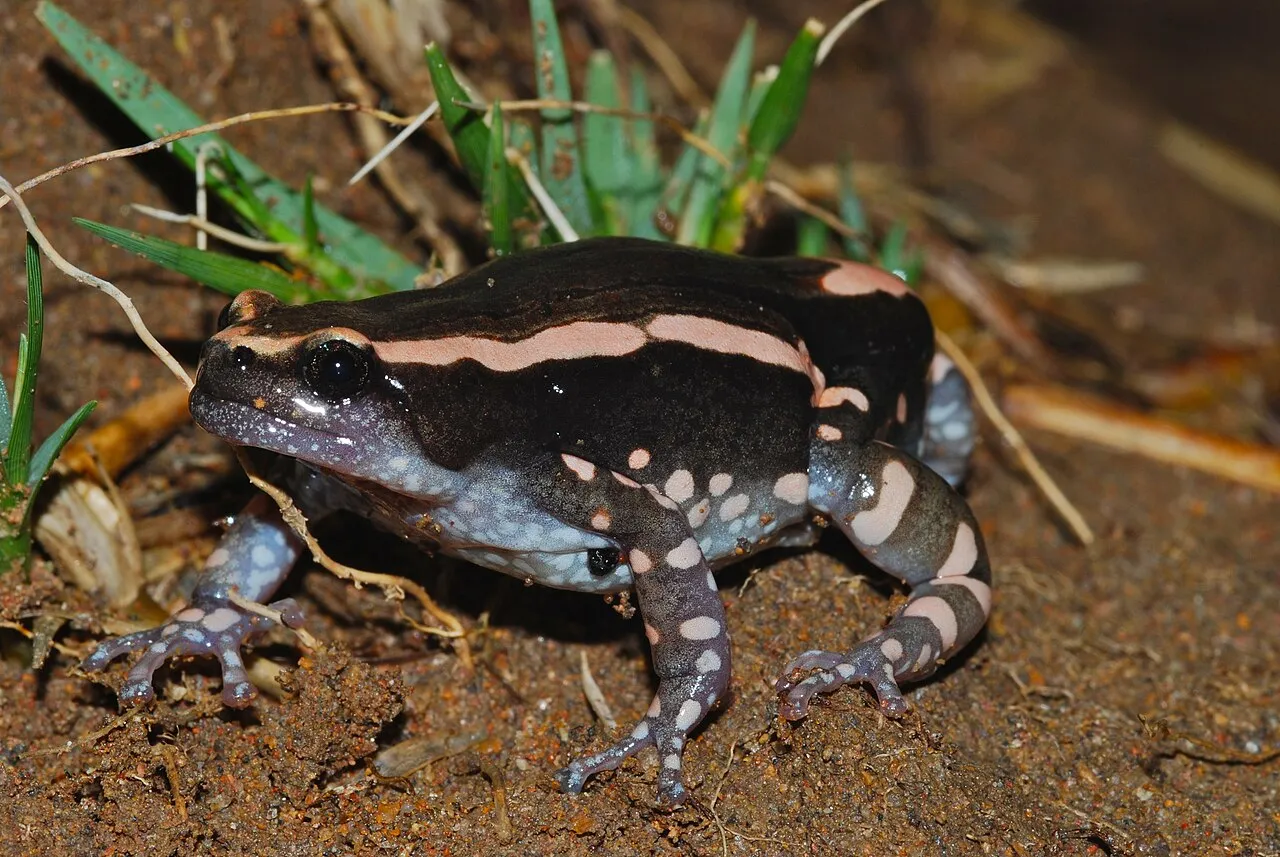
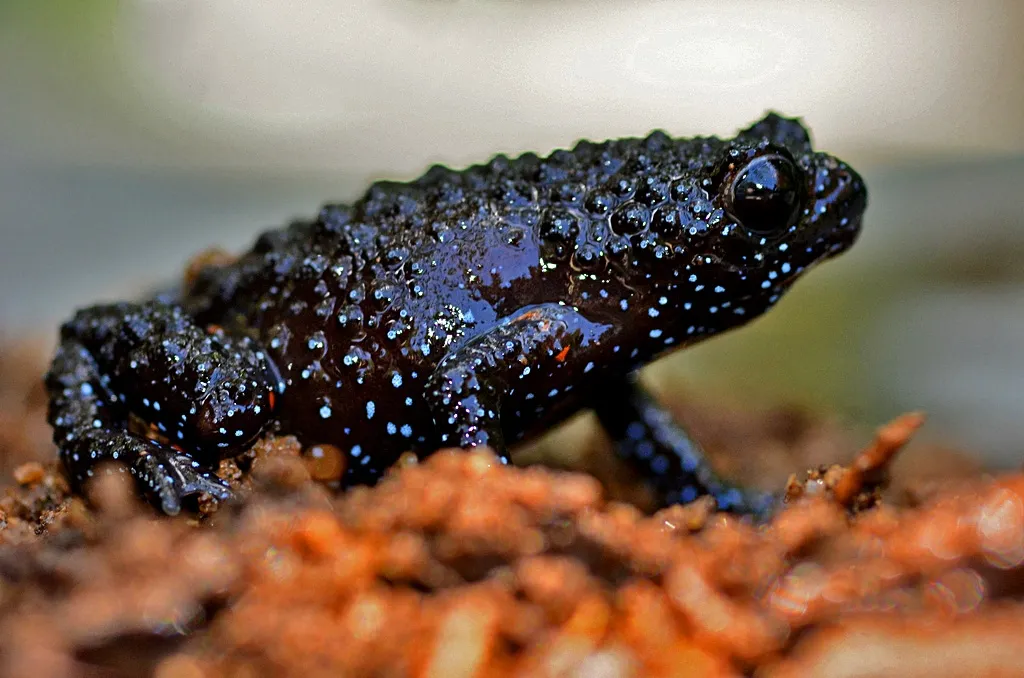
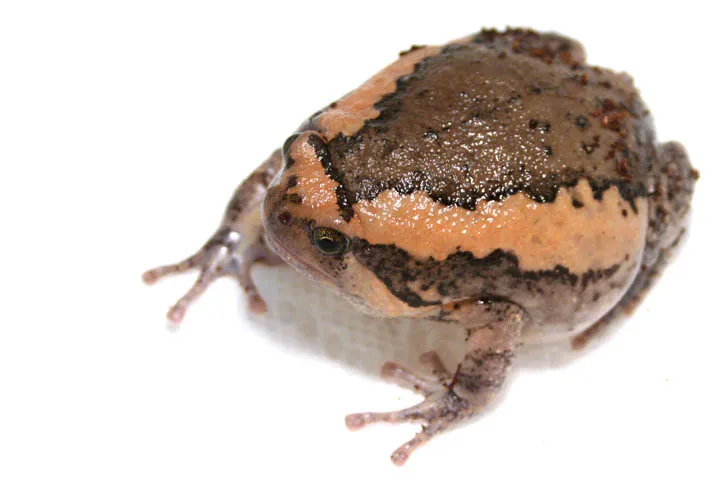
Adults are tiny, with a snout–vent length of approximately 2 cm. The frog has no webbing on the hind foot, a narrow, pointed head and a slender body, and its cryptic camouflage1 makes it resemble the leaf litter it lives in.
The male’s advertisement call is a series of short pulses, repeated 7–8 per second with 22–63 pulses per call at Panguana in Peru. Its dominant frequency there is much higher than in calls recorded in Vaupés, Colombia3.
The tadpole has a total length of 17 mm and a body length of 7 mm. Its body is about twice as wide as deep, it has no nostrils and no horny mouthparts, and in life it is nearly uniform pale brown3.
Habitat and range
The species is found mostly in the western Amazon region, and its distribution is described as quite disjointed. Its natural habitats are moist lowland forests, swamps and intermittent freshwater marshes1. At Panguana, a biological station in Peru, it shares its range with Ctenophryne geayi and Hamptophryne boliviana: all three inhabit the leaf litter, at least during the rainy season and breed at the same small blackwater pond. A 1991 study3 reported that nearly nothing was known about their habits during the dry season.
Behaviour and breeding
The tarantula partnership was reported in 1989 from southeastern Peru, where the frog seemed to benefit by eating small invertebrates drawn to the spider’s prey remains. Young spiders have sometimes been seen to grab the frogs, examine them and release them unharmed. In a 2002 study, spiders that grabbed another frog species wearing skin from humming frogs also released them unharmed. One suggestion is that the spider gains as well: microhylids specialise on eating ants, ants are a major predator of spider eggs, and so the frogs might help protect the spider’s eggs2.
It is an ant specialist at Panguana. Of 220 stomachs of adults examined, most were empty, but 39 contained small ants of 1–5 mm, and two frogs were seen feeding on mites at night3.
The species is an explosive breeder1. At Panguana, males appear near the pond at midday after the first rainfall above average, about 60 mm or more, calling first from the leaf litter. Females reach the pond by sunset, the chorus continues throughout the next day and night, and on the third morning the frogs leave the pond, which is covered with clutches. A preliminary count gave males to females of 12 : 13.
Males call from floating twigs and leaves, raising their inflated vocal sacs. Mating takes place by day and night, but mainly at night between 20.00 and 4.00 hr. The female floats to the calling male, which jumps into the water and clasps her in axillary amplexus; the amplexus mainly lasts up to 30 minutes. A female lays a typical clutch of around 400 eggs1, held together by a thin layer of viscous jelly, each 2 mm egg in a jelly capsule of about 6 mm3.
The tadpoles hatch about 36 hours after fertilization at a water temperature of 26 °C and at first remain motionless, head up, under the surface; they begin to move 48 hours after hatching. In the shallow edge of the pond, about 60 cm deep, they form big, nearly motionless aggregations, every tadpole facing the same direction. The froglets leave the water after three weeks3.
Tadpoles are caught by the crustaceans Dilocarcinus and Goyazana, and dragonfly larvae fed on tadpoles of the genus. At the pond, snakes seem to be the main predators of frogs. Besides its cryptic appearance, the frog has a defensive behaviour that enhances its resemblance to fallen leaves3.
Conservation
The IUCN lists the species as Least Concern4, the category of its 2004 Red List assessment. The Amazon is a centre of degradation from human occupancy, deforestation and mining, which puts large parts of its habitat at risk1.
Similar species
Hamptophryne boliviana breeds at the same Panguana pond, but its males call from floating structures such as trunks, which are bigger than the calling sites of the dotted humming frog. Ctenophryne geayi shares the pond too; its call repeats 40–43 pulses per second, against 7–8 in the dotted humming frog, and its males call from under leaf litter at the edge of the pond3.