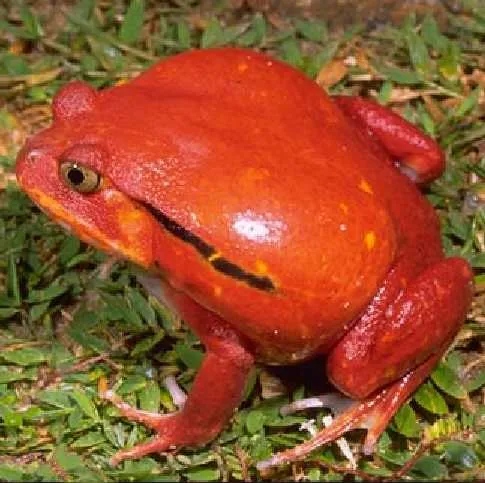
Dyscophus antongilii, the tomato frog, is a stout, round-bodied microhylid endemic to the northeastern part of Madagascar, in the region around Antongil Bay, including Andivoranto, Maroantsetra and the Ambatovaky reserve. Females carry the fruit-like colour behind the name; males are duller. The species is best known for a defensive trick rather than its diet or call: squeezed in a predator’s mouth, its skin releases a glue-like secretion that fouls the attacker’s eyes and jaws.
Identification
Females are reddish-orange to bright dark red with a yellowish belly and sometimes black spots on the throat, reaching 85 to 105 mm in length; males are smaller, 60 to 65 mm and duller orange or brownish-orange, almost more brown than red. Average body mass is about 26 g. A black stripe typically runs from behind the eye to the abdomen, and the belly shades from reddish near the chest to white toward the vent. Tadpoles and newly transformed juveniles are black to tan, only reaching full adult colour several months after metamorphosis. When gripped by a predator, the frog’s skin secretes a white, glue-like substance, among the most adhesive known in amphibians, that can attach a snake’s mouth to the ground or foul the eyes and digits of a mammal; the same secretion contains a toxin that occasionally causes allergic reactions in humans, though these are not deadly.
Habitat and range
The tomato frog occupies rainforest and wooded coastal areas, wet and dry underbrush, and urban and agricultural land, from sea level up to about 200 m elevation. It needs a natural or manmade refuge such as vegetation or a burrow, next to a stable, slow-moving water source: lakes, ponds, rivers, marshes, swamps, temporary pools and drainage ditches all serve, which is part of why the species adapts well to urban environments, turning up in drainage ditches and farmland as readily as in undisturbed forest. Its range is narrow even by Madagascar standards, confined to the humid northeast around Antongil Bay rather than spread across the island.
Behaviour and breeding
Tomato frogs are burrowers, fond of digging into soft substrate and largely nocturnal and terrestrial, emerging to feed on small invertebrates and arthropods, including insects, worms and molluscs. Prey capture uses the same rapid tongue projection documented in the closely related Sambava tomato frog, Dyscophus guineti: the frog turns only its head toward prey within about 40 degrees of centre, but can aim its tongue independently of its head for prey at a wider angle, extending its effective strike range.
Males call and pair with females after heavy rainfall, in both the wet and dry season, and in the wild eggs have been recorded in eleven months out of twelve, with only November free of clutches; activity is highest from January to May. A female lays several thousand eggs in a single clutch, and there is no parental care once the eggs are laid. Eggs hatch quickly, within two to four days, and tadpoles reach metamorphosis in around a month in captivity, though wild timelines can run longer. Sexual maturity follows at two to three years for both sexes. In the wild, females have been recorded living up to 11 years and males up to 7, with captive frogs living 12 years or more.
Conservation
The facts box above carries the species’ current IUCN Red List category, Least Concern. Historically the main pressure was collection for the international pet trade, which the species’ bright colour and hardiness in captivity made lucrative; that pressure has eased as captive breeding largely replaced wild-caught animals in the trade, and the species was rapidly placed on CITES Appendix I in response to that pet-trade pressure, the strictest tier; it has since been downlisted to Appendix II, the same tier that covers other Dyscophus species and that requires exporters to hold a government permit rather than barring trade outright. Ongoing risks are habitat degradation and pollution within its already narrow Antongil Bay range, and captive-breeding stock has shown an excess of homozygosity at microsatellite markers, a sign of limited genetic diversity worth monitoring even without an immediate change in wild numbers.
Similar species
The genus Dyscophus holds two other tomato frogs, both Malagasy endemics and both frequently confused with D. antongilii in the pet trade because of their similarly flashy colouring. Dyscophus guineti, the Sambava tomato frog, replaces D. antongilii along humid, mid-altitude forest and marsh further down Madagascar’s east coast; its males are smaller and yellowish, at 60 to 65 mm, while its females run larger than D. antongilii’s, at 90 to 95 mm, red-orange with fine reticulated markings. D. guineti has stayed on CITES Appendix II throughout, rather than passing through the Appendix I ban D. antongilii once carried, which left D. guineti more exposed to collection for the pet trade on account of its own flashy colouring during that period. The third species, Dyscophus insularis, the Antsouhy tomato frog, is endemic to western Madagascar, the opposite coast from both of its eastern relatives, making the Antongil Bay-restricted D. antongilii identifiable chiefly by locality among the three.