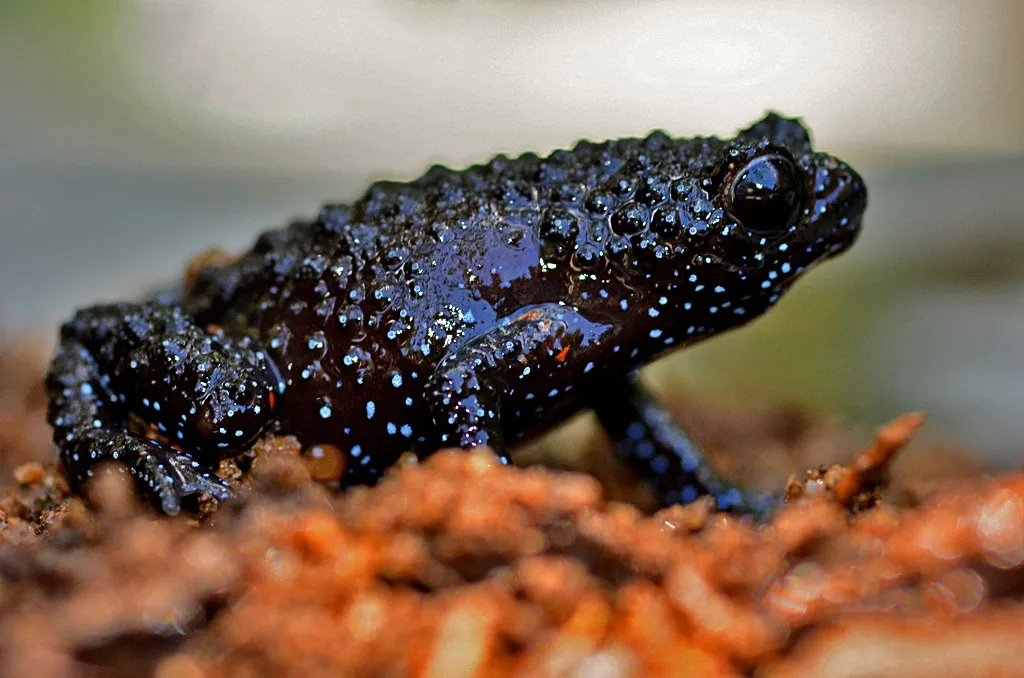
Melanobatrachus indicus, the Malabar black narrow-mouthed frog, is a dark-coloured microhylid endemic to the wet evergreen forests of the southern Western Ghats in Kerala and Tamil Nadu, India. It is the sole species in its genus, and Melanobatrachus is itself the only remaining genus in the monotypic subfamily Melanobatrachinae, a taxonomic position that sets it apart from the rest of the narrow-mouthed frogs it shares its forests with. The species was first described by the British naturalist Richard Henry Beddome in 1878, making it one of the longer-known frogs of the Western Ghats even though it is rarely seen. Much of what is recorded about it comes from scattered field notes rather than sustained study, and basic data such as a measured body length have not been published in a source this guide can cite.
Identification
The species is a small, dark narrow-mouthed frog typical of the family Microhylidae, set apart from most of its relatives by the blackish colouration that gives both the species and its genus their names. Like other microhylids, it has the compact body, short limbs and small, pointed head typical of frogs that move through leaf litter rather than leap or climb, though no sourced measurement of its snout-vent length is available: AmphibiaWeb, which would normally carry that figure, could not be reached as a source for this profile. Its dark colouration against the pale leaf litter of its forest floor habitat, visible in the photograph above, is in practice the most reliable field mark for separating it from the generally paler or more boldly patterned microhylids found in the same hills. Because it is the only member of its genus and subfamily, correct identification at the family level (narrow mouth, short limbs, ground-dwelling build) combined with the near-black body colour is normally enough to rule out confusion with Microhylidae from elsewhere in its range.
Habitat and range
Melanobatrachus indicus lives among leaf litter, rocks and other ground cover of moist evergreen tropical forest, spending its time at or below the surface of the forest floor rather than in the open or in the forest canopy. Within that forest type it is confined to the southern part of the Western Ghats, recorded at Anaimalai, Munnar, the Palni hills, Periyar Tiger Reserve and Kalakkad Mundanthurai Tiger Reserve in Kerala and Tamil Nadu. That is a narrow, high-rainfall range running along one of India’s richest amphibian regions, and every confirmed locality lies within wet evergreen forest rather than the drier or more disturbed habitats nearby. The species’ dependence on this single, fairly specific forest type means its fortunes are tied closely to the condition of a small number of forest blocks; two of its known localities, Periyar and Kalakkad Mundanthurai, are protected tiger reserves, which gives at least part of its range a formal conservation status beyond the species’ own.
Behaviour and breeding
The species keeps to ground-level cover within its forest habitat, staying among leaf litter and rocks rather than climbing or ranging widely, a lifestyle consistent with its short limbs and the generally secretive habits of ground-dwelling microhylids. No sourced account of its calling behaviour, clutch size or breeding season has been published in a source this guide can cite, which is itself informative: it reflects how little direct observation this species has received since its description. What is recorded is its discovery history, which doubles as the best available evidence of how hard it is to find: it is a rare species that went unrecorded for decades before being rediscovered in 1997, well over a century after Beddome’s original description. A gap of that length, in a region that has otherwise been reasonably well surveyed for amphibians, points to a species that is either genuinely scarce, highly cryptic in its litter-dwelling habits, or both, and that any population estimate drawn from sightings alone is likely to undercount it substantially.
Conservation
The facts box above carries the species’ current IUCN Red List category, Vulnerable. It is also listed as an Evolutionarily Distinct and Globally Endangered (EDGE) species, a designation reserved for species that combine a high conservation priority with few close relatives, which fits a frog that is the last member of its own genus and subfamily: its loss would remove an entire branch of the amphibian family tree, not just one species among many similar ones. Beyond habitat loss within its narrow Western Ghats range, the species faces disturbance from photography trips that specifically target it, a pressure its 1997 rediscovery and the resulting attention from photographers and naturalists have likely sharpened. That combination, a naturally narrow range, forest dependence and renewed human interest since its rediscovery, is consistent with the Vulnerable rating it carries today.
Similar species
As the only member of the genus Melanobatrachus, and of the subfamily Melanobatrachinae, this species has no close generic relatives to confuse it with; its blackish colouration sets it apart from most other ground-dwelling microhylids sharing the same Western Ghats forests. Within peninsular India it does, however, share its family, its ground-litter habits and parts of its range with the much smaller and more widespread ant frog, Microhyla ornata, though that species’ pale, mottled colouration and far smaller size make confusion between the two unlikely once a specimen is seen clearly. A confident field identification of Melanobatrachus indicus still rests mainly on its combination of near-black colour, Western Ghats locality and family-typical build, since no other dark litter-dwelling microhylid with a published profile on this site shares its specific range.