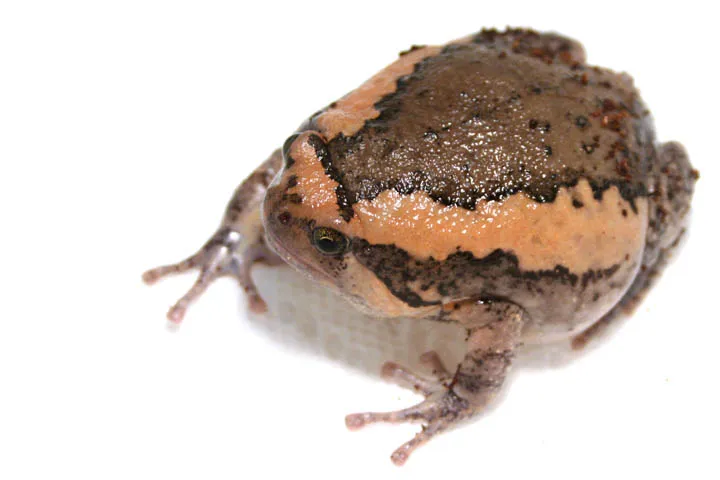
Kaloula pulchra, the ox frog, is a plump, short-limbed burrowing frog of the family Microhylidae, native to Southeast Asia, from northeastern India and Nepal to southern India and Sri Lanka, to southern China (especially Hainan) and Myanmar, and south to the islands of maritime Southeast Asia. Its wide native range and tolerance of disturbed ground have also made it a species that turns up well outside its original distribution.
Identification
The ox frog is a compact, rounded species with males measuring 54-70 mm in snout-vent length and females slightly larger at 57-75 mm, and a body weight of roughly 80-120 g. It has a stocky, triangular body with a short snout and little difference in shape between the sexes. The back is dark brown with stripes running from copper-brown to salmon pink along the sides, set against a cream-coloured belly. Its short limbs and small head are suited for walking and burrowing rather than jumping, an adaptation shared with other burrowing frogs in the family Microhylidae.
Habitat and range
The species keeps to low elevations, occurring from sea level up to about 750 m, and shows little preference for undisturbed wilderness. It is found in both urban and rural settings as well as in forest habitats, a flexibility that helps explain its broad native range across South and Southeast Asia, from northeastern India and Nepal through southern India and Sri Lanka, southern China and Myanmar, to the islands of maritime Southeast Asia. Outside that native range, established populations are now found in Taiwan, the Philippines, Guam, Singapore, Borneo and Sulawesi, with the Philippine introduction thought to have arrived via contaminated plant nursery material or maritime cargo; individual frogs have also turned up as far afield as Australia, New Zealand and Florida.
Behaviour and breeding
For most of the year the ox frog lives underground, burying itself hindlimb-first during the dry season and staying there until rain brings it back to the surface. It is nocturnal, sheltering under leaf litter by day and hunting in the evening, mostly on ants and termites, with flies, crickets, moths, grasshoppers and earthworms taken as secondary prey; its small mouth restricts it to small, slow-moving prey. When threatened, it inflates its body dramatically and secretes a noxious white substance through the skin that can cause hemolysis, though it is not considered toxic.
Heavy monsoon rain triggers breeding, drawing frogs out of the ground and into temporary rain pools. Calling males in India produce 28-56 pulses per second across a frequency range of 50-1,760 Hz, while Thai populations call at a dominant frequency of around 250 Hz, each call lasting 560-600 milliseconds with 18-21 pulses. Tadpoles hatch at about 5 mm and grow to roughly 11 mm snout-vent length by the time metamorphosis is complete, a process that begins around two weeks after hatching.
Conservation
The facts box above carries the species’ current IUCN Red List category, Least Concern, consistent with a wide native range that spans multiple countries and a demonstrated tolerance for human-altered habitat alongside forest.
Similar species
The ox frog’s rounded, short-limbed body and small head are shared with other members of the genus Kaloula and the wider family Microhylidae, many of which are similarly adapted to a burrowing lifestyle. Its dark brown back with copper-brown to salmon-pink side stripes and cream belly are the most reliable field marks separating it from slimmer, longer-limbed frogs sharing the same lowland habitats, and its habit of inflating and secreting a noxious white substance when handled is a further distinguishing trait at close range.