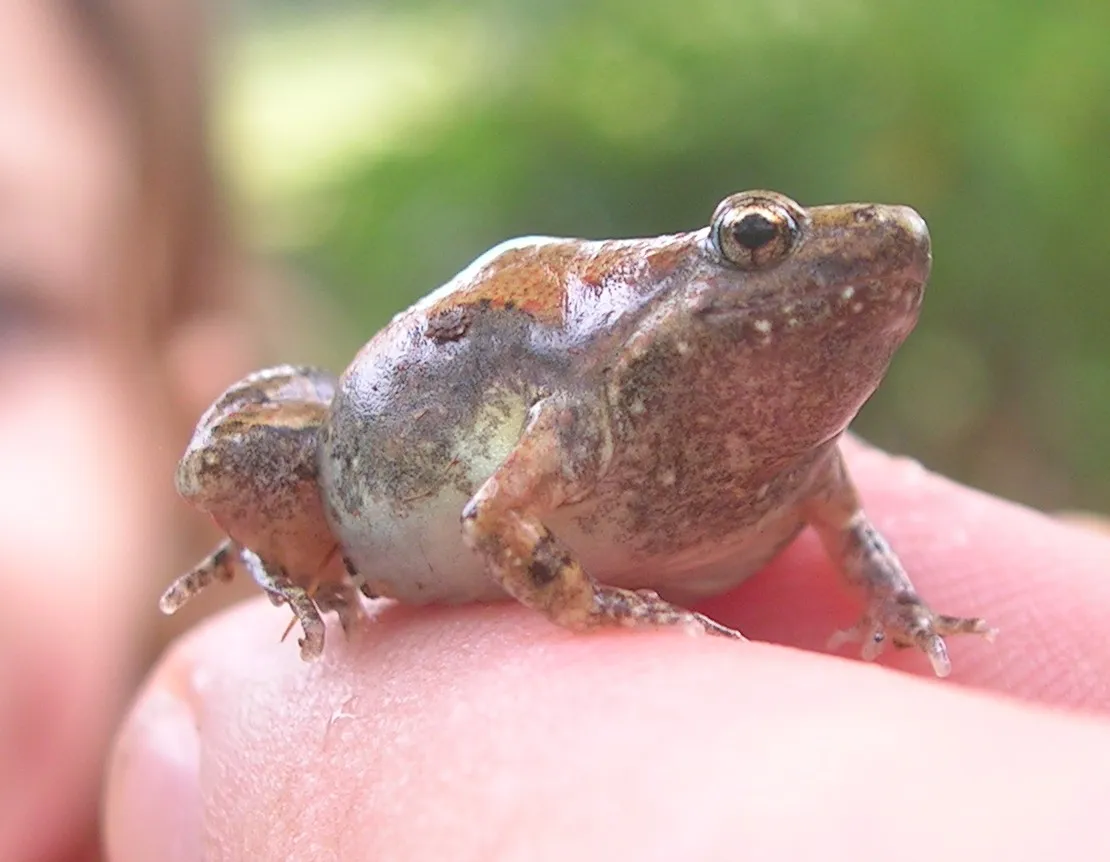
Microhyla ornata, the ant frog, is a tiny narrow-mouthed frog of the family Microhylidae, found across South Asia in Kashmir, Nepal, peninsular India, the Andaman and Nicobar Islands, Sri Lanka and Bangladesh, with records also in Bhutan and Pakistan. Its small size and secretive, litter-dwelling habits make it easy to overlook outside the breeding season.
Identification
The species is small even by the standards of its genus, with males measuring about 24 mm and females about 28 mm in snout-vent length. It has a small head with no teeth and no visible tympanum, along with spathulate fingertips and little webbing between the digits, traits typical of ground-dwelling microhylids that spend more time crawling through litter than leaping.
Habitat and range
The ant frog occupies tropical and subtropical grasslands, savannas and shrublands, as well as broadleaf and coniferous forests. It is semi-fossorial, sheltering in leaf litter on the forest floor and, in some areas, inside elephant dung, an unusual refuge that shows how readily the species exploits whatever cover is available at ground level. This habitat flexibility matches its wide distribution across Kashmir, Nepal, peninsular India, the Andaman and Nicobar Islands, Sri Lanka and Bangladesh, with records also in Bhutan and Pakistan.
Behaviour and breeding
The ant frog is mainly nocturnal, but becomes active by day during the rainy season. Breeding is tied closely to rainfall: the species breeds in ponds and temporary pools that form after rain, a strategy shared with many other small microhylids that time reproduction to the brief availability of standing water.
Conservation
The facts box above carries the species’ current IUCN Red List category, Least Concern, consistent with a wide South Asian range and use of multiple habitat types from grassland to forest.
Similar species
The ant frog’s small size, toothless mouth and lack of a visible tympanum are shared with other members of the genus Microhyla and the wider family Microhylidae, many of which are difficult to distinguish from one another without close examination. Its spathulate fingertips and reduced webbing are among the more useful field marks separating it from similarly small frogs sharing the same leaf-litter habitats, though confirming an identification in this genus often calls for a closer look than a field photograph allows.