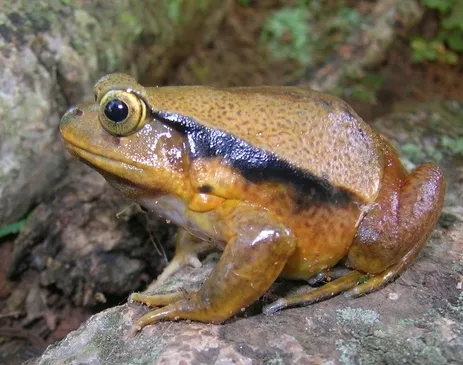
The Sambava tomato frog, Dyscophus guineti, is a stout, round-bodied amphibian known for the orange-red colouring that gives the genus its common name. It is endemic to Madagascar, found in mid-altitude regions along the island’s east coast, where it lives alongside the island’s other tomato frog species.
Identification
The species is strongly sexually dimorphic in size: males measure about 60 to 65 mm, while females are notably larger at 90 to 95 mm. Like other members of its genus, it has a squat, inflated-looking body and smooth, rounded limbs, with the vivid orange-red tone that makes it a frequent target of the international pet trade.
Habitat and range
D. guineti occupies subtropical or tropical moist lowland forest, swamps and freshwater marshes, both permanent and intermittent, as well as heavily degraded former forest. Its tolerance of disturbed habitat means it can persist in areas where the original forest cover has already been cleared, though this does not remove the pressure on the species from further land conversion.
Behaviour and breeding
As with other tomato frogs, D. guineti breeds in the still or slow-moving water bodies within its lowland range, relying on the marshes and swamps that make up part of its habitat for egg-laying. Its bright warning colouration is typical of the genus and is thought to signal the skin secretions it produces when threatened.
Conservation
The facts box carries the species’ current IUCN Red List category, Least Concern. Even so, the species is threatened by habitat loss and by pressure from the international pet trade, driven by the demand for its distinctive coloration. Its adaptability to degraded habitat has so far kept its overall population stable.
Similar species
D. guineti is easily confused with its close relative D. antongilii, the common tomato frog, which shares the same orange-red colouring and squat body shape but is typically restricted to the area around Maroantsetra and the Bay of Antongil, further north on Madagascar’s east coast. The pronounced size difference between males and females is a feature shared across the genus and is not by itself a reliable way to separate the two species.