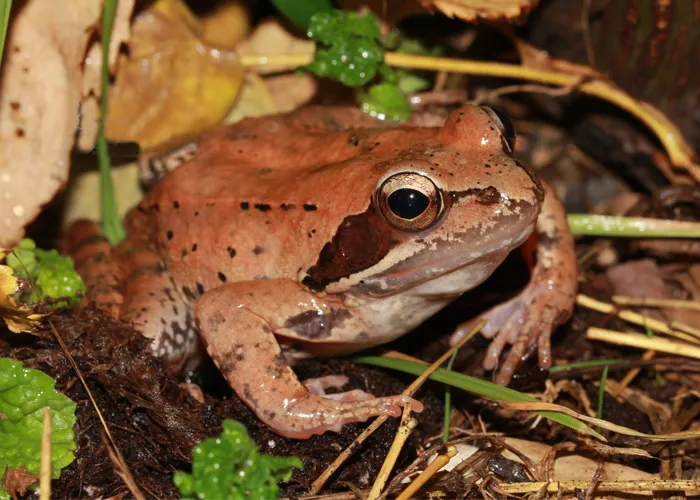
Rana pseudodalmatina is a species of true frog in the family Ranidae, described by Josef Eiselt and Josef Friedrich Schmidtler in 1971. It is endemic to the Hyrcanian forests along the southern Caspian Sea coast, found in Iran and Azerbaijan, and since 5 July 2019 those forests have carried UNESCO World Heritage Site status.
Identification
No open-access source describes the adult frog’s size, colouring or markings in detail. What is confirmed is its placement: it is a member of the brown frog genus Rana in the family Ranidae, the same genus that holds the common frog and the agile frog.
Habitat and range
The species lives in temperate forests, temperate grassland and rivers within its Hyrcanian range, the narrow belt of forest running along the southern Caspian coast. That range is confined to Iran and Azerbaijan, making it one of the more geographically restricted members of its genus, and its forest habitat now sits inside a UNESCO World Heritage property recognised in 2019.
Behaviour and breeding
Detailed accounts of this species’ calls, egg-laying or larval development were not found on an open-access source during research for this page.
Conservation
The species’ facts box above carries its current IUCN Red List category, Least Concern. The Hyrcanian forest habitat it depends on now has a layer of formal protection beyond national law, since UNESCO listed the Hyrcanian Forests as a World Heritage Site on 5 July 2019; the listing protects the forest belt itself, not the species directly.
Similar species
Rana pseudodalmatina shares its genus with other brown frogs already covered here, including the agile frog, Rana dalmatina, and the long-legged wood frog, Rana macrocnemis, which reaches neighbouring Iran from the Caucasus. The sources used for this page do not give field marks that separate Rana pseudodalmatina from its relatives, so its narrow endemic range to the Hyrcanian forests of Iran and Azerbaijan is what identifies it in the field.