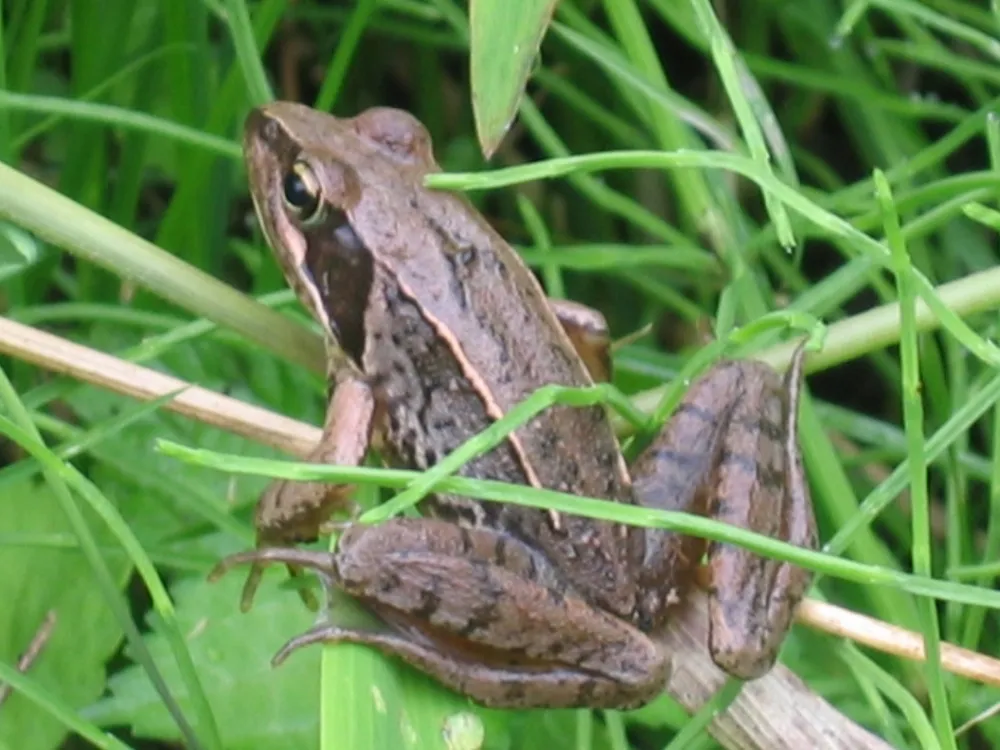
Rana japonica, the Japanese brown frog, is a member of the true frog family Ranidae and is endemic to Japan, found on the islands of Honshu, Shikoku and Kyushu. The species was formally described by the herpetologist George Albert Boulenger in 1879, and it keeps mostly to the lowlands: it occurs mainly in low-lying ground and is rarely found in mountain ranges.
Identification
The body is slender and reddish-brown, carried on a long, narrow head, a build that marks it out from the stockier brown frogs elsewhere in Asia. Females run larger than males: snout-vent length averages about 48 mm in males and about 54 mm in females, making the female the more substantial of the two by a clear margin. Neither sex has vocal sacs, so the male’s call relies on the throat alone rather than an inflatable pouch. Coming into the breeding season, males grow yellowish-brown nuptial pads, roughened patches on the forelimbs that give a firmer grip on the female during mating. That plain reddish-brown body is itself a field mark against patterned relatives: Rana amurensis, for comparison, is light brown with smooth skin and irregular dark brown and yellow stripes rather than the Japanese brown frog’s more uniform tone.
Habitat and range
The Japanese brown frog’s range covers Honshu, Shikoku and Kyushu, with lowland ground preferred over mountain terrain. It is a species of open, often human-shaped country, inhabiting temperate grasslands, hillsides, plains, rivers and swamps, and it readily uses farmland, turning up in irrigated land and seasonally flooded agricultural land. That tolerance for farmed wetland has let it persist even where natural swamps and floodplains have given way to cultivation.
Behaviour and breeding
Breeding runs from January to March, among the earliest calendars of any frog sharing its range, timed to still, shallow water before the agricultural season gets fully underway. Males call to attract mates with songs built from ten to twenty notes, delivered without the help of vocal sacs, and the nuptial pads that develop on their forelimbs over this period help them hold on to a female through amplexus. Once eggs hatch, the tadpoles face a specific local threat: in parts of the range they are preyed on by the aquatic larvae of the Ezo salamander, Hynobius retardatus, one of the few predators documented feeding on this life stage. The species’ combination of shallow breeding water and farmland tolerance has also made it a convenient laboratory subject: in 2007, Japanese researchers produced a translucent strain by combining two recessive gene types, popularly nicknamed the “see-through frog”. The skin itself stays translucent rather than fully clear, but it is enough that internal organs, blood cells and eggs, including the growth of tumours, can be followed without dissection.
Conservation
The IUCN category is shown in the facts box above. The two mainland relatives covered below carry the same Least Concern listing, though neither is free of pressure: Rana amurensis keeps that status despite habitat loss and increased hunting pressure in Russia since the 1990s, and Rana chensinensis keeps it despite its own exposure to habitat loss. None of the three brown frogs on this page is currently considered globally threatened.
Similar species
Japan shares the wider East Asian range of several other brown frogs covered in this guide, including Rana amurensis and Rana chensinensis, both found on the nearby Asian mainland. Rana amurensis is markedly smaller, with a body length of about 20-25 mm against the Japanese brown frog’s 48-54 mm snout-vent length, and it reaches far higher latitudes than Japan’s island range: it is found as far north as 71°N across western Siberia, northeastern China, northeastern Mongolia and Sakhalin, a spread that is reported to make it the northernmost-ranging wild amphibian species anywhere. Its breeding season also starts earlier than the Japanese brown frog’s: calling begins already in late February in Korea, weeks ahead of Rana japonica’s January-to-March window further south.
Rana chensinensis overlaps in general build and lowland habits but is confined to China and Mongolia rather than the Japanese archipelago, where it was formally described by the naturalist Armand David in 1875, four years before Boulenger’s description of Rana japonica. Like the Japanese brown frog it is at home in farmed wetland, using temperate forests, intermittent rivers, swamps, freshwater lakes, marshes, arable land, pastureland and irrigated land, and in parts of its range it is valued for agricultural pest control.